
Election 2026/7 [15] Action South Africa’s prospects in JHB
by The Editor

An in-depth look at Action South Africa’s prospects in the 2026 elections, with a particular focus on its electoral record in Johannesburg. The metro constitutes something of a double-edged sword for ASA, both its greatest strength, and greatest weakness, as it looks to expand.
Action South Africa’s prospects in JHB
By: Gareth van Onselen
Follow @GvanOnselen
17 February 2026
This essay is the 15th in an on-going series on Election 2026/7, for all other editions of this series, please click here: Election 2026/7
Introduction
This essay will take an in-depth look at Action South Africa’s (ASA’s) 2021 performance in Johannesburg, with a view to establishing its prospects in the metro, in 2026.
First, some necessary big picture context: ASA took a serious hammering in the 2024 national and provincial elections (down from 2.61% or 306,167 PR ballot votes, to 1.14% or 223,661 provincial ballot votes), and it is important to understand why and to what degree that matters at all, when it comes to Johannesburg and 2026.
To explain this, there are three core attributes we need to understand about ASA, all linked to one extent or another: 1. It is a local party; 2. It is a regional party; and 3. It is effectively a one-man party.
Let us start with the fact that it is a “local” party. This is not contested. National Chairperson Michael Beaumont, reflecting to the media on the party’s dire 2024 outcome, said: “If you look at these results, and the split ballots and the split voting that took place in this election, far more people voted for us on provincial ballots, than did on national ballots: South Africans see us as a party that is strongest locally.”
More revealing, perhaps, is the why. The short answer is that ASA is built on Herman Mashaba’s personal political brand, which constituents one thing: his short stint as Johannesburg mayor, before he abandoned the position to start ASA. His profile, that position and the City of Johannesburg thus define ASA. And so, it is seen and experienced by those who have heard of it, as local. In turn, its political epicentre is Johannesburg in particular, and Gauteng more generally.
ASA’s short story therefore constitutes its attempt to overcome those limitations: to establish itself as a national force, with national reach and expand its leadership profile beyond Mashaba. 2026 will be its biggest test in that regard. To date, however, it has had small success. In both 2021 and 2024 it remained heavily reliant on the province and metro in which it was born. And so its prospects in Johannesburg are worth understanding in detail.
A local party
The 2021 and 2024 election results illustrate ASA’s electoral contraints.
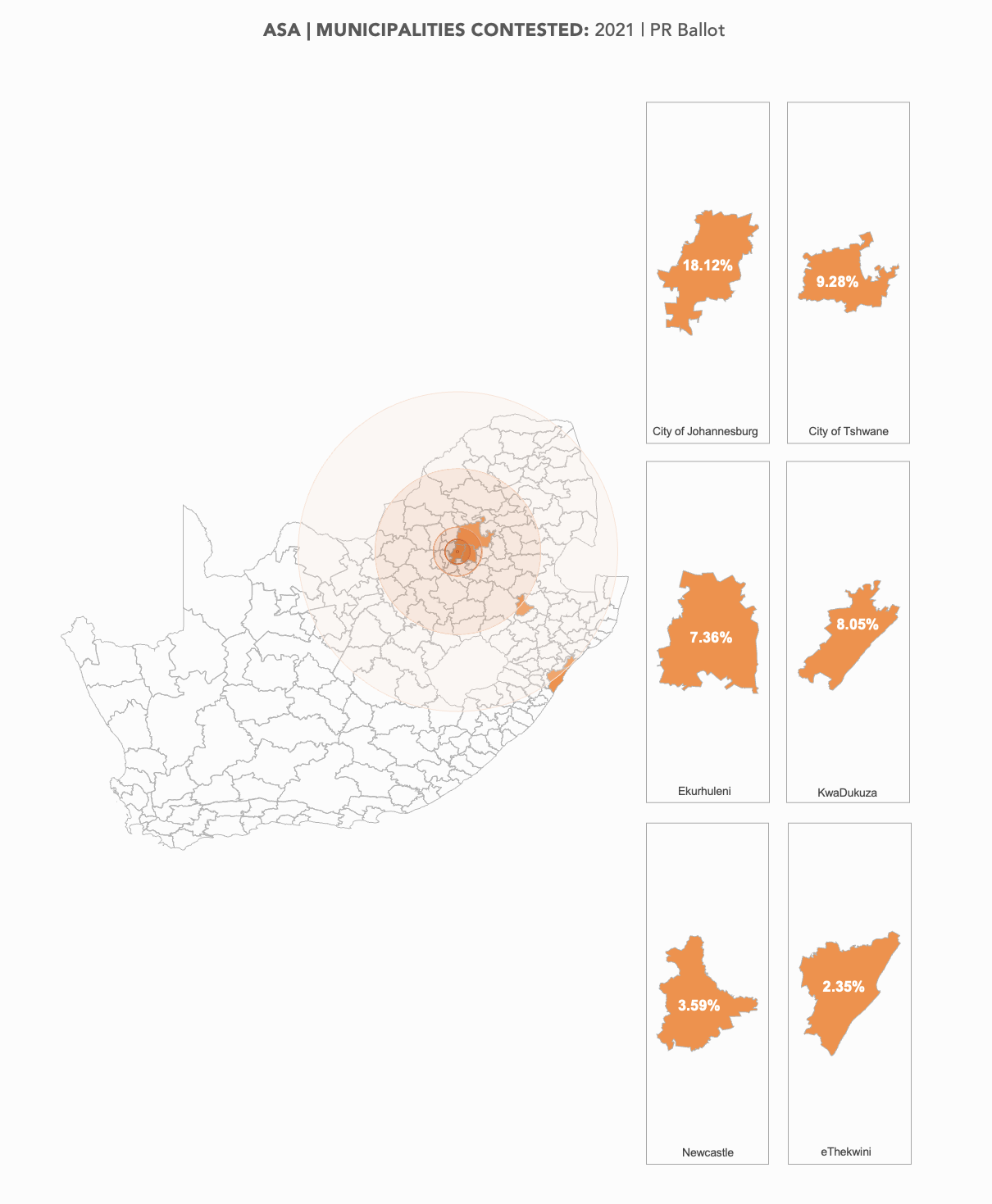
In 2021, ASA only competed in six municipalities. The map above shows each of them (orange), with concentric circles starting around Johannesburg and expanding towards eThekwini. Generally, the further away from its epicentre the party competed, the worse it performed (from 18.12% in JHB, to 2.35% in ETH).
In 2024 ASA competed nationally, but the results followed a similar pattern. The map below show ASA’s 2024 national support. Usually this is shown on a 0% (light orange) to 100% (dark orange) intensity scale, but as ASA did so poorly in 2024 (1.2%), that map would appear blank. So, I have changed the scale. 0 is white, and 100 now represents ASA’s highest percentage in 2024 (around 18%, dark orange). This way we can better see its best results.
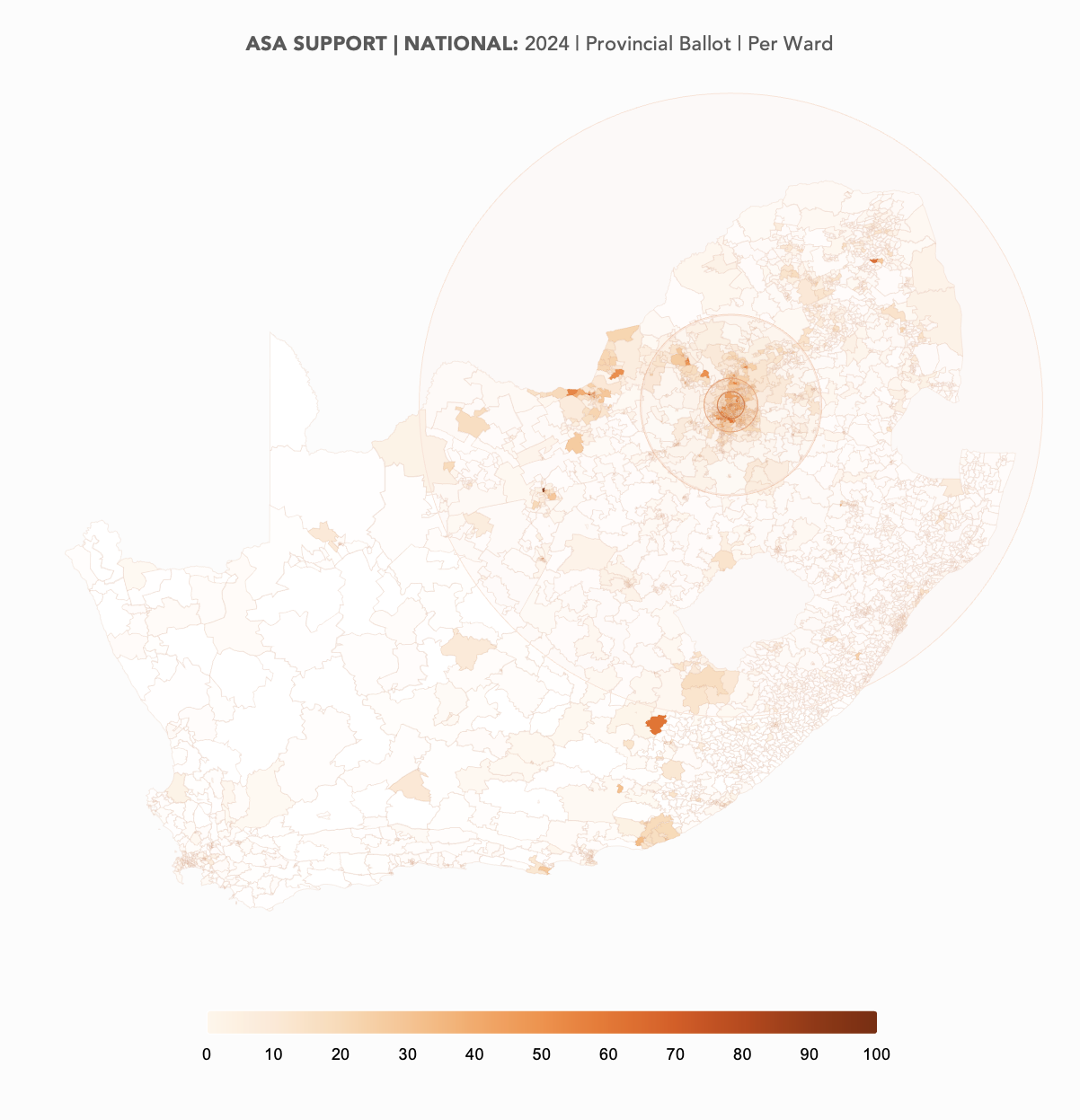
Gauteng is darkest and, except for a few wards in the North West, (worth noting for later), the party’s support generally and quickly fades away to nothing as you leave the province it relies so heavily upon.
In brutal terms, ASA evaporates the further away it gets from Mashaba’s home turf. This is the case for many smaller parties – Bantu Holomisa and the UDM, Mangosuthu Buthelezi and the IFP, Patricia de Lille and GOOD, many others besides. They are at their strongest in the area their leader hails from, and stronger still in local elections, where the that fact is most relevant.
A regional party
But perhaps it is numbers, rather than maps, that best illustrate ASA’s limitations.

The table above breaks down ASA’s 2024 performance into chunks, using the provincial and national ballot. As it did better on the provincial ballot, let’s focus on that.
Excluding Gauteng, all eight other provinces contributed just 26.9% towards ASA’s total support. Gauteng alone was responsible for the rest: 73.1%. And, within Gauteng, Johannesburg alone was responsible for 39.4% of all ASA support.
Here is another set of numbers, that make the same point in a different way. There were 4,468 wards as of 2024; of them all, ASA got:
- 0% exactly in 488 wards;
- 0%–1% in 3,001 wards;
- 1%–2% in 425 wards;
- 2%–3% in 206 wards;
- 3%–4% in 108 wards;
- 4%–5% in 79 wards; and
- 5% and above in 161 wards.
Of the 161 wards where ASA got 5% or more, 126 or 78.3% of them were in Gauteng. Of the 3,489 wards where ASA got less than 1% (78.1% of all wards), only 60 of them, or 1.7%, were in Gauteng.
Out of interest, although limited to a universe of 529 wards (the total number of wards in the six municipalities ASA stood in), in 2021 ASA did as follows:
- 0% exactly in 0 wards;
- 0%–1% in 57 wards;
- 1%–2% in 53 wards;
- 2%–3% in 27 wards;
- 3%–4% in 24 wards;
- 4%–5% in 35 wards; and
- 5% and above in 333 wards.
Back then, those 333 wards where ASA won 5% or more, 307 (or 92.2%) where in Gauteng and 134 (or 40.1%) where in Johannesburg.
All of which brings us to the second primary characteristic of ASA: it is, to date, a regional party – without Gauteng it would effectively cease to exist; and without Johannesburg, it would be crippled.
A one man party
Regarding its final attribute – that it is a one man party – ASA won’t like that description, and in truth the party has tried hard to expand its leadership profile (although still rooted in Gauteng), but in 2021 and 2024, that had not yet done much to shift perceptions.
In Johannesburg, in 2021, with Mashaba as its mayoral candidate, the party’s differing performance on the PR ballot and Ward ballot, demonstrates how reliant it was on Mashaba. Remember, a ward ballot is used to vote for a candidate to represent your specific ward, a PR ballot is used to vote for a party, led by the mayor. The latter is thus far more heavily associated with a mayoral candidate, even if that is not strictly how it works – as they are the face of any given party in a local election.
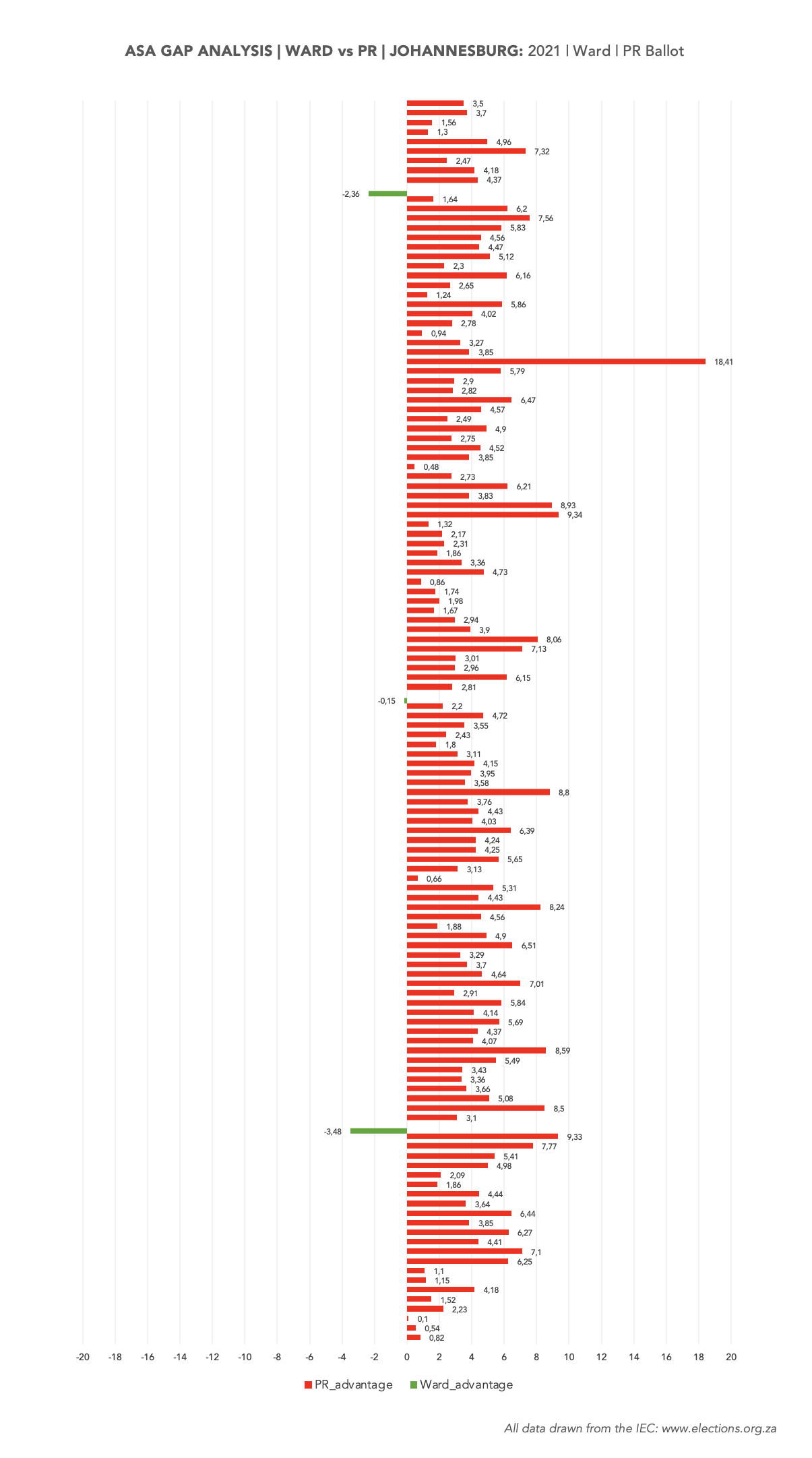
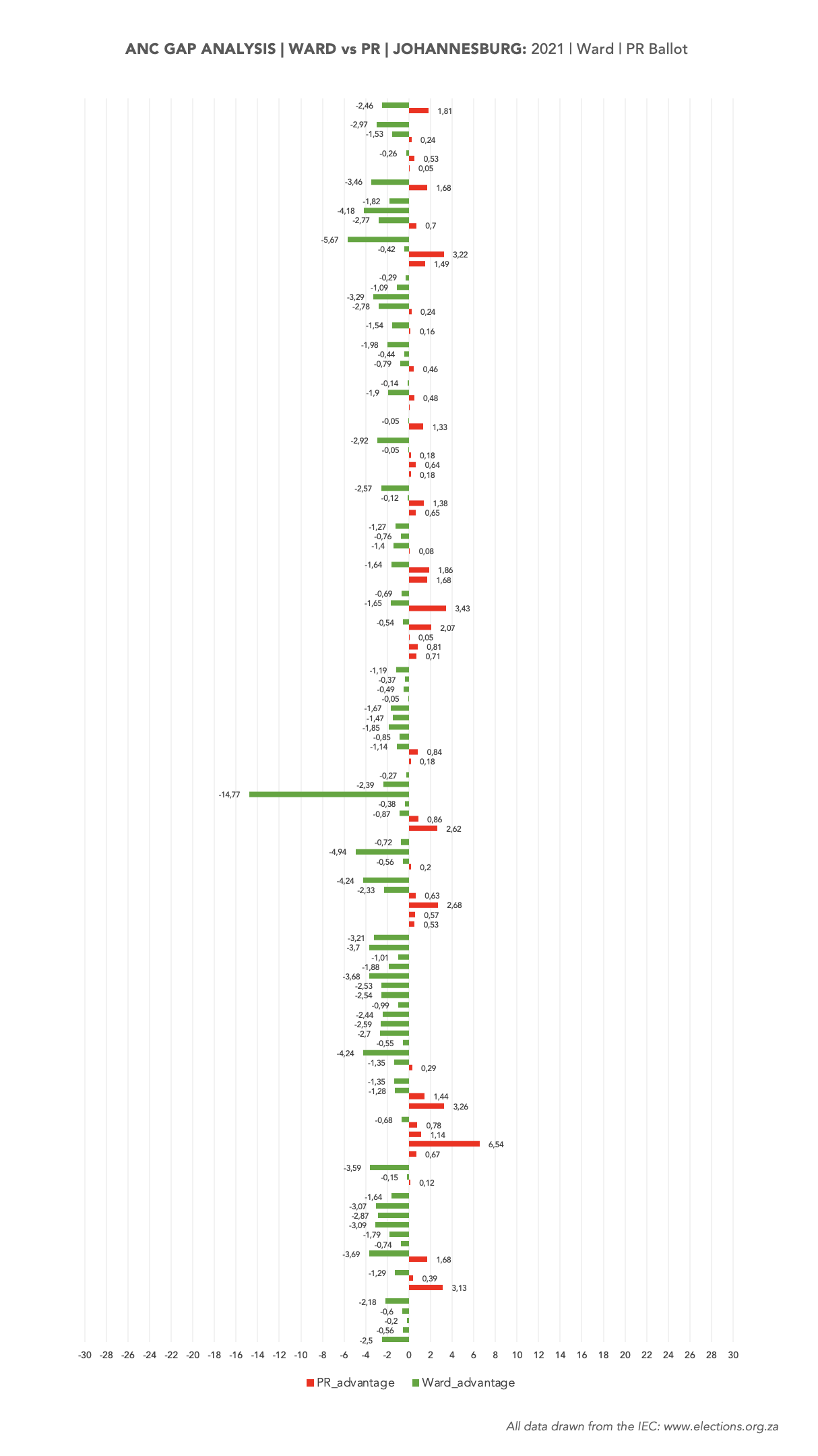
The graph above (left, I have included the ANC’s graph, right, for comparative purposes) shows how ASA’s 2021 Johannesburg vote split between the Ward and PR ballot, per ward. The red bars illustrate wards where ASA’s PR vote exceeded its Ward vote; the green bars vice versa. With the exception of just three wards, ASA scored significantly more PR than Ward votes in every other ward.
The difference between the two ballots is presented in percentage points on the graph, but if you add those up in terms of absolute votes, they come to +38,373 PR votes. That 38,373, in turn, represents 23% of all ASA’s PR votes (167,359). And you can be sure, they were almost all for Mashaba specifically. By comparison, it got just 128,986 votes on the Ward ballot.
That 38,373 PR excess also sets ASA apart. The ANC and DA, both significantly bigger parties, had smaller differentials – of around 6,500 and 12,000 respectively – but both in favour of their Ward, not PR vote – a sign that those party brands reside as much in those party’s ward as they do in their mayoral candidates. Like Gauteng and Johannesburg, Mashaba is disproportinately central to any good ASA performance.
Johannesburg: ASA’s greatest strength
Having now established the necessary context, let us look in detail at ASA’s 2021 performance in Johannesburg.
Here is a standard (0%-100%) heat map of its showing:
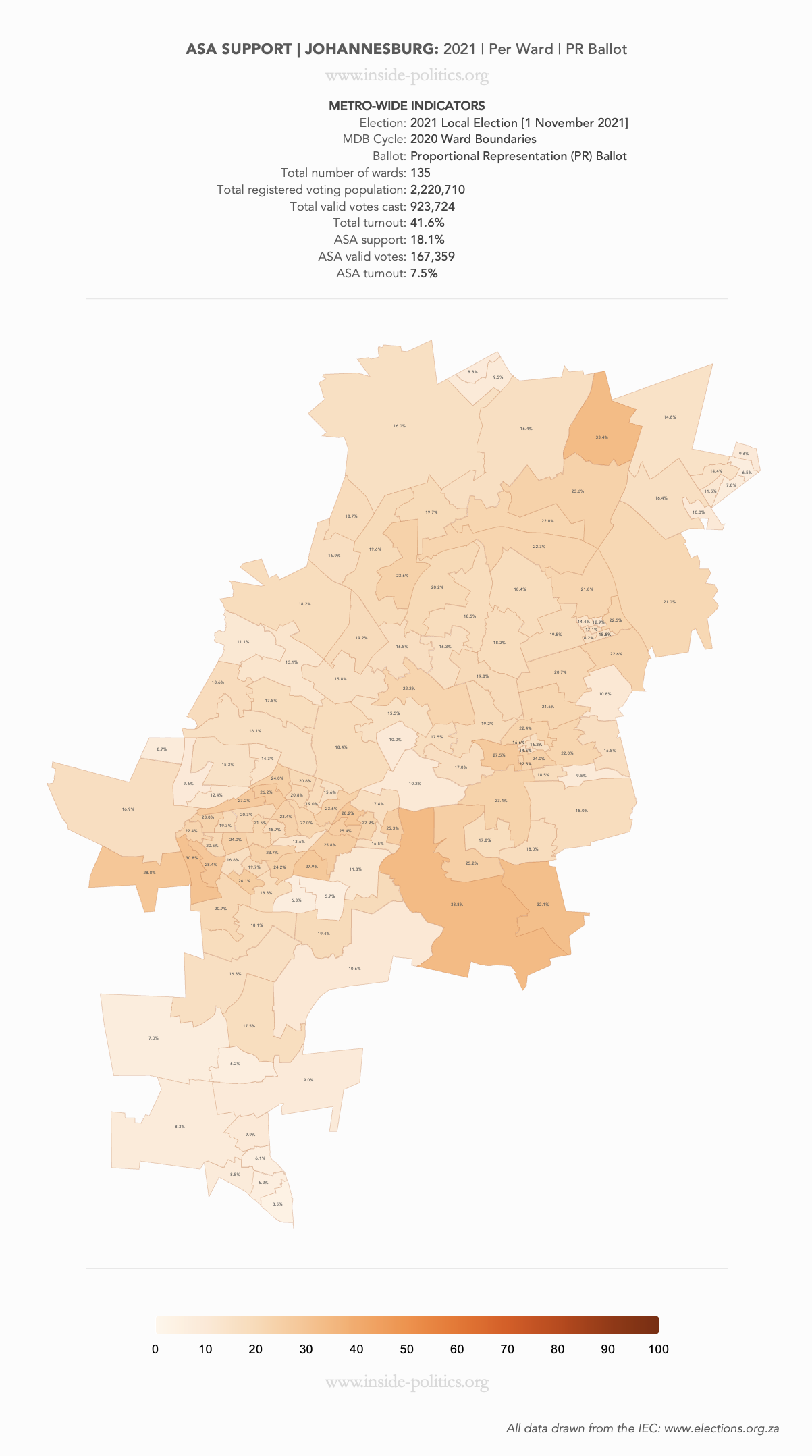
2021 was an exceptionally good performance for ASA. Not only was its support broad (with near universal coverage) but consistent. This is incredibly rare in South African politics. Typically, certainly with regards the ANC and the DA, a party has strongholds and areas of weakness. But the uniformity of ASA’s vote is remarkable. Consider the following:
For Johannesburg’s 2021 135-ward total, ASA’s ward-level performance breaks down as follows:
- 0%–5% in 1 ward
- 5%–10% in 19 wards
- 10%–15% in 16 wards
- 15%–20% in 50 wards
- 20%–25% in 33 wards
- 25% and above in 16 wards
In 88 out of 135 wards (65% of all wards), ASA got between 15% and 25%. In 104 wards (77% of all wards) it got between 10% and 25%. And, for a new party to have just one ward, where it got less than 5%, is exceptional. That high, universal coverage meant ASA was able to eat directly into ANC and DA potential support alike, and into those party’s strongholds too.
The following two maps demonstrate to what degree ASA was able to do that. Each map constituents a selection of wards that represent either the ANC’s or DA’s JHB stronghold and show how ASA performed in each (to understand why these wards, you need to read this piece).
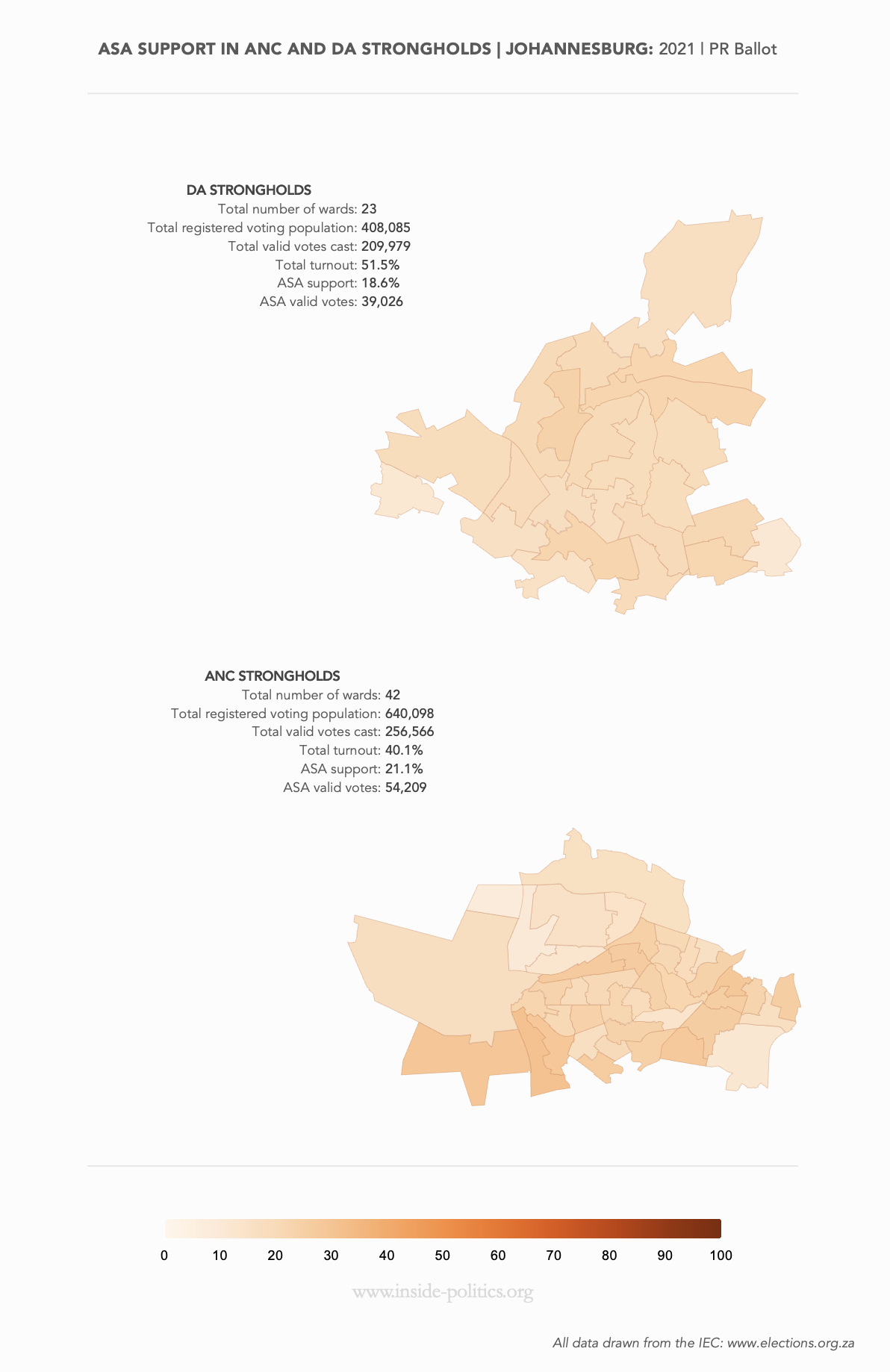
Just to explain how important those ward blocks are to the ANC and DA. In 2021, the ANC’s cluster of 42 wards (essentially Soweto) delivered 42.5% of all ANC votes in the metro; the DA’s cluster of 23 wards delivered 56.4% of all DA votes. ASA was able to get around 20% in both – something neither the ANC or the DA have ever managed in the opposing party’s stronghold.
There is another way to appreciate how good ASA’s 2021 performance was, using a turnout track (again, for a fuller understanding of what you are looking at, see here).
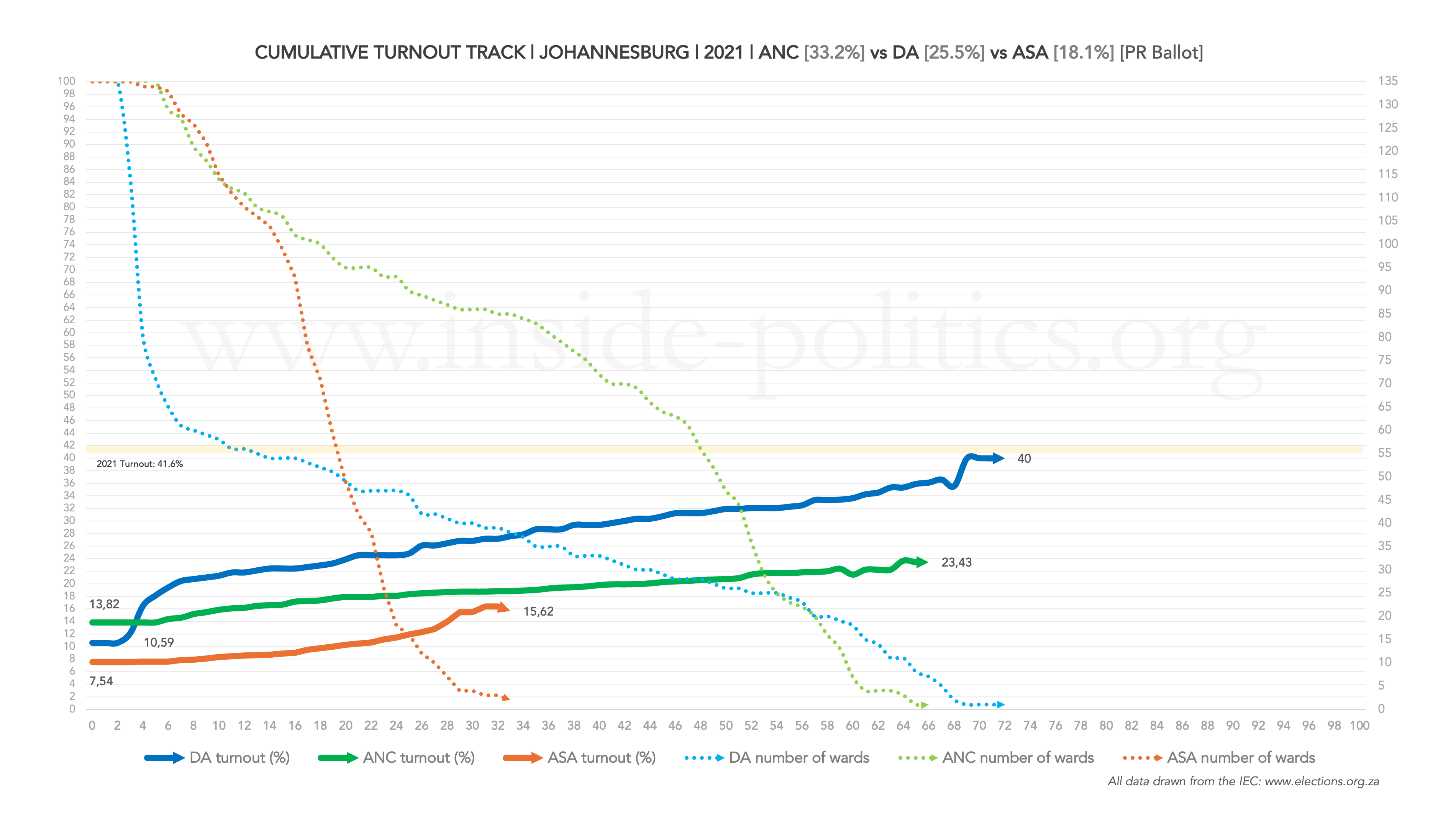
The orange dotted line is the most important thing on this graph. It shows the number of wards contained at each point on ASA’s solid orange line (its turnout track). It balloons way past the DA’s blue dotted line and even overtakes the ANC for a while, before falling behind its dotted green line. This means that although ASA’s support did not run very long, it was very deep (that 15%-25% support band). And, looking ahead, if ASA is able to grow even a small amount, but retain that deep support level, it has the potential to make serious further inroads, and push that dotted along further to the right.
Where is ASA most competitive
One of the most effective ways of determining ASA competitiveness, is by looking at those wards where ASA is closest to the leading party. Here is what that look like:
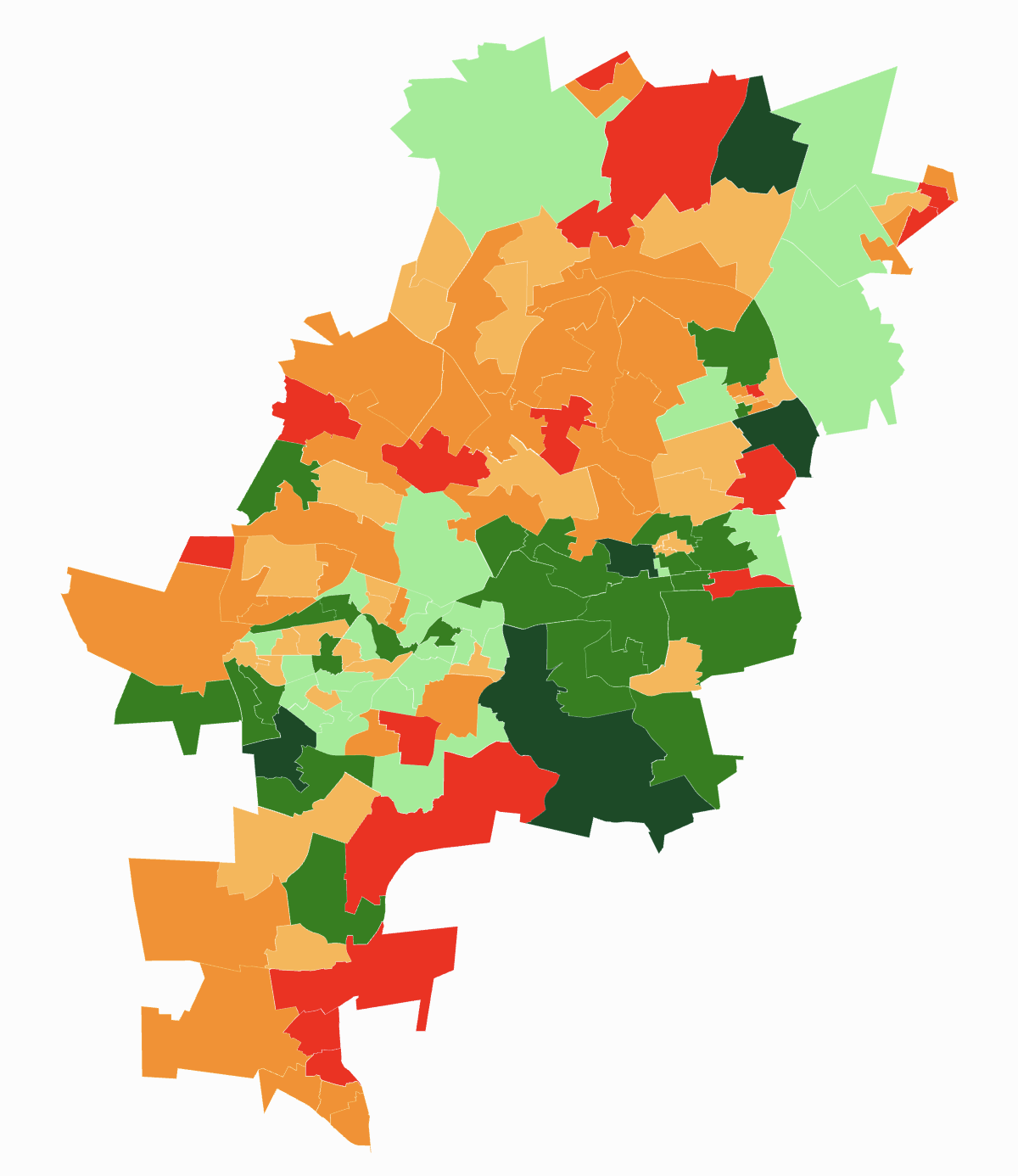
There are six colour blocks, moving from Dark Green to Red, each designed to demonstrate how far off the leading party ASA was per ward. They are broken up as follows:
- Gap = 50 ppt +: Red
- Gap = 40-50 ppt: Orange
- Gap = 30-40 ppt: Light Orange
- Gap = 20-30 ppt: Light Green
- Gap = 10-20 ppt: Green
- Gap = 0-10 ppt: Dark Green
In short, Green means ASA is close to the leading party, and Dark Green means it is very close (less than 10 ppt). But let’s remove all other colours except for Light Green, Green and Dark green – and let’s label only those wards where ASA is within 20 ppt of the leading party.
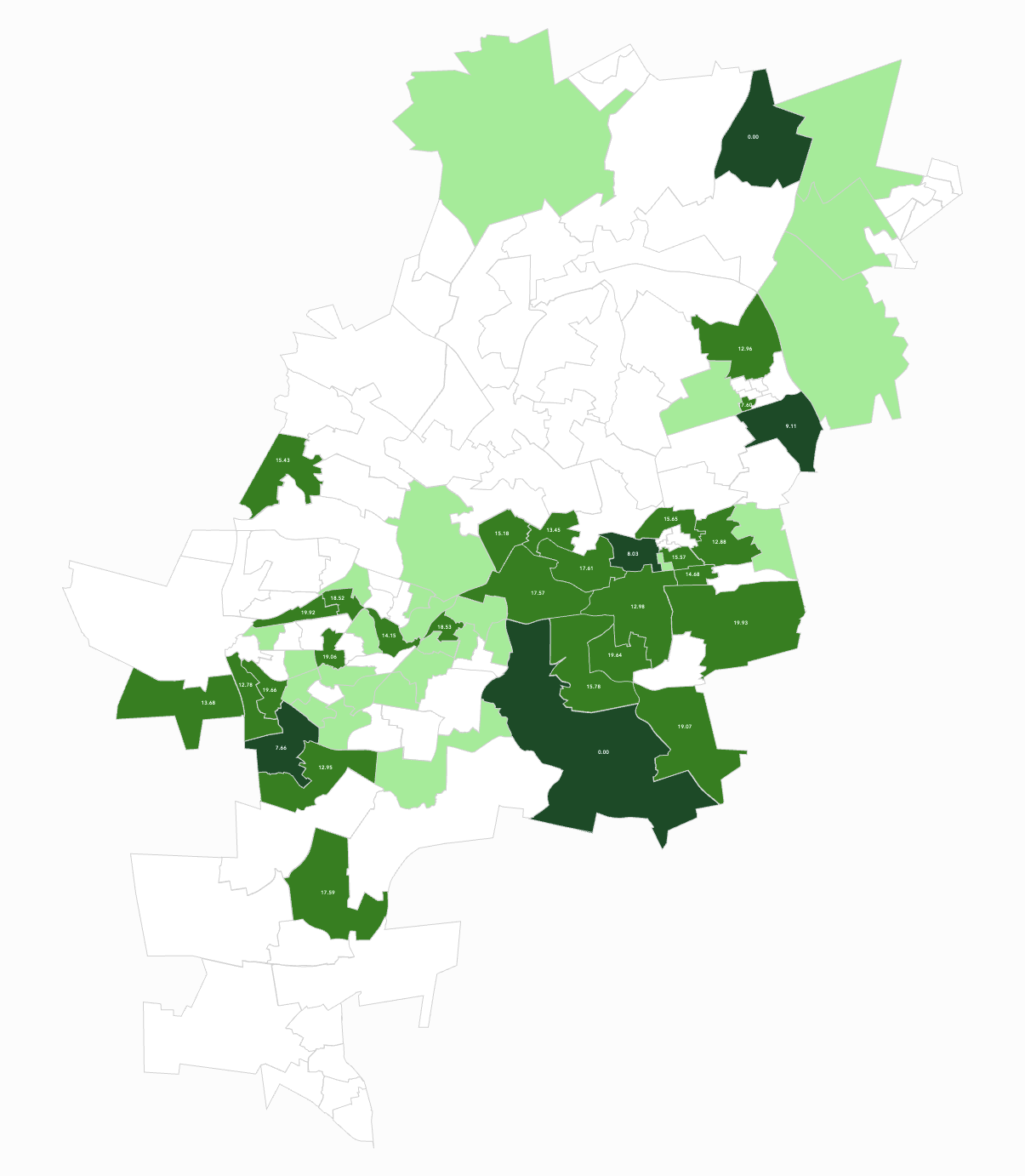
The bulk of those wards are led by the ANC (six of the top ten, the DA three and Al Jama-ah, one).
- Ward 010: ASA [20.7%] – Gap: 7.7pp – Leader: ANC [28.4%]
- Ward 060: ASA [27.5%] – Gap: 8.0pp – Leader: ANC [35.5%]
- Ward 081: ASA [22.6%] – Gap: 9.1pp – Leader: ANC [31.8%]
- Ward 013: ASA [30.8%] – Gap: 12.8pp – Leader: ANC [43.6%]
- Ward 066: ASA [22.0%] – Gap: 12.9pp – Leader: DA [34.9%]
- Ward 009: ASA [18.1%] – Gap: 13.0pp – Leader: ALJ [31.1%]
- Ward 109: ASA [21.8%] – Gap: 13.0pp – Leader: DA [34.7%]
- Ward 124: ASA [23.4%] – Gap: 13.0pp – Leader: ANC [36.3%]
- Ward 069: ASA [17.5%] – Gap: 13.5pp – Leader: DA [31.0%]
- Ward 135: ASA [28.9%] – Gap: 13.7pp – Leader: ANC [42.5%]
This is primarily because the ANC is declining at a faster rate than the DA. While ASA has made inroads into the DA’s strongholds (to the North and in the centre of JHB), it has less chance of winning them. Rather, it is to the South, where the ANC traditionally holds sway, that ASA would seem to have the best chance of winning wards.
(You can actually prove this with regression analysis. I have run a couple of regressions and will write a separate piece on them.)
What are ASA’s prospects
The problem with many smaller parties, so heavily reliant on their leader, is that whomever that person is, they are both that party’s strength and weakness, a point well illustrated by the above. Herman Mashaba is therefore ASA’s greatest, arguably its only, real asset, but also the party’s greatest liability.
Time away from the DA, its infrastructure, policy, ideological and intellectual hinterland, has revealed Mashaba to be more of a populist than a mayor. He has come to view South Africa, white South Africans in general (“descendants of a savage and brutal system”) and DA supporters in particular (“racists”) entirely through a racial lens. He believes Helen Zille yearns to “bring back apartheid”, and (white) critics of ASA’s performance in government, should leave the country. And so his outlook, once defined by a staunch liberalism, even libertarianism, is now increasingly held hostage by identify politics; in many ways, indistinguishable from that of the ANC.
He is not able to speak with any authority on any substantive policy matter, his positions reduced to rambling rhetoric and soundbites, that lack depth or understanding, nuance or insight. He is locked fully into the binary universe of the populist, where everything can be reduced to a simple right or wrong. Effective enough for the politics of politics, but not reassuring for any actual position in government. It is a behaviour exacerbated by Twitter on which he, like Helen Zille before him, has found that a lack of any filter or awareness, produces not reverence but rage, which only provokes him further.
He has failed to read the ANC, both in Johannesburg (where his equivocation on the ANC mayor, and ASA’s late abandonment of their agreement with the ANC, presumably to avoid any culpability, was poorly managed and received) and nationally, specifically on the VAT increase, ASA was run circles round by the ANC, as it desperately tried to manufacture a middle ground that simply did not exist. And so ASA is seen as potentially gullible.
With this has come endless instances of hypocrisy or double standards, many of them to do with the ASA’s love-hate relationships with the ANC, but altogether so extensive that his personal brand is now tainted by duplicity. His trust levels, and those of ASA, have been severely damaged in turn.
And ASA has another problem: Helen Zille. As of writing, ASA has not yet announced its mayor candidate. Given the above you feel any candidate other than Mashaba would be a significant risk. But even if Mashaba does stand, Zille constitutes both a bigger, tougher (and more coherent) personal brand. She also boasts a far superior service delivery record. She simply dwarfs Mashaba.
She would neutralise much of Mashaba’s appeal, particularly among potential DA voters. With that, ASA’s ability to generate a significant differential on its PR ballot would also suffer.
ASA’s response to its dire 2024 performance has been to try and replicate its 2021 model: stand in a limited number of municipalities (42 at the last count), where its prospects are best, and use the results to engender the perception it is bigger than it is. But even that has been somewhat undone by 2024. In 2021 such a move might be seen as born of strategic wherewithal, in 2026, and given what we now know, it seems born of weakness.
Outside of Gauteng, there is the North West and ASA is trying extremely hard, with some successes, to capitalise on the party’s latent support in that province. You can see expect a significant number of those 42 municipalities to be in that province.
To do this, it has run a programme of amalgamation, encouraging smaller parties to merge with ASA, in order to supplement its limited human infrastructure and reach. There are upsides and downsides to this, much of which revolves around ASA’s brand. If it is seen as a more appealing idea than those of the smaller parties it absorbs, it can grow in those areas. If it is not, then the voters of those parties may not follow them. But some by-elections suggest either way it will deliver more votes than doing nothing.
There is also Tshwane and Ekurhuleni, the most immediate and obvious growth points for the party, simply because of their proximity to Johannesburg. ASA is coming off a very low base in both, so it difficult to image it going backwards here. How much it grows remains to be seen.
But, at the end of the day, it is Johannesburg or bust for ASA. When 40% of all your national votes come from a single metro, you have to throw the kitchen sink at it. It puts you in a bind, reinforcing the very limitations you need to overcome.
Conclusion
We have a limited data set for ASA: one local and one national election. This makes any analysis tricky, because we cannot definitively identify the trends that define its historical performances in each kind of election, and we are forced to be slightly more anecdotal than we would be with the ANC or DA. But we do know the following, as of 2024:
- 70% of ASA votes come from Gauteng.
- 40% of ASA votes come from Johannesburg.
- The party is heavily on Mashaba.
- It is generally more competitive against the ANC, than the DA, but not unable to win DA votes.
- It has a good turnout record in Johannesburg local elections, in which it does significantly better than national elections, where it brand limitations dramatically and negatively impact its performance.
- Its most obvious growth points are Tshwane and Ekurhuleni, with the North West next.
- Helen Zille’s candidacy is likely going to limit its effectiveness in Johannesburg, and among DA voters.
- Mashaba’s and ASA’s brand is no longer what it was, tainted by a series of bad strategic decisions which have resulted in less trust and a lack of clarity regards its relationship with the ANC. Put another way, the novelty of ASA as an “independent third way” has run its course.
The British comedy series The League of Gentleman, has a wonderfully twisted set of characters who run a local shop, a comment on English parochialism. They say to every customer, “This is a local shop, for local people.”
That, in the big picture, is ASA. Its goal in 2026 will be to try and open a series of new franchises. It really needs to succeed, because if 2024 is anything to go by, national elections are not its strength. It has the benefit of a blank canvass outside of Gauteng. It is, however, no longer new and exciting. It is known, not unknown. And that means a lot of voters are able to make a far more informed decision about it. The last five years, and how those people have experienced Herman Mashaba away from the DA, will tell us to what degree his personal brand has held up, as it will ASA’s ability to break the one-man party mould.
This essay is the 15th in an on-going series on Election 2026/7, for all other editions of this series, please click here: Election 2026/7
Discover more from inside politics
Subscribe to get the latest posts sent to your email.
 inside politics
You must be logged in to post a comment.