
Election 2026/7 [16] Can ASA win half the wards in Soweto?
by The Editor

Herman Mashaba says he believes ASA will win half the wards in Soweto outright. This analysis is designed to see what that would take in real terms, by isolating those wards that comprise Soweto, and comparing the results there between the 2016 and 2021 local elections, before determining what that all means for ASA’s potential.
Can ASA win half the wards in Soweto?
By: Gareth van Onselen
Follow @GvanOnselen
1 March 2026
This essay is the 16th in an on-going series on Election 2026/7, for all other editions of this series, please click here: Election 2026/7
Introduction
In a recent interview with the Daily Maverick, Action South Africa (ASA) Johannesburg mayoral candidate Herman Mashaba predicted, “I am confident of winning half, minimum of half of the wards in Soweto, not just PR seats..”.
This analysis is designed to see what that would take in real terms, by isolating those wards that comprise Soweto, and comparing the results there between the 2016 and 2021 local elections, before determining what that all means for ASA’s potential.
Just to put Mashaba’s statement in the simplest terms: What he is saying is that ASA will deliver, at least, 19 ward councillors in Soweto (it comprises 38 wards). Ward councillors are elected on a first-past-the-post basis, so another way of framing his prediction is that he believes ASA will be the leading party, on the ward ballot, in a minimum of 19 Soweto wards.
At of writing, ASA has no ward councillors in Soweto, and the ANC leads in every ward, as it has done since 2000. So, were Mashaba’s confidence to align with reality, this would be a profound change, with profound implications. Soweto is the ANC’s engine room in Johannesburg and, if it collapsed, so would the ANC in the metro more broadly. This is an important flip side to Mashaba’s statement: for it to come true, the ANC would have to totally implode.
Let us see what the numbers say.
Political context
First, and briefly, it is important to understand why Mashaba is saying this. In 2021, ASA made inroads, to a more or less equal degree, into DA and ANC strongholds alike (see here for more on this). But the DA’s announcement of Helen Zille as its mayoral candidate has likely made that outcome far more difficult in 2026. The 2024 election also suggests the DA’s decline has stabilised.
The ANC, however, shows no sign of reversing its, far more serious, decline; and the party certainly seems to have no potential mayoral candidate in its ranks who could meaningfully reinvigorate its prospects. So, with the DA path to growth now seemingly a far more difficult option for a small party with limited resources, ASA has, understandably, turned its attention to the ANC, and its heartland – Soweto. It is highly likely ASA is going to focus far more on the South of Johannesburg, than it will the North.
And ASA is not wrong to do that. The ANC is in free fall in Soweto. It might still lead in every ward, but the graph is unequivocally headed in the wrong direction; it feels like the party is on a precipice. So this is Mashaba’s moment. The question is, does the ANC have enough in the bank to decline significantly, but still win Soweto? And is ASA close enough to overtake it in a significant number of wards?
The 2024 national election hurt ASA badly, and did great damage to the sense of momentum it had established in Johannesburg post 2021. But, if we accept that it is a local party, Johannesburg is its stronghold, and Mashaba’s reputation as a former mayor its greatest brand asset, then we should ignore its 2024 result for this analysis. ASA is simply unlikely to perform in the same way in 2026, other than to acknowledge it is generally on the back foot.
Isolating Soweto
Unlike other metros, Johannesburg’s political geography is extremely helpful in isolating Soweto definitively (which is important, we don’t want any wiggle room here). The metro is divided into regions, see below, and Soweto is Region D.
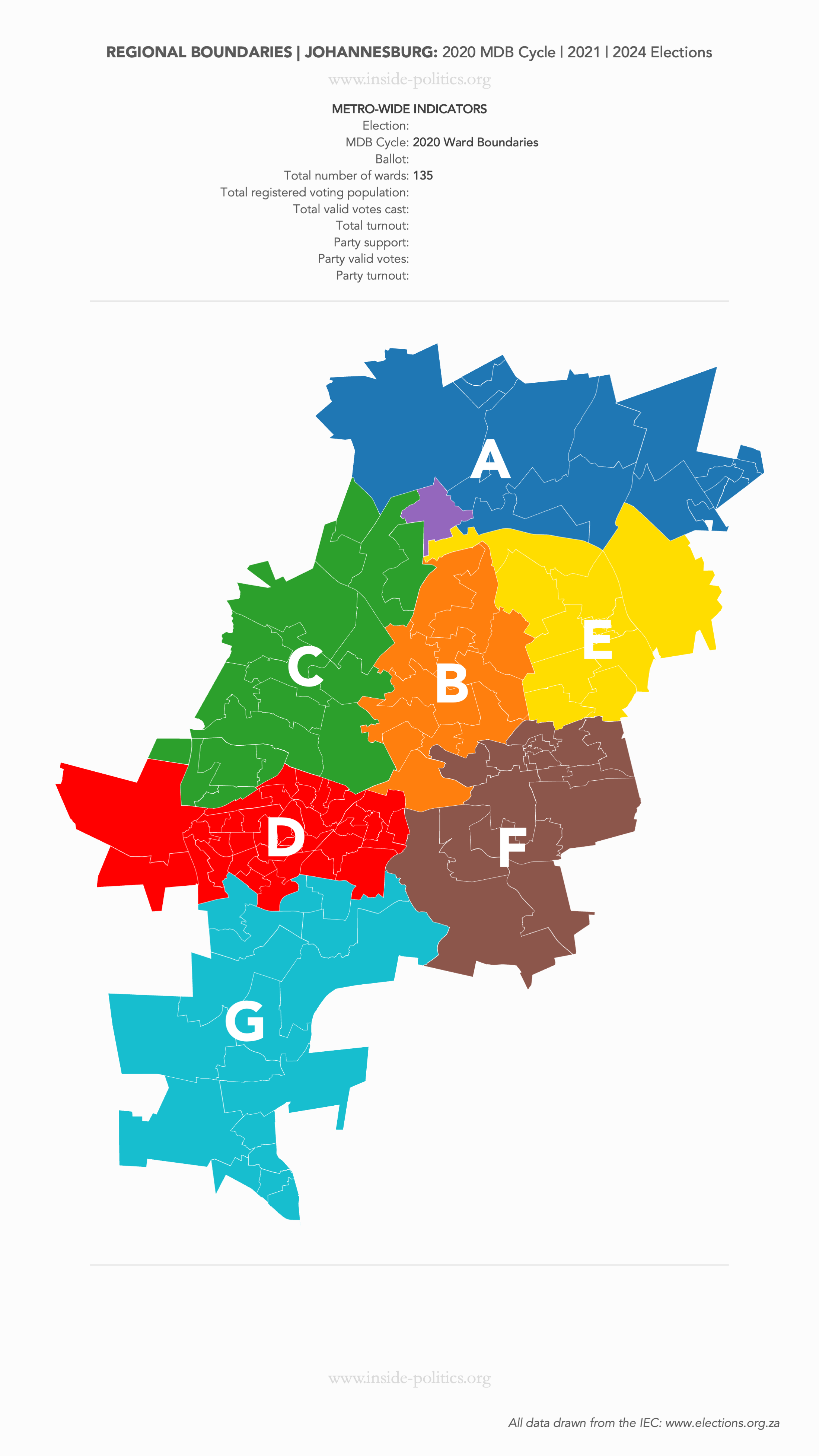
So let us cut Soweto out of that map, see below, and focus only on that.
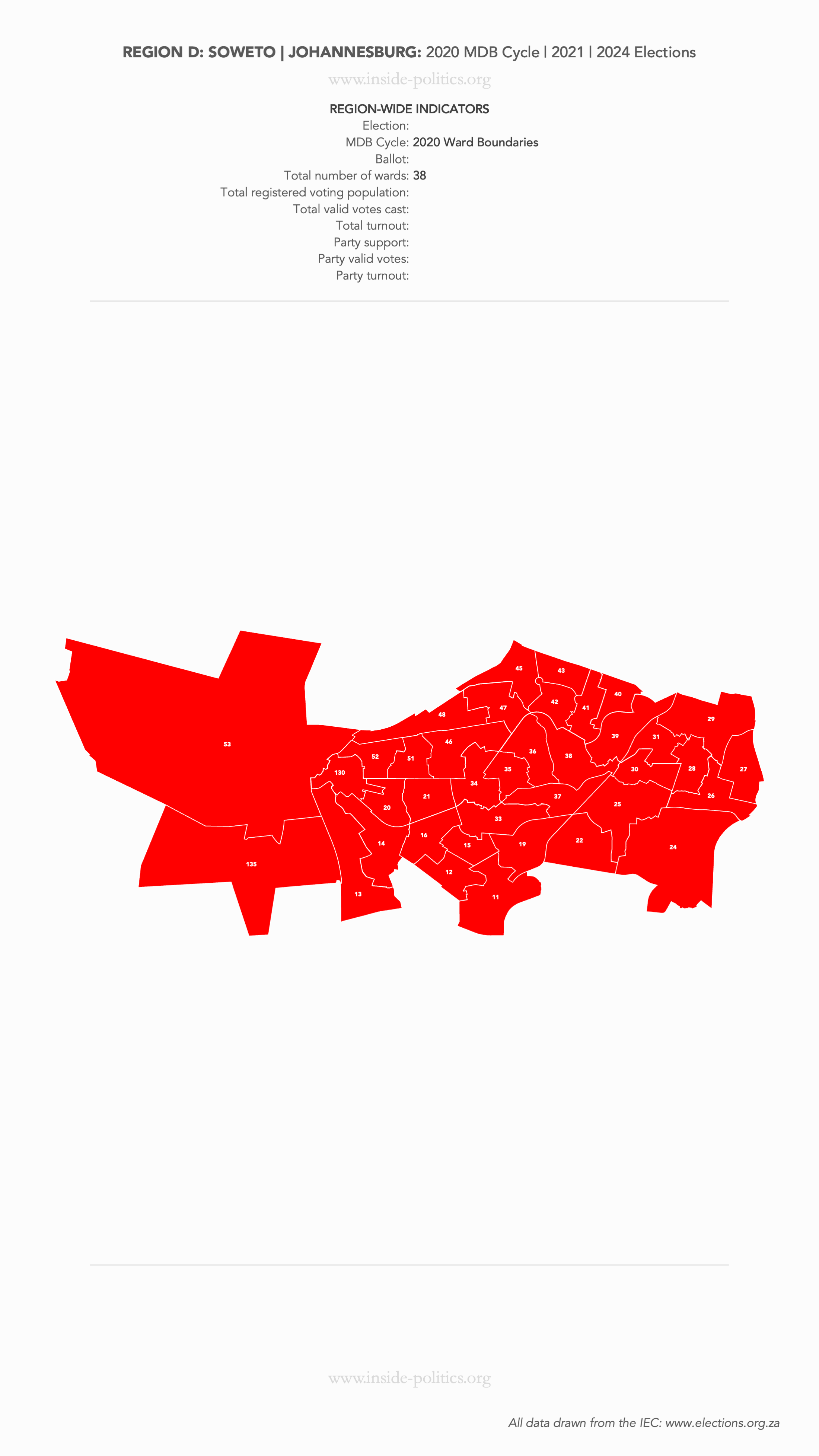
A brief methodological point at this juncture. The Municipal Demarcation Board (MDB) map for Soweto in 2021 (above), is ever-so slightly different from the MDB map for Soweto in 2016. Three or four wards were slightly smaller back then. But essentially there is a 99.9% ward-for-ward match for all 38 wards, and so I shall be using the 2020 MDB map for both elections.
Also, given the nature of Mashaba’s prediction, this analysis will only focus on the Ward Ballot, going forward.
Party support levels in Region D
The ANC’s support map for 2021, below, can serve two purposes – both to map the ANC’s support itself, but also as a leading party map because, conveniently, the ANC won every Region D ward in 2021.
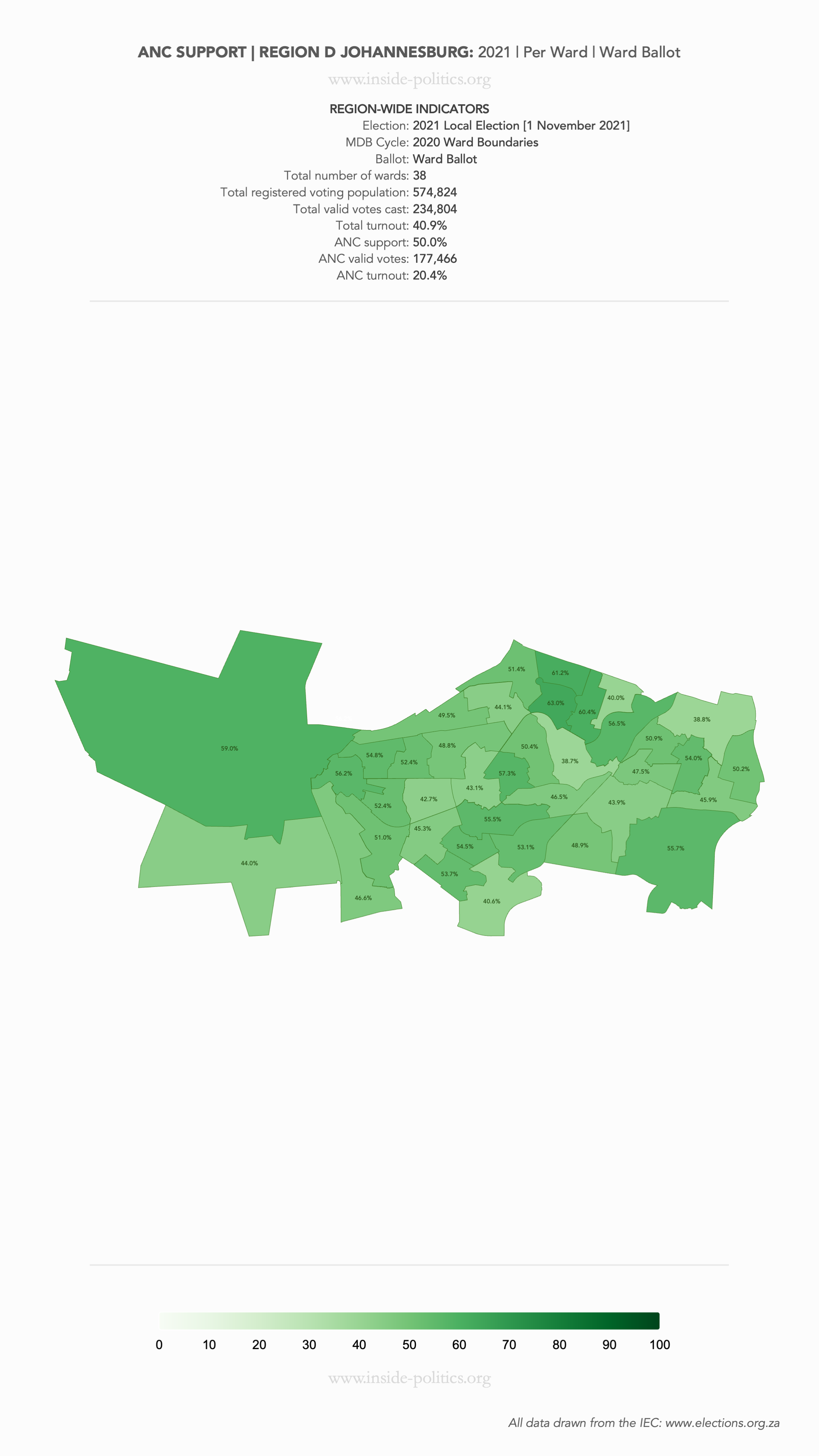
You can immediately see why ANC support is best described as on a precipice. Its average across all 38 wards is 50%, and, in a number of wards, it won with less than 50%. In fact, in two wards, it won with just 38%.
Next, here is ASA’s 2021 performance in Region D:
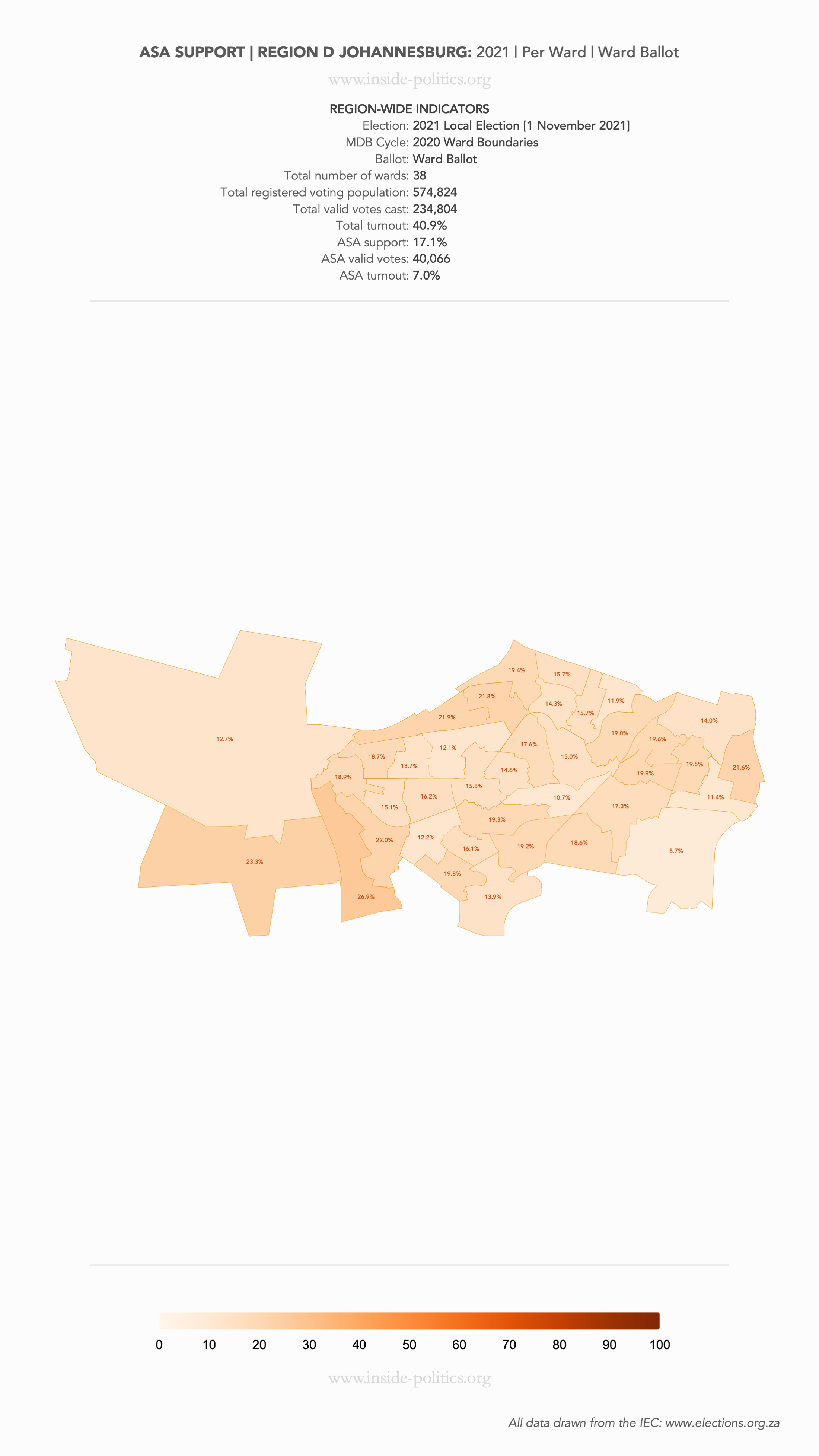
ASA’s performance in Soweto, in 2021, was its crowning achievement. It wasn’t just that it averaged 17%, it was its consistency. in 24/38 wards it managed between 15% and 25%. And, as a result, it finished in second place, behind the ANC, in 25 wards.
There are two other support levels we must understand before we can move on to ASA’s prospects: The EFF’s performance, the other significant political force in Region D, and “Other Parties” (the performance of all parties other than the ANC, ASA and EFF) which make up the difference. Let us start with the EFF, its heat map is below.
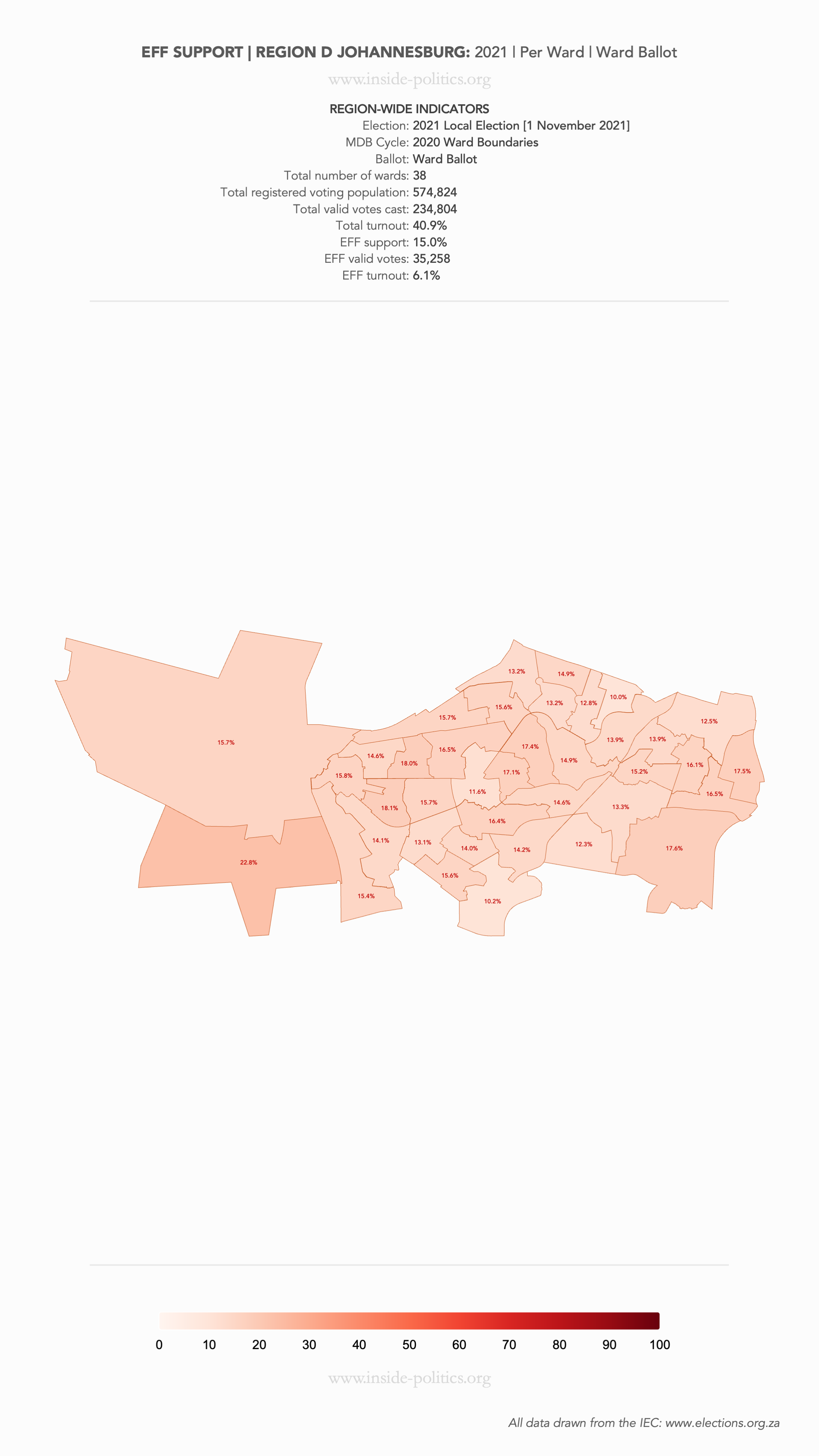
The similarities between ASA and the EFF are remarkable. Both were extremely consistent across Region D, and only 4,000 votes separate the two. The EFF finished second, behind the ANC, in 7/38 wards. In 2016, it finished second in 30/38. So although it is close between the two, ASA was very effective in locking down second position across the region, and pushing the EFF into third.
Finally, all other parties that make up the difference. Their map is as follows:
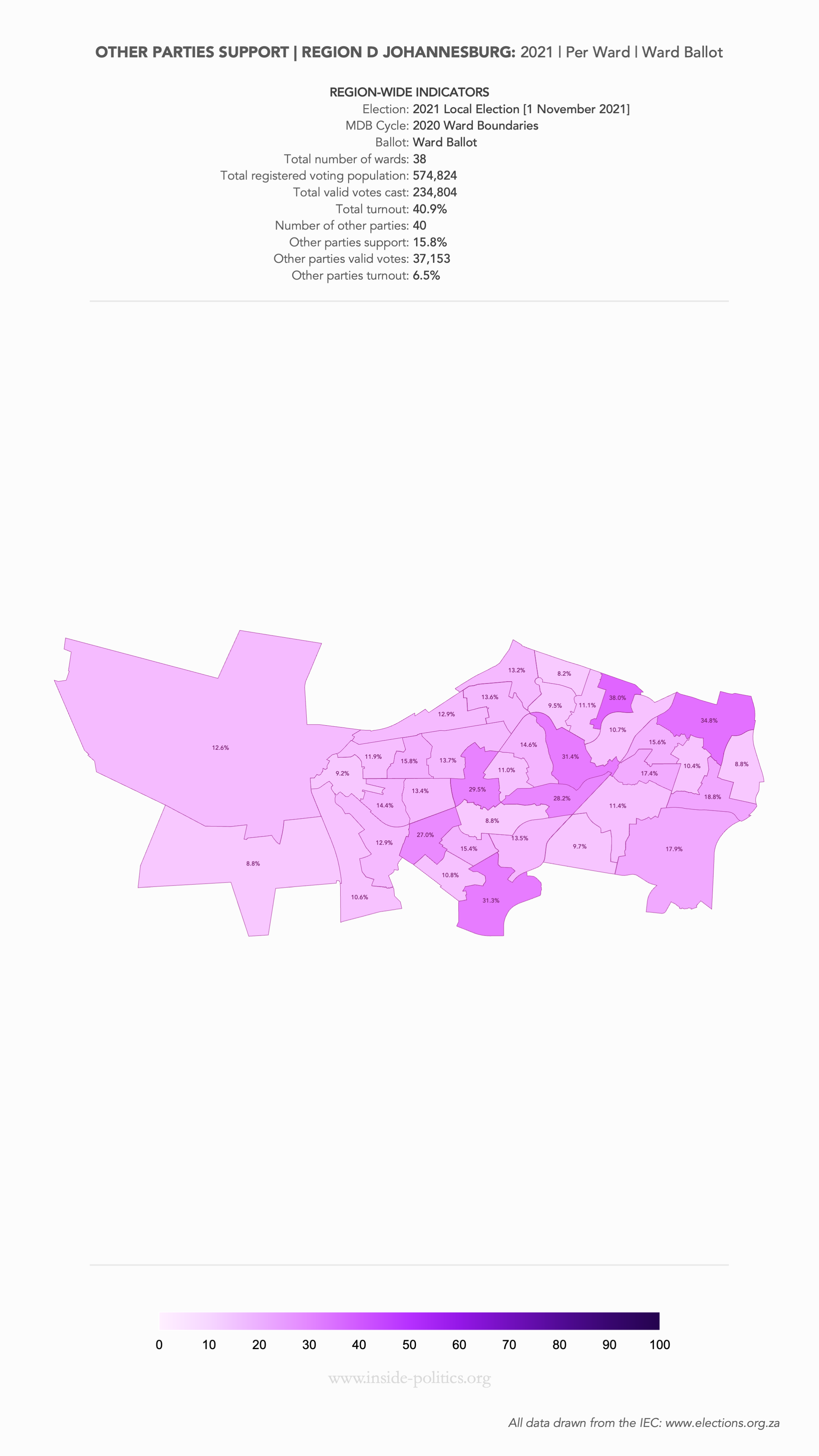
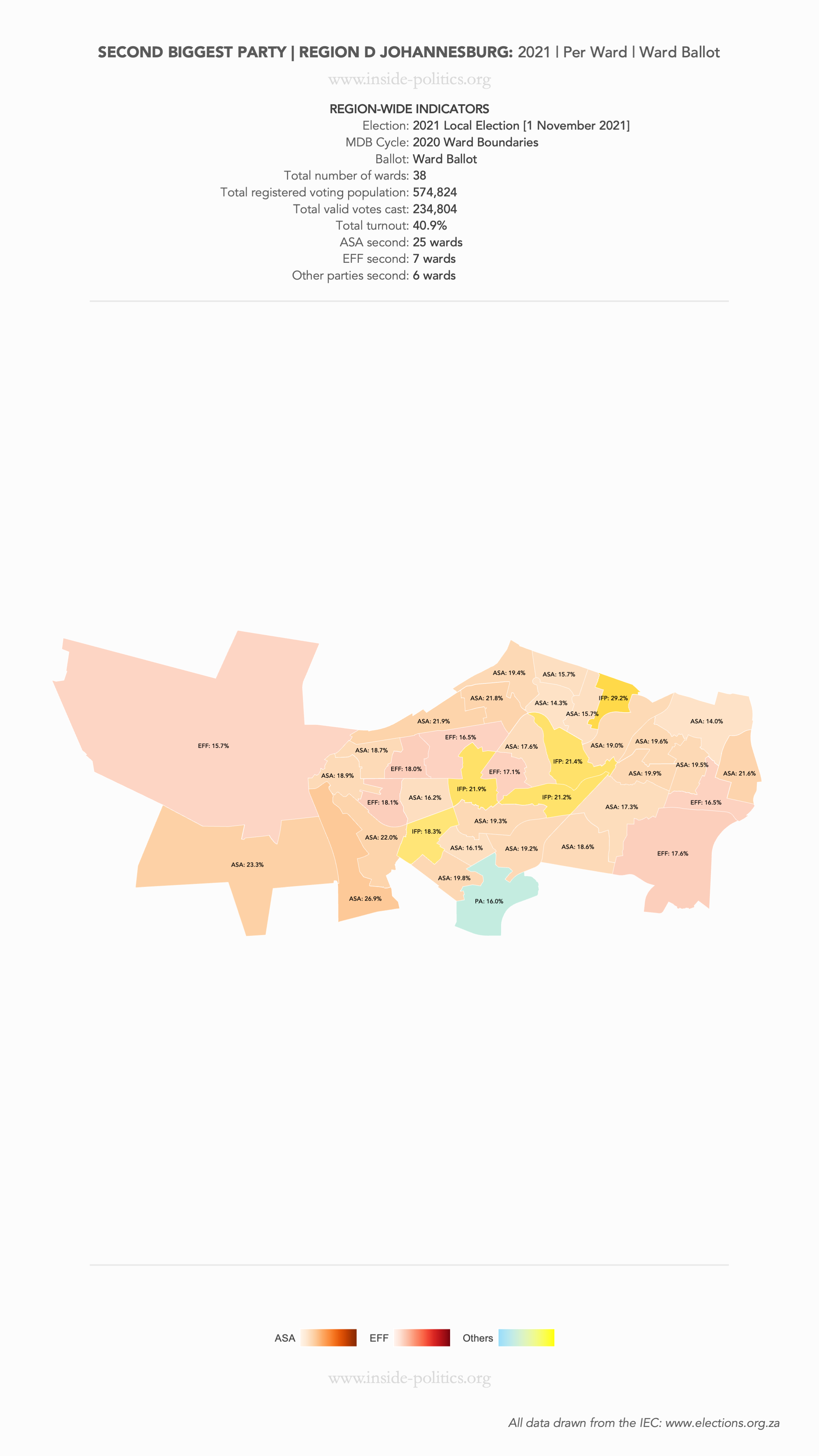
Other parties finished second in 6/38 wards in Soweto (IFP 5, PA 1). Again, seen as a combined whole, a fairly consistent set of indicators, and together with the others, give us the four primary forces in Soweto politics:
- ANC: 50% [1st place: 38/38]
- ASA: 17% [2nd place: 25/38]
- EFF: 15% [2nd place: 7/38]
- Others: 16% [2nd place: 6/38]
Outside of the ANC, they split quite nicely into almost exact thirds. Here is how all those second place party positions look, when mapped:
Direction of travel in Soweto
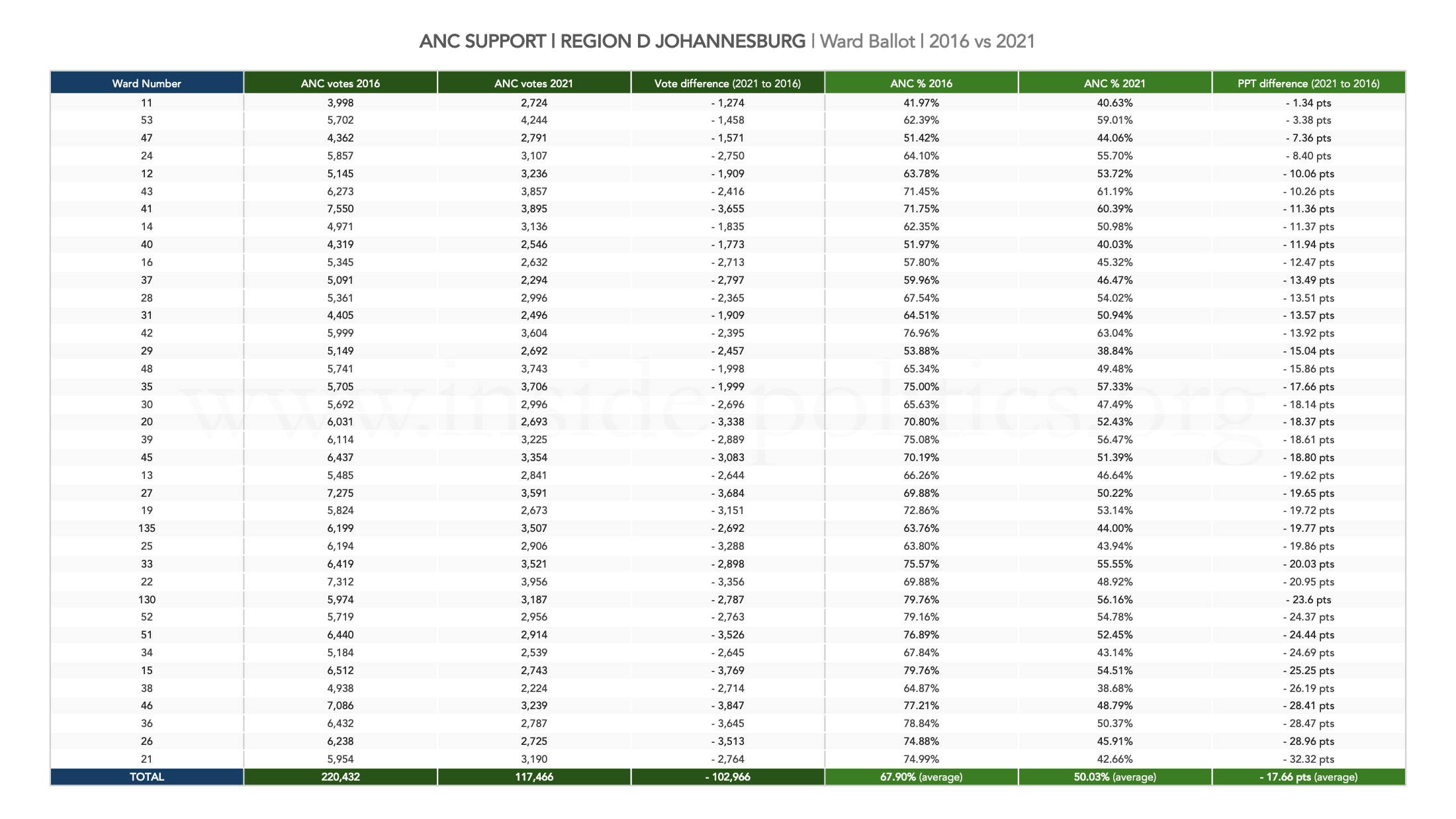
Now that we understand the lay of the land, as of 2021, we need to understand what those numbers represent. Are those four forces on the rise or in decline? Obviously, ASA stood for the first time in 2021, so we cannot do this analysis with that party, but for the other three we can. Here is each comparative performance in 2021, compared to 2016.
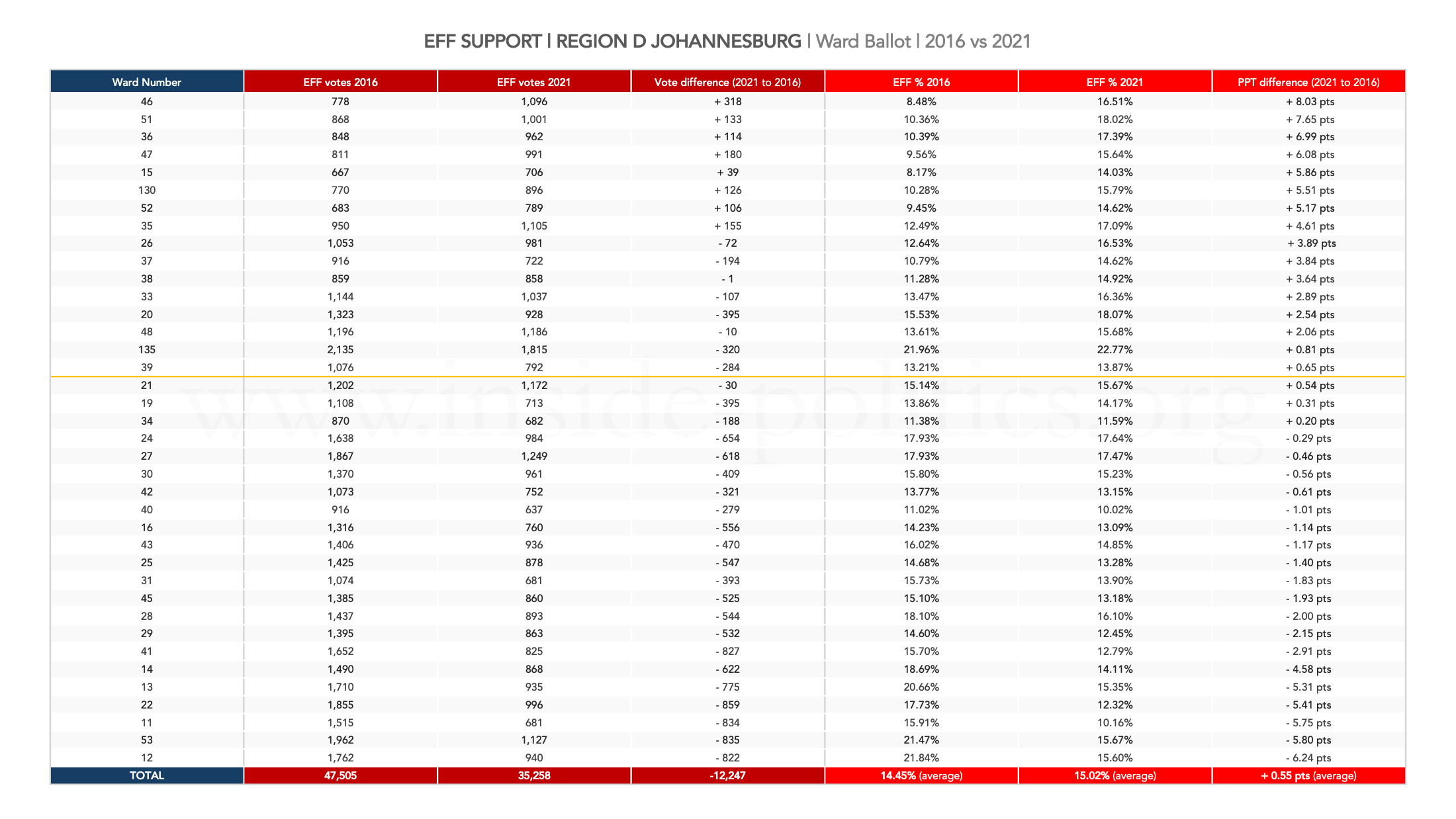
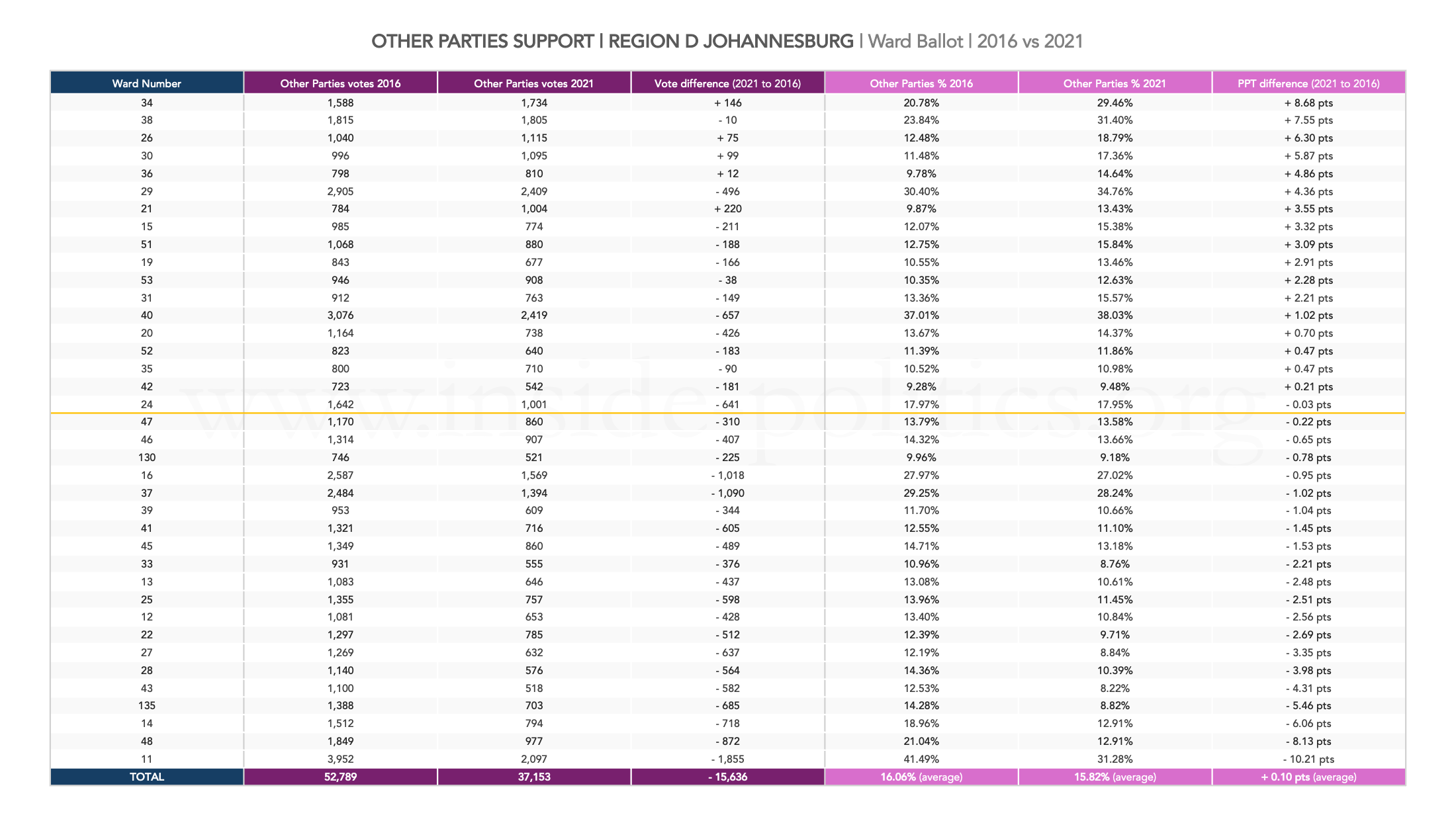
In summary:
- The ANC: In dramatic decline. Down 103k votes and 18pts, from an average of 67.9% to 50%. Declined in every ward, an average of -17.7pts.
- The EFF: Stable, although given the decline in turnout, practically in decline. Went from 14.5% to 15%, but from 47.5k votes to 35.2k votes, a loss of 12.2k. Declined in 19 wards, grew in 19, the majority being marginal movement in either direction.
- Other Parties: Stable but, like the EFF, practically in decline. Went from 16.1% to 15.8%, but from 52.7k votes to 37.1k votes, a loss of 15.6k. Declined in 21 wards, grew in 17, the majority being marginal movement in either direction.
Not a pretty picture, but it does explain some of Mashaba’s hubris. As of 2021, ASA had no real competitors on the growth front. This brings us to the final, crucial indicator we need to understand: turnout. It has had a significant and negative effect on all comers in Soweto. This was the situation in 2021:
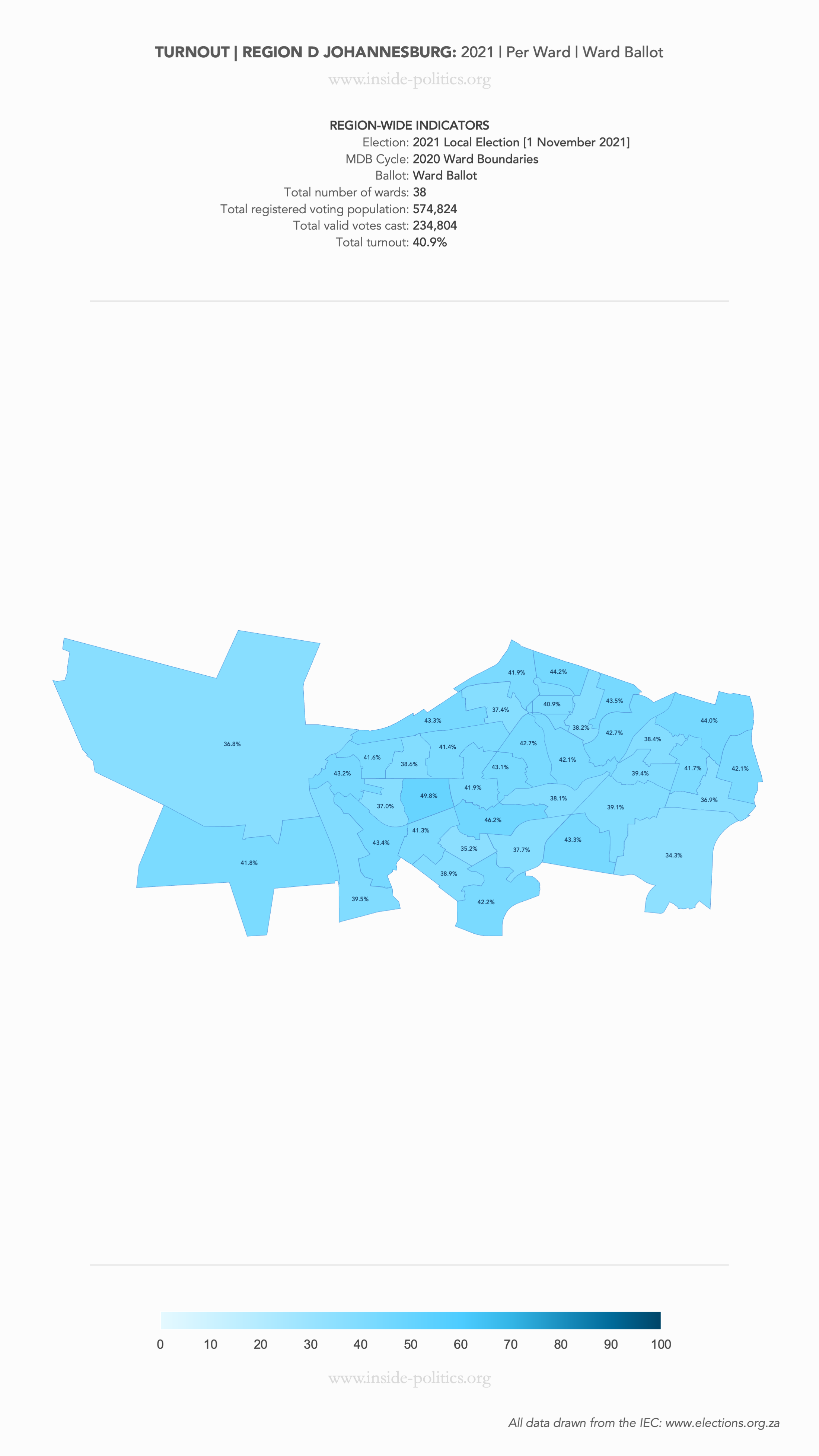
That map will scare the life out of all parties. You can grow by eating into other parties, but that is a game of diminishing returns. To really grow you need new voters, or voters to return, and that means turnout improves. There is no sign of that happening, in Soweto, or Johannesburg (or South Africa), in 2026.
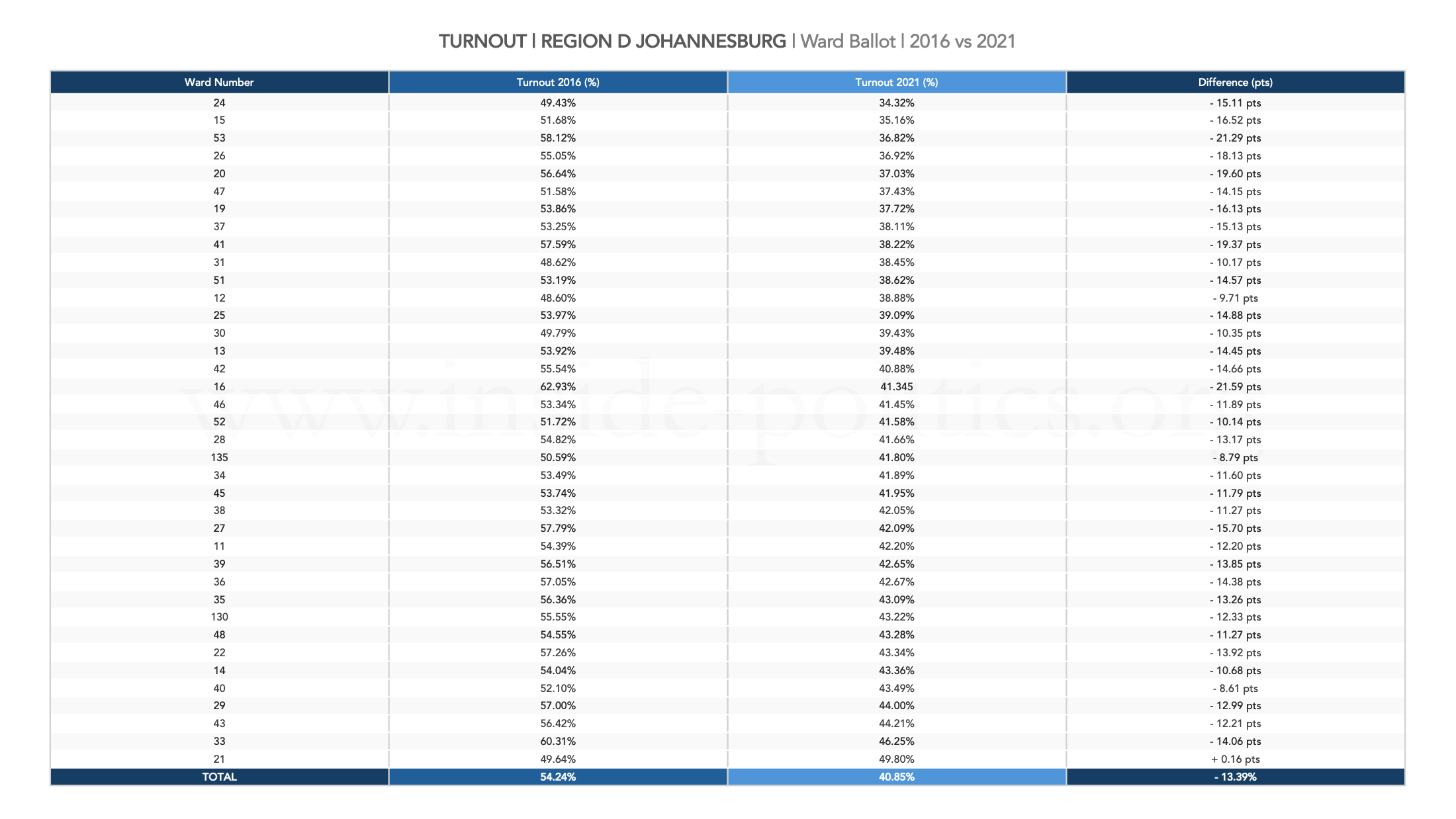
It is the extent of the drop that is remarkable. -13.39pts is a profound problem. In a couple of wards, it broke -20pts. In brutal terms: lower turnout means a smaller pool of voters, for all parties. And, given the extent of the downward trend, we must factor that into our calculations.
That said, we have everything we need for the next stage.
Where did ASA’s 2021 votes come from?
To answer this question, we need to run some regressions. Regressions are a complicated business, but they are an immensely powerful and insightful statistical tool.
I am not going to set out the details here. For those of you who are interested in this, and to prove I am not making this stuff up, you can read a summary of how this all played out here. Instead, here is a summary of the results:
1. ASA’s 2021 vote most strongly overlaps with where the EFF was strong in 2016
Across share models, vote models, combined models, forced models, turnout-adjusted models and restricted samples, the EFF variable was consistently the strongest predictor of ASA strength: the stronger the EFF was in a ward in 2016, the more likely ASA was to be strong in that same ward, in 2021.
2. ANC strength plays a role, but it is far smaller and secondary
ANC 2016 strength sometimes predicts ASA 2021 strength, but it is always weaker than the EFF effect when both are tested together. If ASA’s rise had primarily come from ANC, as opposed to the EFF (or Other Parties) it would have been the dominant predictor. It was not.
3. “Other Parties” explain very little
When I tested “Other Parties” as a possible source of ASA’s performance, the coefficients were consistently small and often insignificant. The idea that ASA mainly grew out of fragmented “Other Party” space is hard to support statistically.
4. Turnout decline mattered – especially for the ANC
Turnout change repeatedly showed statistical significance. When I focused directly on the ANC as the dependent variable, turnout and prior 2016 structure explained ANC decline more clearly than ASA strength did.
In short: The regressions do not show a dramatic one-to-one transfer from the ANC to ASA. What they consistently show is that ASA’s rise in Region D is most closely associated with what was previously strong wards for the EFF, while ANC’s decline appears more linked to turnout change and broader restructuring than to a simple direct loss to ASA.
So, the EFF is important to understanding ASA’s potential. What ASA did in 2021 was replace the EFF as the primary opposition in Soweto. In doing so, the numbers suggest it consumed a lot of the EFF’s vote share, inspired some new or returning voters to vote for it, and made inroads into the ANC vote share, but relatively less than it did into the EFF’s. But it seems to have operated primarily in the opposition vote market.
In which wards does ASA’s have the greatest potential
First things first, here are all the wards in Soweto, as of 2021, with the leading party in each ward (the ANC in every case), and the size of the gap between it and ASA.
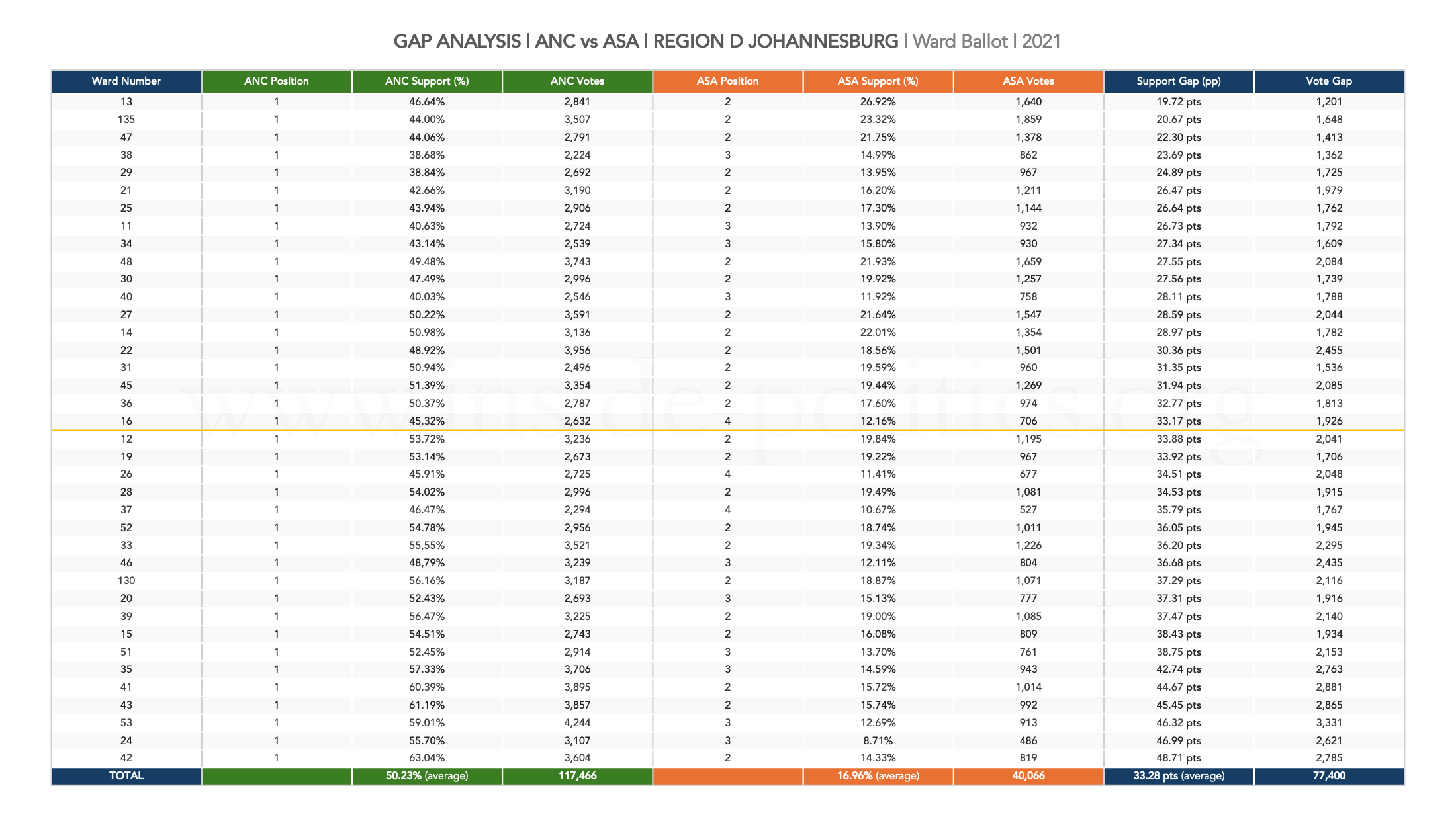
You can see it is a big ask for ASA to win 19 wards. The smallest gap between it and the ANC is 20pts. The biggest is 48pts and the average gap: 33pts. Assuming the half way point is where they meet in each case (ASA grows, ANC declines) that’s at very least a 10pts swing ASA needs, and an average of 16pt swing across the Region.
So where is that most likely? Following our regression findings, we need to find 1. Wards where the ANC lost the most support; 2. Wards where the EFF lost the most support, and 3. Wards where ASA did the best. As ASA is after 19 wards, let’s use the top 19 for each. When we have those, we can line them up against the wards with the smallest gaps between the ANC and ASA.
I have simplified them, and put them all on one page, so we can merge them.
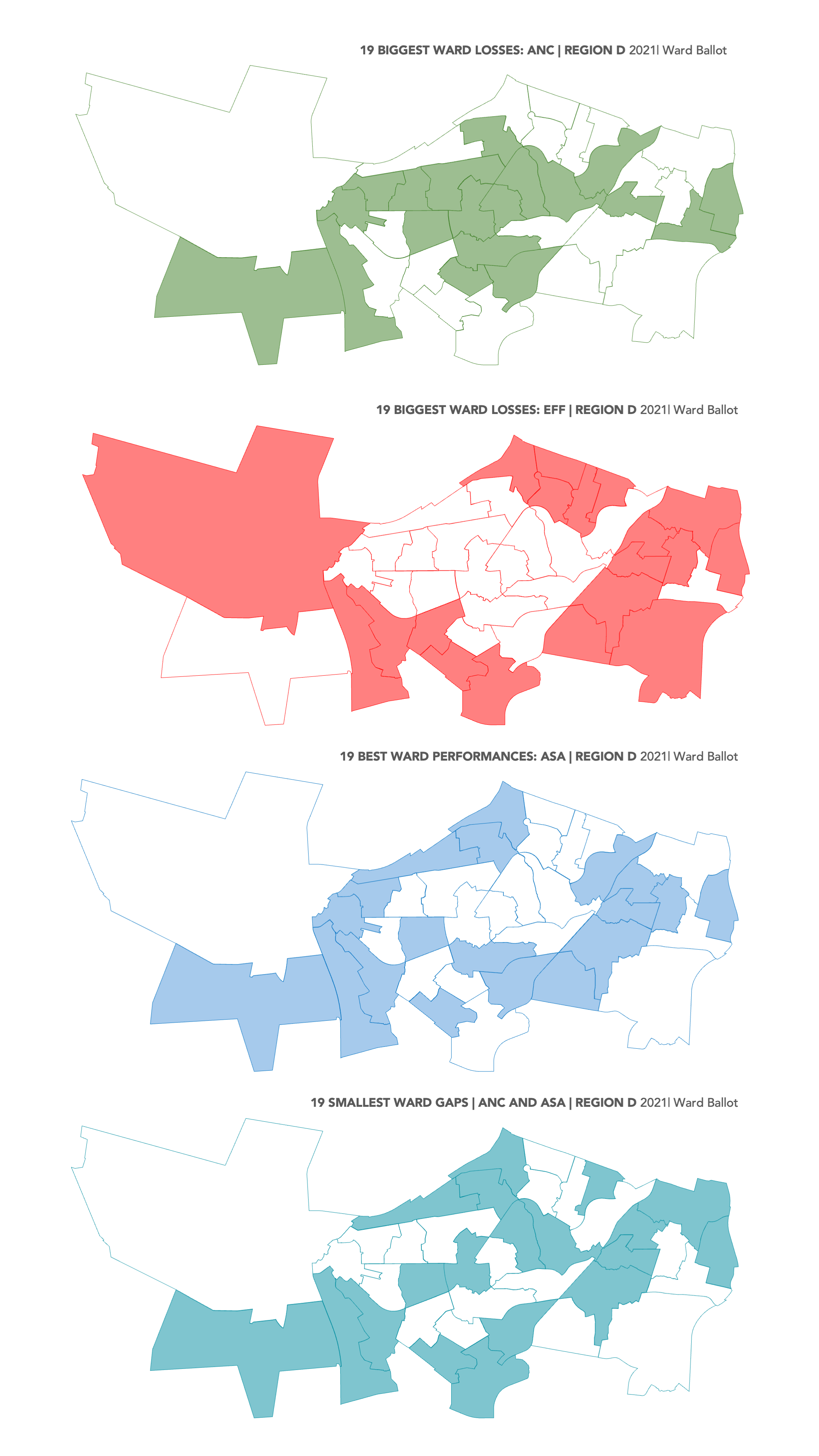
When we merge all those maps together, we get the following:
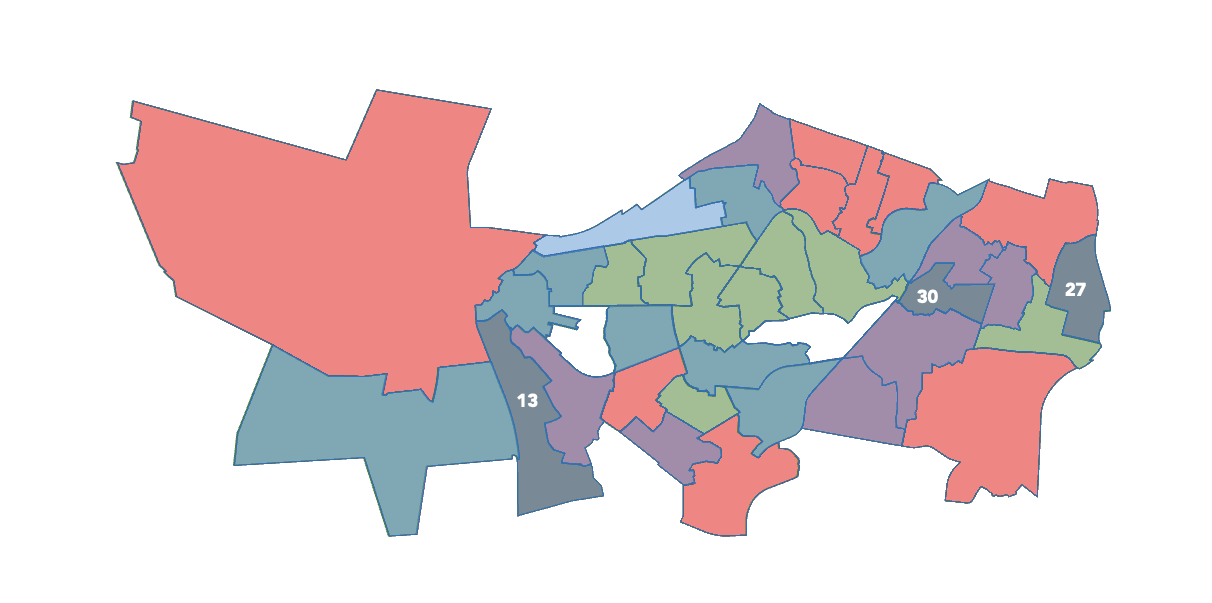
Only three wards – 13, 27 and 30 – overlap for all four maps (the same three overlap without the fourth, gap map). So there is a strong case to be made, these are three of ASA’s best prospects. But let’s be a little more thorough and approach our regression findings another way. If we assume ASA makes the most inroads in wards there is strong (EFF-led) opposition, we can also see how those overlap. So lets us swap out the EFF map for one that shows the top 19 wards where the EFF was strongest, and replace the ANC map with the 19 wards where the ANC was weakest, both for 2021.
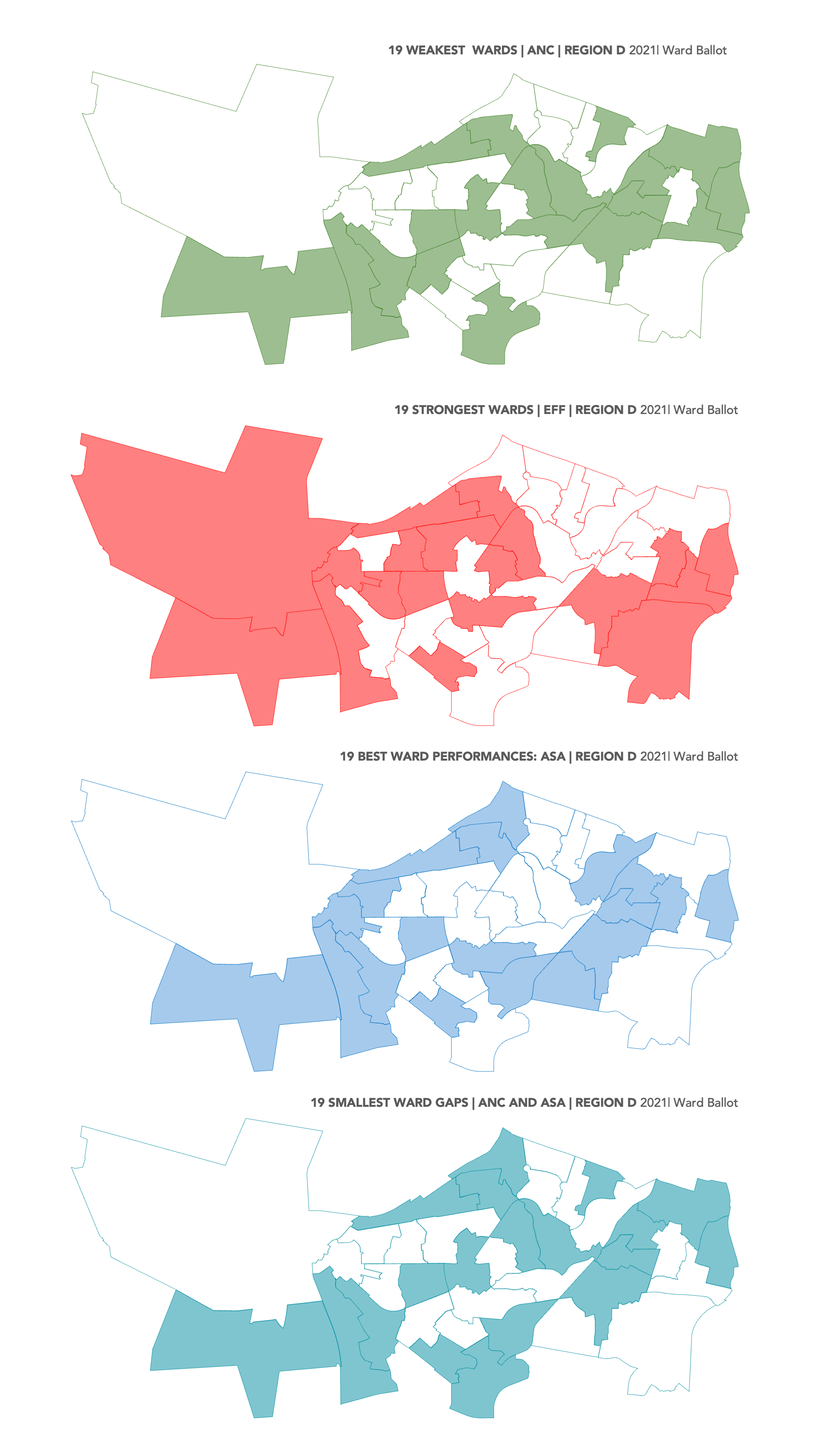
Merge those together and we get:
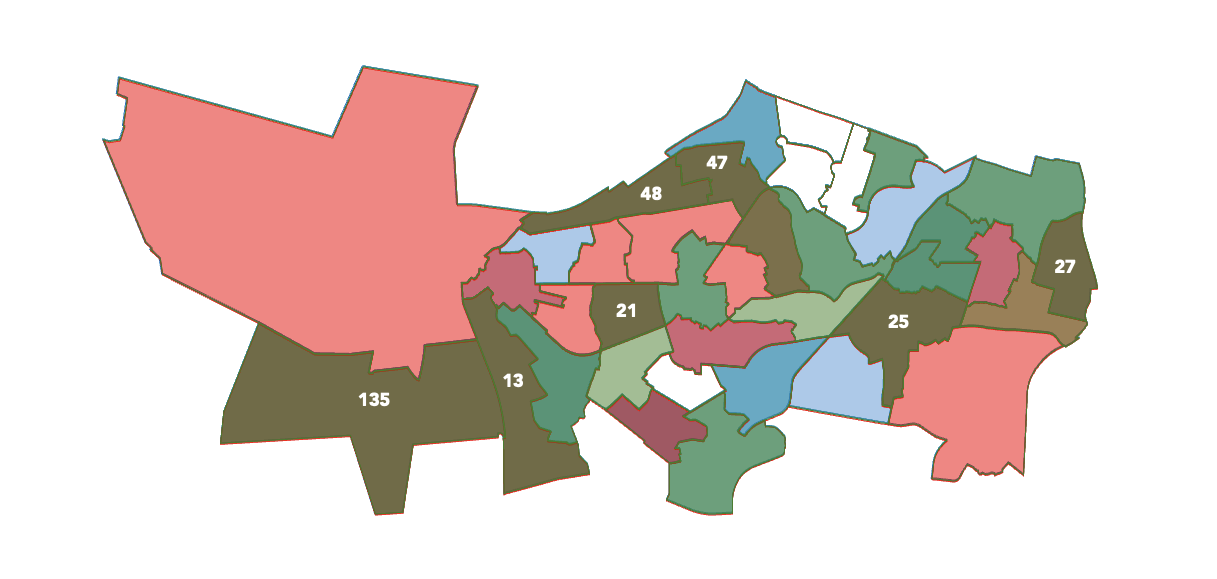
This time we have seven overlapping wards – 135, 13, 21, 48, 47, 25 and 27 (and no, that one ward that looks like a full overlap is not). These are also legitimately strong ASA potential wards, where it can feed further off the EFF, the ANC is at its weakest and ASA at its strongest. Interesting, it includes two of the same wards from the first overlap.
Conclusion: ASA’s prospects in Soweto
Here is the ANC vs ASA gap analysis with all eight wards – the wards with its highest potential for growth – highlighted:
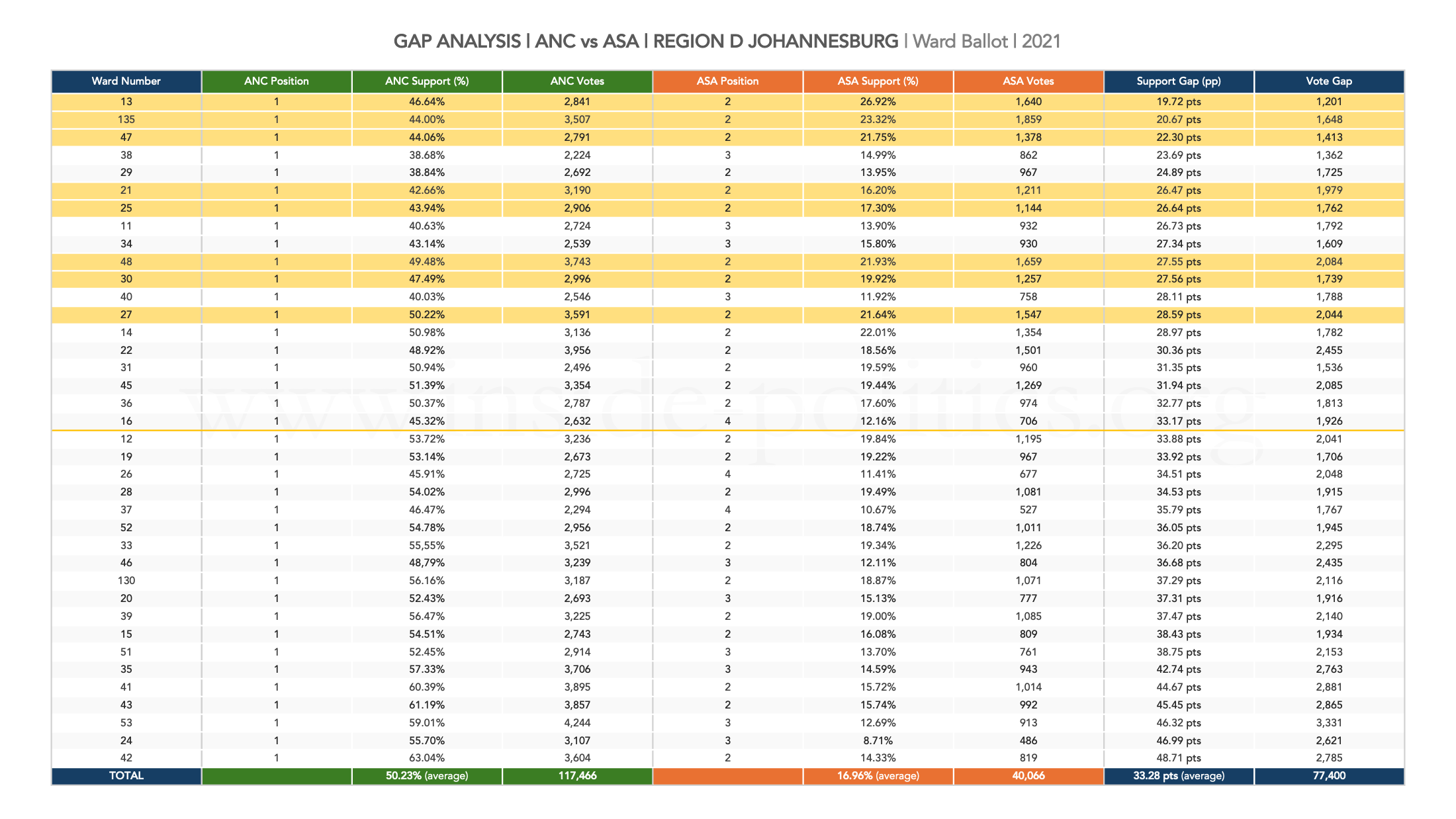
To illustrate how hard ASA’s goal is, if we take those eight wards, and double ASA’s vote count in them (leaving everything else the same – so literally just make ASA perform twice as well), in only two of them, does ASA overtake the ANC, and then only just.
It was important to do this analysis in the manner above. It allows us to identify the wards where ASA has the greatest potential for growth, as opposed to just saying: “This is where the gap between the ANC and ASA is smallest, and this is how many votes it needs to overtake the ANC”.
The reason why that would not work is captured by the following unknown factor: MK. it simply did not exist in 2021.
There has only been one by election in Soweto in recent months, in Ward 130, in September last year. ASA did well there, finishing second with 947 votes behind the ANC, with 1,426 votes. But MK got 905 votes, and wasn’t far behind ASA at all:
ANC
- Votes: 3,187 down to 1,426 (−1,761)
- %: 56.16% down to 34.13% (−22.03 pts)
ASA
- Votes: 1,071 down to 947 (−124)
- %: 18.87% up to 22.66% (+3.79 pts)
EFF
- Votes: 896 down to 721 (−175)
- %: 15.79% up to 17.25% (+1.46 pts)
It is incredibly difficult to determine what that by-election means. Among other things, both the DA and the IFP did not stand. But we do know the following: 1. Turnout went through the floor again (down to 30,9%) and, with it, 2, the ANC plummeted again; 3. MK got 20% out of nowhere. Outside of that, the fact that the EFF grew is not good for ASA.
So really, you get the sense, ASA’s prospects, indeed the prospects of all parties in Soweto, are ultimately going to come down to the ANC itself, and perhaps MK.
But, we can say the following about ASA and its 19 ward councillor mission in Soweto:
- ASA has the potential to grow most in 8 particular wards where the ANC is weak, and the gap between the two parties is relatively small. using its 2021 performance as a guide, these wards represent the most growth-rich environment for ASA. That said, even with that in mind, the gap between the ANC and ASA maybe be relatively small, but it still substantial.
- It is difficult to generate 19 wards where ASA’s potential will allow it to overtake the ANC.
- To grow, ASA needs four things: EFF voters to feed off, ANC voters to feed off (to a lesser degree), turnout to decline, exacerbating the ANC’s implosion and momentum of its own. All of these are challenges for ASA.
- The ANC must decline, significantly, for ASA to have a chance at winning any ward. Declining turnout is a double-edged sword in this respect: if it drops dramatically, it will hurt the ANC disproportionately (the evidence suggests its voters are opting out more than switching), but it will hurt ASA too. ASA needs new or returning voters to show up for it, if it is to capitalise on the ANC. The Ward 130 by-election is a good example of this: declining turnout helped the ASA grow, but its absolute votes shrank. To beat the ANC, it needs both.
- Our analysis did not show anything fundamental about ASA’s performance in 2021. There was no X factor. It seemed to boast its own independent support base and, outside of that, to have consolidated the opposition vote, supplemented by some ANC switching.
- The ward 130 by-election (admittedly our only contemporary data point), does not show any ANC switching towards ASA, to the degree it would need. Rather, as in 2021, its decline its driven by apathy and alienation.
- MK is a problem from ASA. It too, like the EFF, will compete for the opposition voter in Soweto (the most disgruntled former and current ANC voters). That space is now highly competitive: The EFF, ASA and MK. There is a strong case to be made they will all cancel each other out.
- After ASA’s dire 2024 election result, Mashaba said, “What went wrong is the MK factor. The numbers are there. When you look at every voting station, when you look at everywhere we contested, you’ll see the impact of MK on our voters. What they did, unfortunately we did not see them coming.” I am not sure that is true, we would have to test it, but, if it is, Ward 130 would suggest MK will be one of the key differences between ASA holding its own, and being able to unseat the ANC.
- We have covered the DA Soweto vote under “Other Parties”, but it is worth mentioning specifically. In 2016 the DA got 31,324 ward ballot votes (9.77%) in Soweto. In 2021 it got 9,355 (4.1%). But regression analysis – and I have run some for the DA in particular – suggest there is no meaningful relationship between ASA strength in 2021, and DA strength in 2016. So it might well be the case that, like the ANC, those DA voters simply opted out. If Helen Zille is able to replicate any of the DA-2016 enthusiasm in them, that too might damage ASA’s prospects of growth, and intensify even further competition in the opposition space.
- Finally, the 2024 election result will have hurt the momentum ASA managed in 2021. So it will be entering this election on the back-foot, as a known entity, and with a less than impressive 2024 performance behind it. This is in stark contrast to 2021, when it was unknown and exciting, and Mashaba’s brand less polluted by his personal politics.
- In summary: It is incredibly difficult to see a scenario where ASA wins 19 wards in Soweto. Even in wards where it has the best prospects of growth, the gap between it and the ANC is substantial. ASA has also consolidated a lot of the opposition vote (particularly from the EFF), and the extent to which it can continue to do that is limited. The advent of MK makes that space so much more competitive, and the EFF is not in any profound decline, like the ANC. Ultimately, ASA’s prospects are directly linked to the ANC itself. It more than ASA will control the party’s fate. Just an ounce of enthusiasm among ANC voters, and even if it only manages to just arrest the turnout decline, will make Mashaba’s outlook redundant.
- A final caveat: None of this is a prediction. Please do not treat it like that. It is an exercise in identifying the forces that have, historically, moved Soweto local politics. History is a good indicator of trends, but not a predictor of them. If you read this all in that spirit, hopefully it will provide a good frame of reference to better understanding what is and what is not realistic in Soweto, in 2026.
This essay is the 16th in an on-going series on Election 2026/7, for all other editions of this series, please click here: Election 2026/7
Discover more from inside politics
Subscribe to get the latest posts sent to your email.
 inside politics
One wonders how much of an indicator contesting by-elections is. I would suggest that they act as “flag wavers”, raising a party’s profile (much like posters-on-poles do), rally the base — both voters and activists — and, above all, indicate a party’s strength.
EFF in particular seems to contest “no-hope” by-elections.
An analysis of ASA’s by-election contestation might be interesting.
Good morning, WordPress,
Could you please change my email address from the one in the header below to the one from which this email has been sent. Thank you. Please confirm when it’s done.
Regards,
Dennis Jane.
083 701-8856