
Election 2026/7 [17] Did Unite for Change capture ANC voters in 2024?
by The Editor

A look at: 1. The performance of the UFC in 2024 (and that of its component parts), 2. Whether it achieved its objectives (of securing ANC votes and not fragmenting the opposition) and, 3. To try and establish some parameters for its prospects in 2026.
Did Unite for Change capture ANC voters in 2024?
By: Gareth van Onselen
Follow @GvanOnselen
4 March 2026
This essay is the 17th in an on-going series on Election 2026/7, for all other editions of this series, please click here: Election 2026/7
Introduction
There is an interesting experiment taking place on the fringes of the opposition electoral space. In October last year, Rise Mzansi (RM), GOOD and Build One South Africa (with Mmusi Maimane, to quote its full official title) (BOSA), announced they intend, at some point in the future, to merge under the banner: Unite for Change (UFC). They had “put aside their differences” (unstated) to “build an offering that citizens can unite around”.
That will only formally happen towards 2029. Each party will remain as it was until then, at least so far as national and provincial politics goes. But, at local level, and when it comes to the 2026 elections, all candidate councilors for each party will be selected under the UFC banner. That will be what appears on the ballot paper and, to date, the UFC has confirmed it will contest all eight metros, with mayoral candidates, and a selection of other local municipalities, to be announced later, if they can attract the right kind of people.
The UFC says its objective is to offer South Africans “a credible and consolidated alternative to the lack of real options South Africans face on the ballot paper” (Note: as of writing, there are 527 political parties registered at municipal level). The three respective leaders: Songezo Zibi, Patrica de Lille and Mmusi Maimane said in a joint statement that “the door is wide open” to anyone else interested in joining and who shares their values. No one else has walked through yet, but there is still time.
There is much to be said about the politics of the UFC itself – that is, its formation seems complex, and will require compromise and maturity internally in the face of some difficult decisions. GOOD, for example, brings 44 existing local councillors with it. It will be a tough sell to them in particular, as every candidate will be elected on merit in 2026, and that could well mean a number of them lose selection to candidates from the other two parties. At least, that is how it will be experienced, even if they are all brothers in arms now.
The UFC’s values and principles are amorphous and cliched, things like “social justice”, “the rule of law”, “ethical leadership”, “creating jobs”, “fighting corruption” and “delivering basic services”. The kind of things that everyone is on board. So it lacks any distinctive ideological or policy edge. All it is basically seems to be saying is, “we mean well”.
The focus of this essay, however, is on the electoral politics of the UFC. 2024 saw RM and BOSA (bar a failed experiment in a niche set of councils in 2021) compete for the first time. GOOD has a couple of elections under its belt but remains relatively new. It wasn’t the best election for any of them. In descending order, on the national ballot, RM finished with 0.42%, BOSA with 0.41% and GOOD with 0.18%, for a combined UFC total of 1.01%.
That would have been disappointing, even embarrassing given the hubris that proceeded Election Day. Maimane had said BOSA would “beat both MK and ANC” (sic; and, elsewhere, that BOSA would secure two million votes) and Zibi believed RM would secure, “conservatively, between five and six percent, and that’s basically the minimum” (at one point he thought 500,000 votes and 12 seats in parliament was possible). It would have been a hard reality check too because their personal brands would have been at the heart of that hyperbole.
But self-belief, or ego, is a relentless task master. Less than half a percent would be interpreted by many as time to throw in the towel. De Lille said of the UFC, however, “We’re not merging to survive – we’re uniting to build”. That remains to seen but the UFC certainly needs to deliver something significant in 2026 if that sentiment is to hold true. The bonds of political unity tend only ever to be as strong as the last electoral outcome. Maimane and de Lille will know that better than anyone.
Which brings us onto the final introductory observation. To one degree or another, all three leaders have an issue with the Democratic Alliance (DA). Maimane and de Lille have much personal animosity towards the party as a result of their own experience. Zibi has had a few political fallouts with the DA, in the run-up to 2024. But all of them believe that the DA will not solve South Africa’s problems, as it is not designed to speak to all South Africans, rather exclusively to its own racial enclave.
This is usually alluded to, or implied, sometimes said explicitly, but tends to come to the fore when the DA suggests voters should focus on the DA, and not smaller parties, which are generally structured around the ego of a singular personality, and do more damage to the DA, through fragmenting the vote, than they do the ANC (De Lille says of this, “Unite for Change isn’t adding to fragmentation; we’re reversing it”.)
All three insist this was not their purpose, and have been quite explicit about their electoral objectives. Zibi said of RM’s target market, “It is what we refer to as disaffected voters. Mostly voting for the African National Congress. In other words, it is somebody who registered, they have voted once or twice or more times in previous elections, they voted previously but very unhappily so; or they didn’t vote at all.” And Maimane has said, “I wanted to give hope to disillusioned ANC voters by saying: ‘You can vote for BOSA and know that we are here to articulate a post-liberation movement moment in South Africa’”. De Lille too, has been at pains to emphasise GOOD’s objective, to bring the alienated and apathetic back into the fold, by offering them “hope”.
It was a compelling message for donors. RM and BOSA were both exceptionally well-funded, if you consider the plight of the other 525 registered parties, most of which cannot afford to put out a tweet. But a “moderate messiah”, selling a “third way”, from Change Starts Now through to Agang, is an idea that never struggles to raise capital (in the financial or media stock markets). The historical ROI, however, tends to be a ratio on which donors do not publicly comment: ANC voters are not captured, the party inevitably competes directly in the DA’s market, and the opposition fragments.
That is because the brutal truth is that a great many disaffected ANC voters don’t want another version of the ANC. They want the ANC itself to work. And, those who do want something different, really do want something different. Not the pretence of difference. Regardless, this time around we have the UFC, and a “Leaders’ Council” at its head. So, it worth seeing: will history repeat itself, again?
With that background, let us then look at 1. The performance of the UFC in 2024 (and that of its component parts), 2. Whether it achieved its objectives (of securing ANC votes and not fragmenting the opposition) and, 3. Try to establish some parameters for its prospects in 2026.
The UFC in 2024
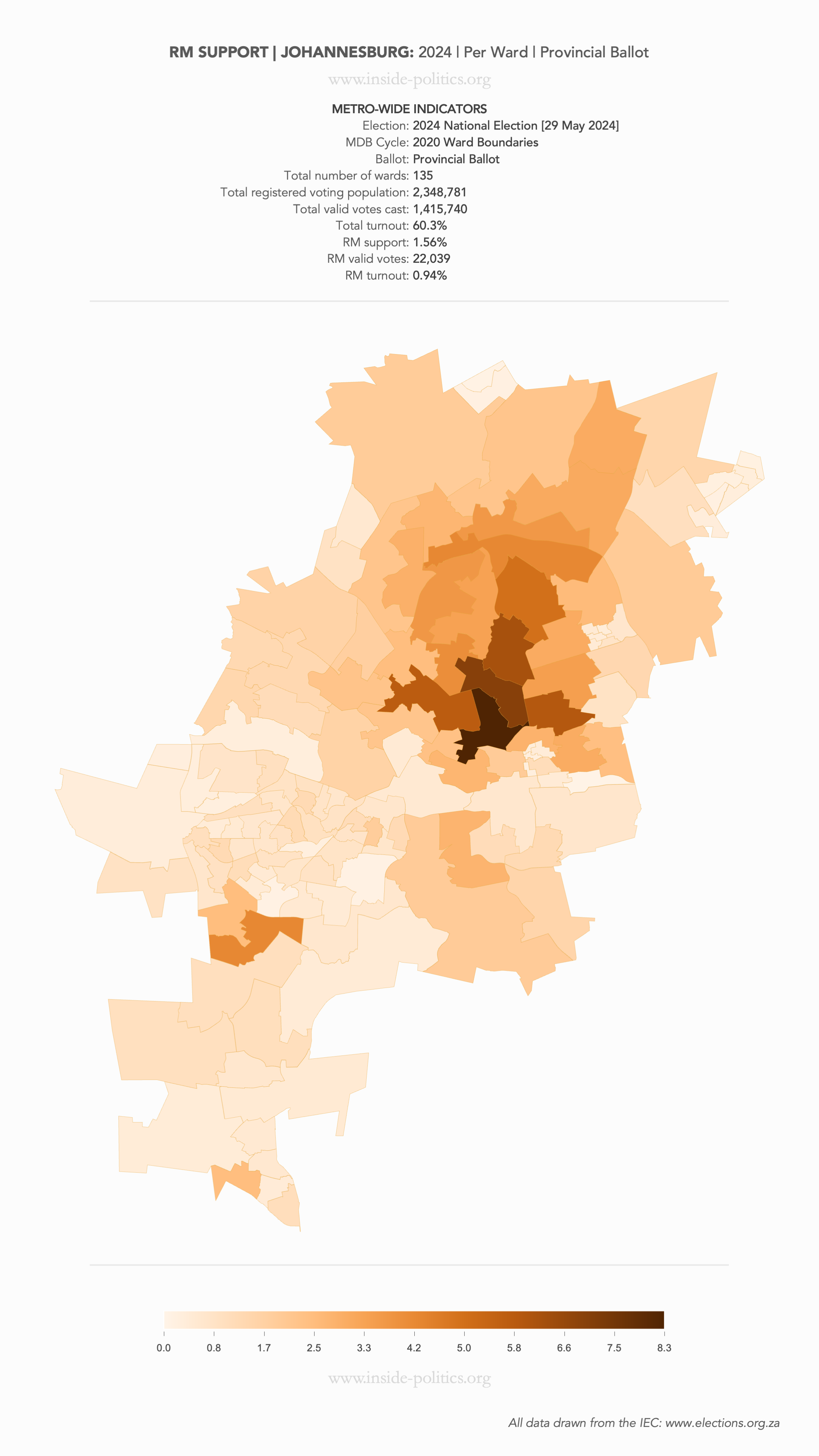
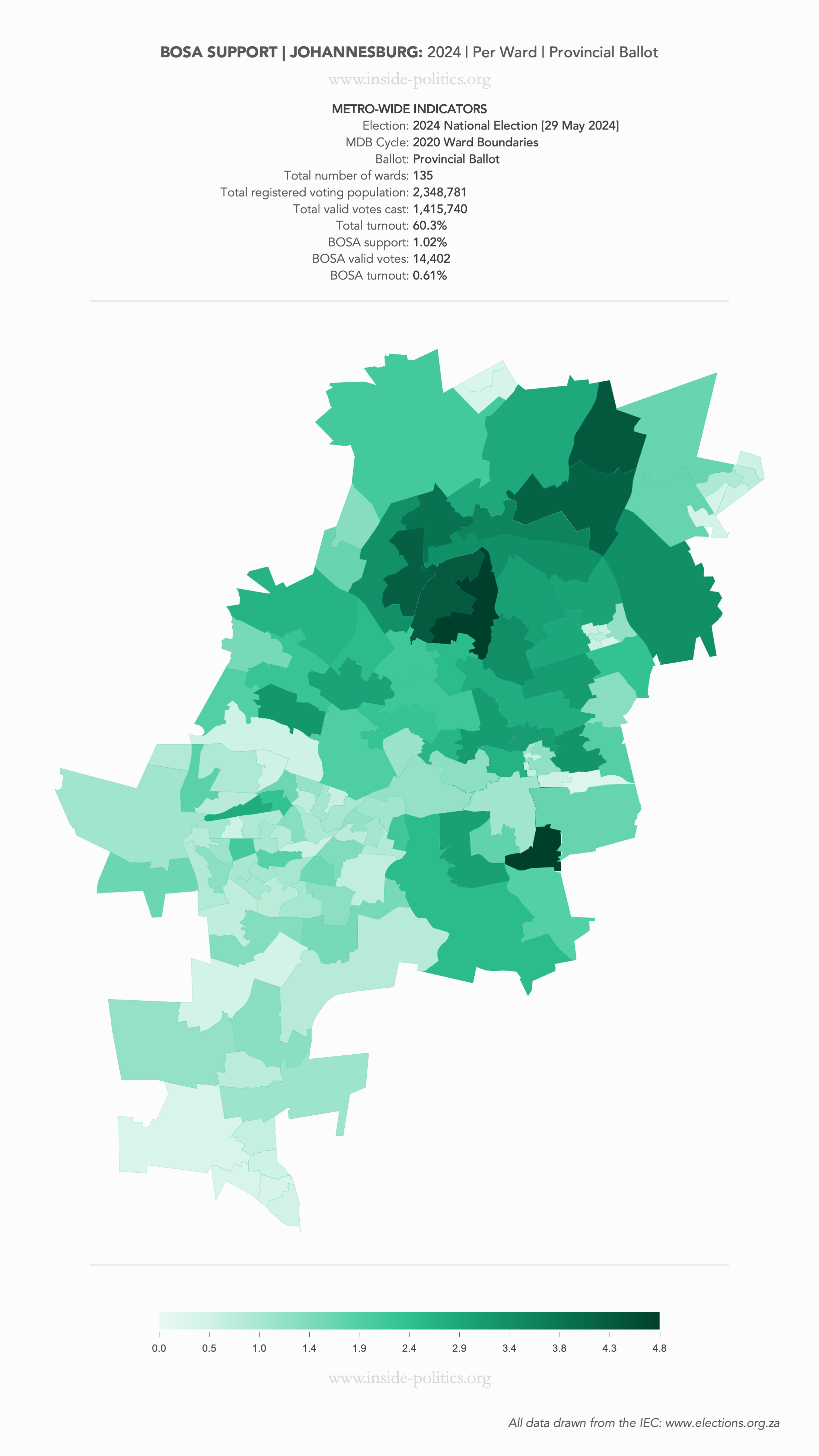
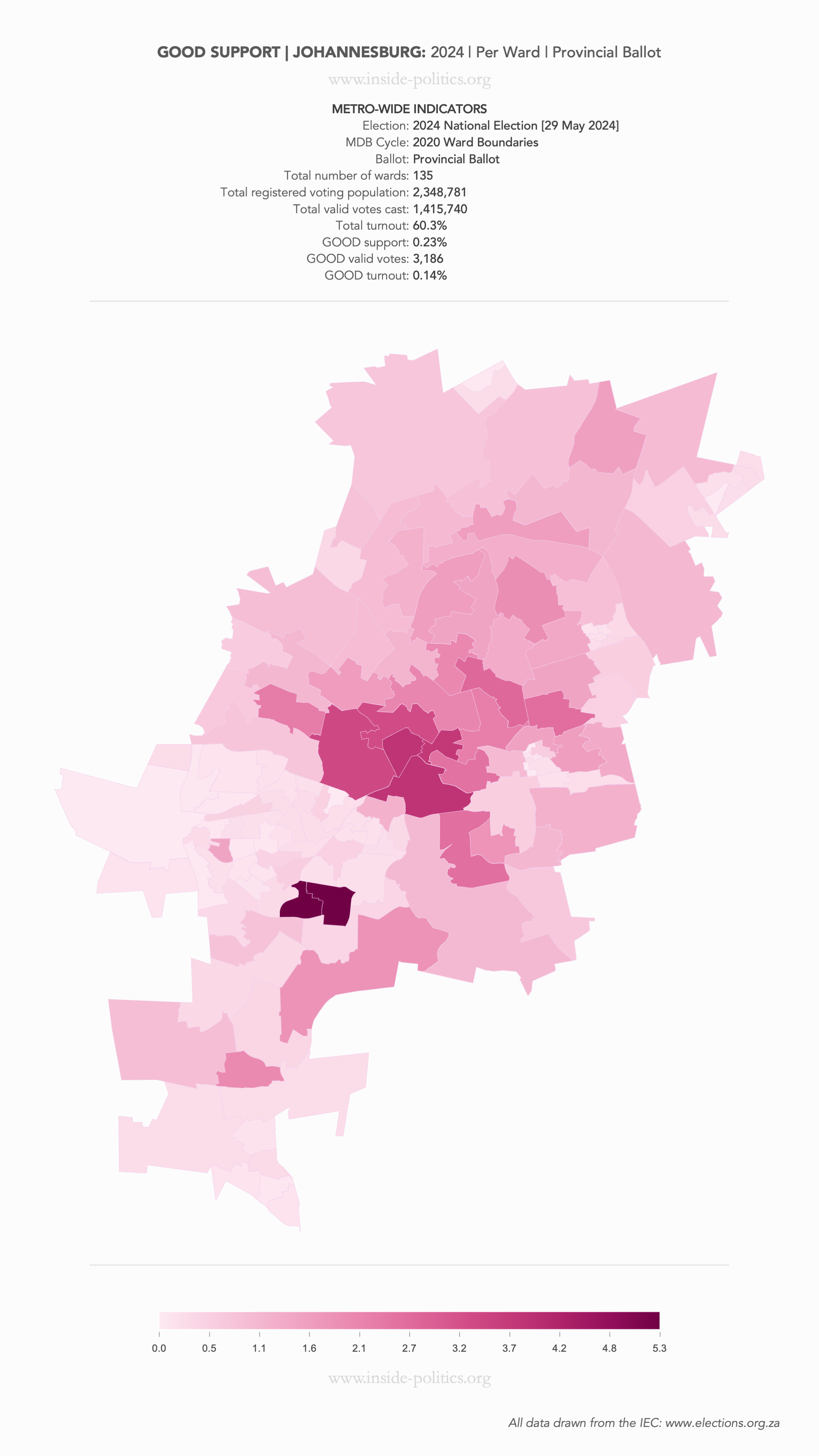
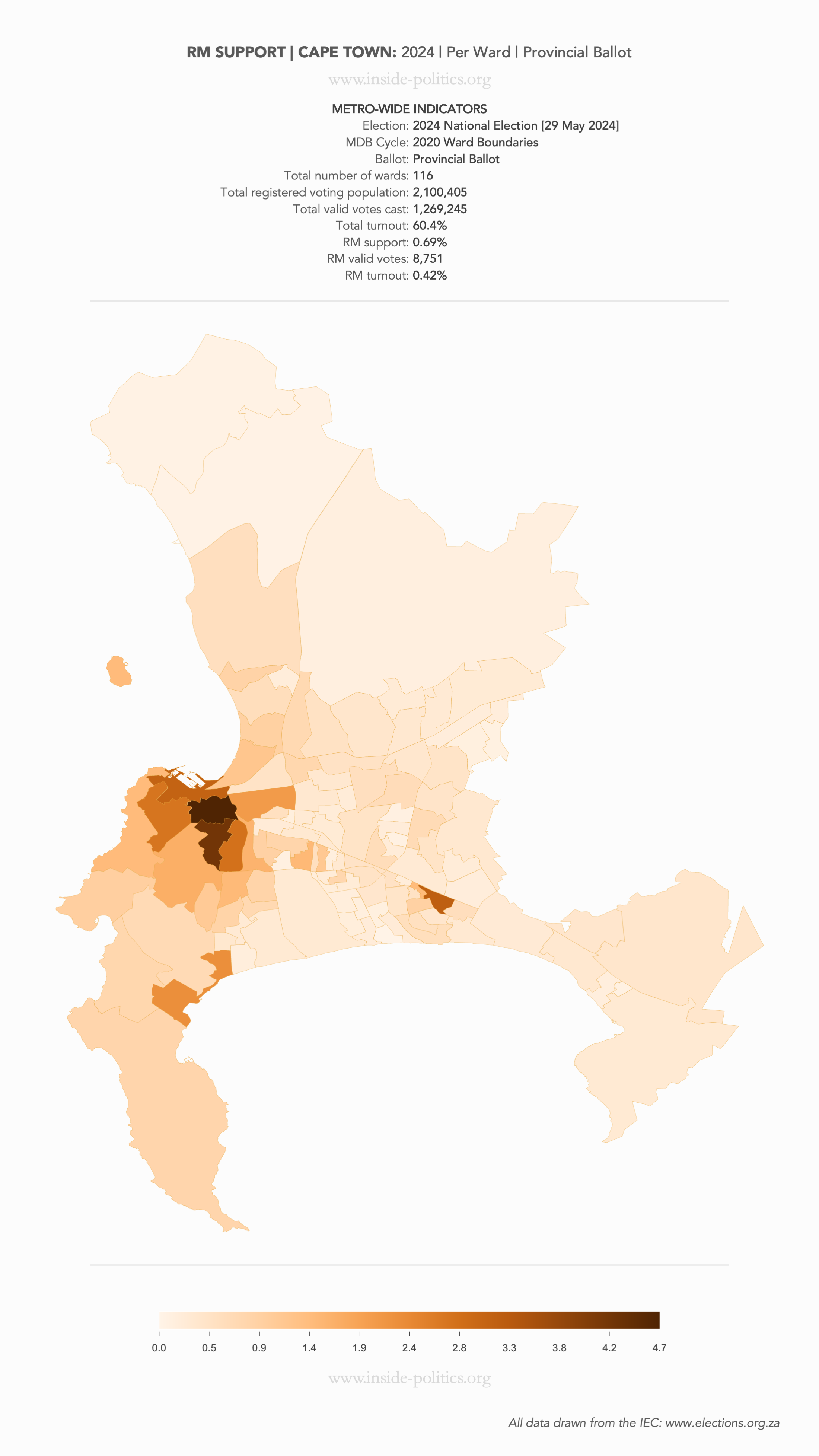
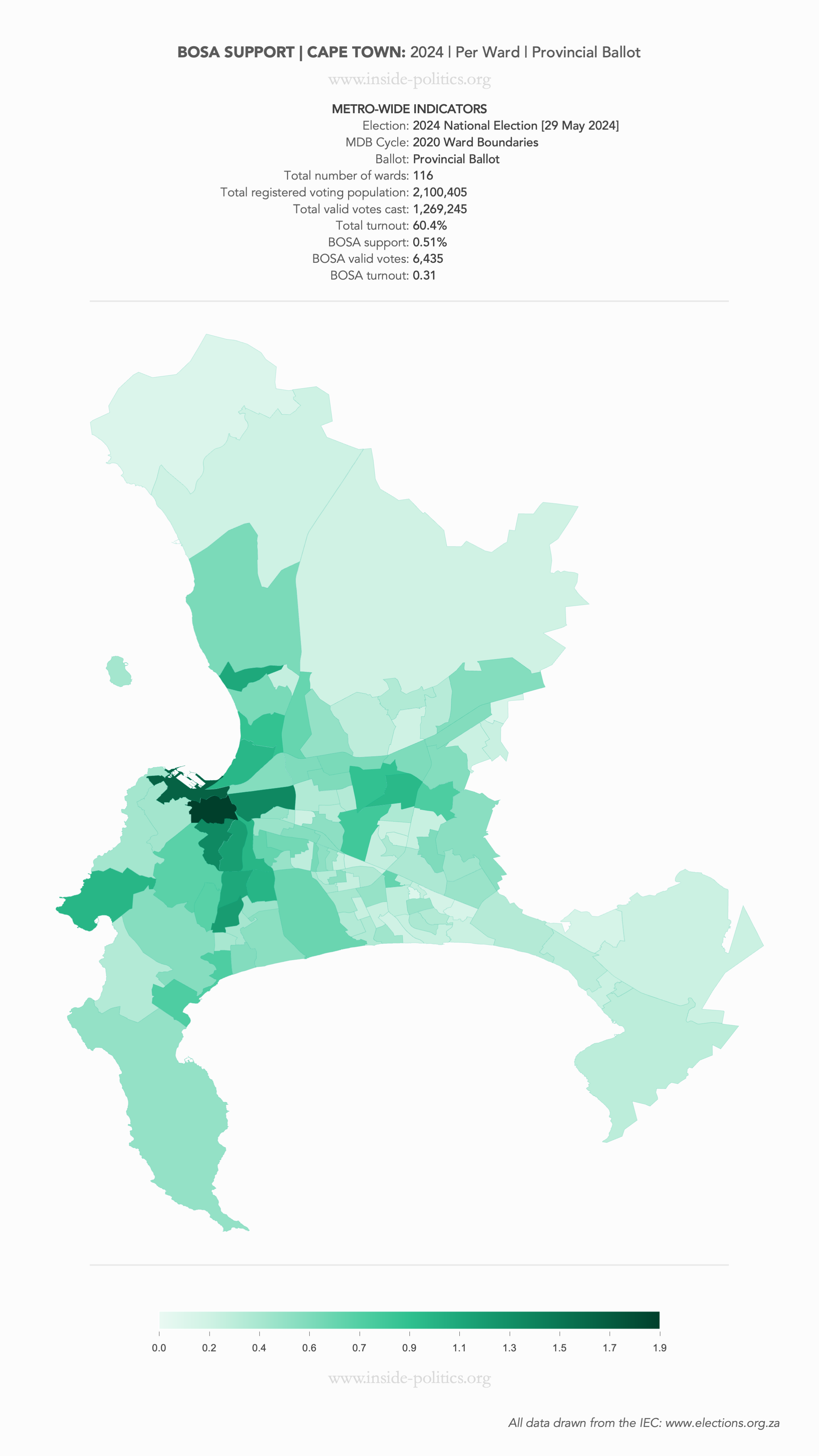
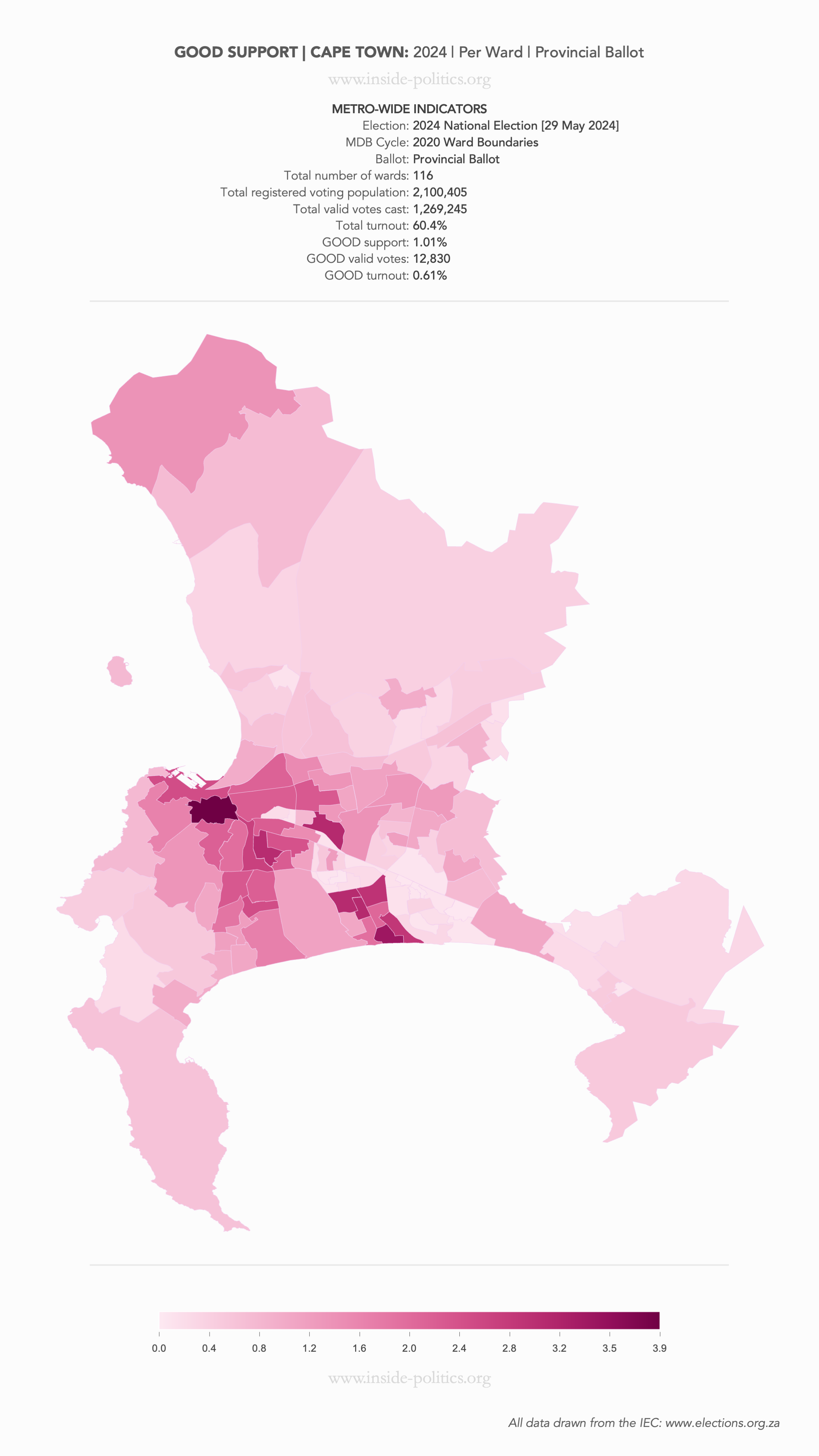
Let us start with some basic heat maps. Here are the national maps, by ward, for RM, BOSA and GOOD, followed by their combined performance as the UFC.
(Note: Because the percentages of these parties are so small, the intensity of each map is scaled to that party’s own performance, which you can see in the respective legends at the bottom of each map. So, for example, instead of going from 0% to 100%, RM’s scale goes from 0% (blank) to 8.3% (darkest, its highest percentage in any ward, in 2024). Also, we will be using the provincial ballot for all maps, as it is as close as we can get to replicating a “local vote” in 2024, and the difference between the two ballot is negligible anyway.)
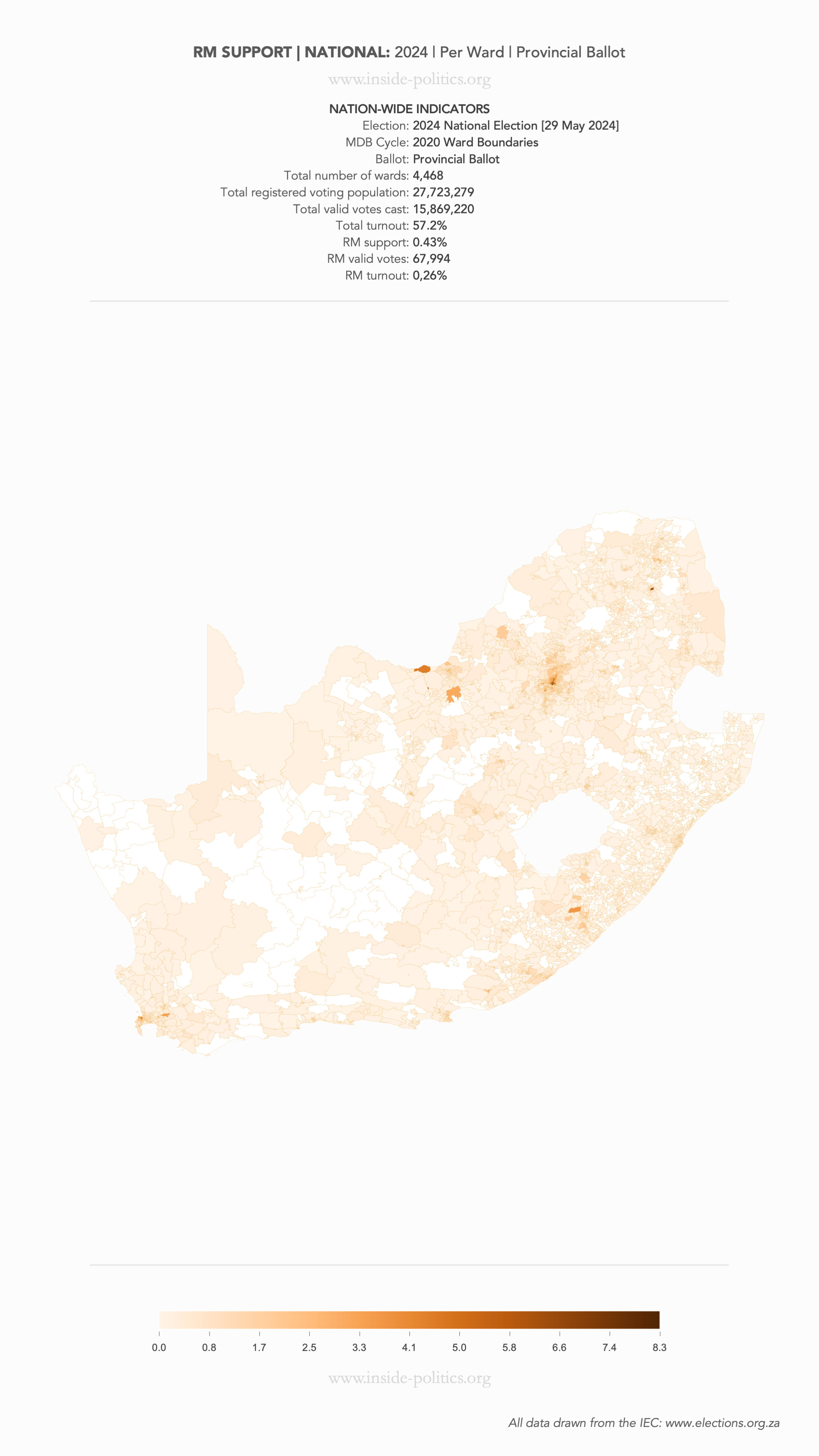
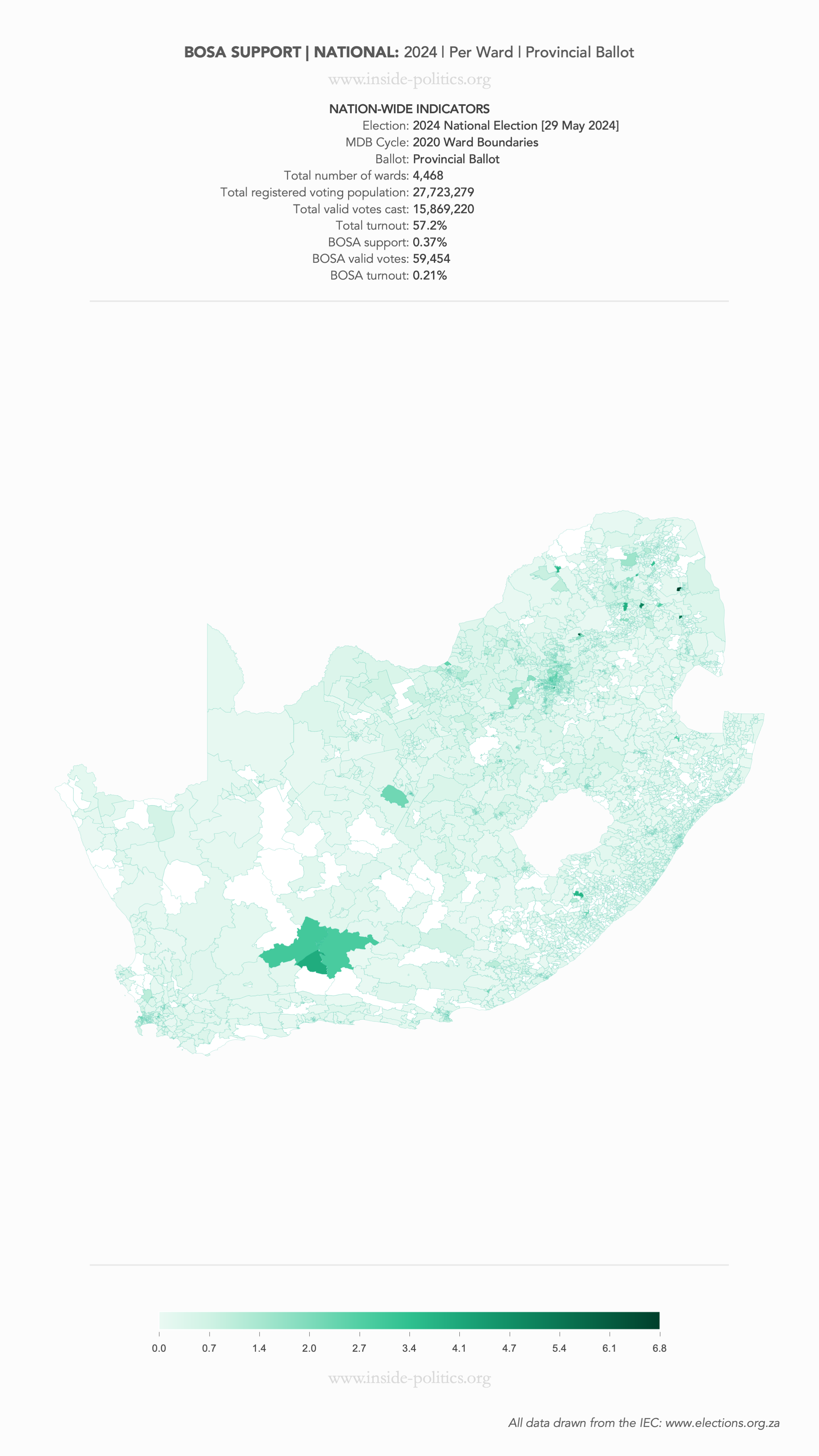
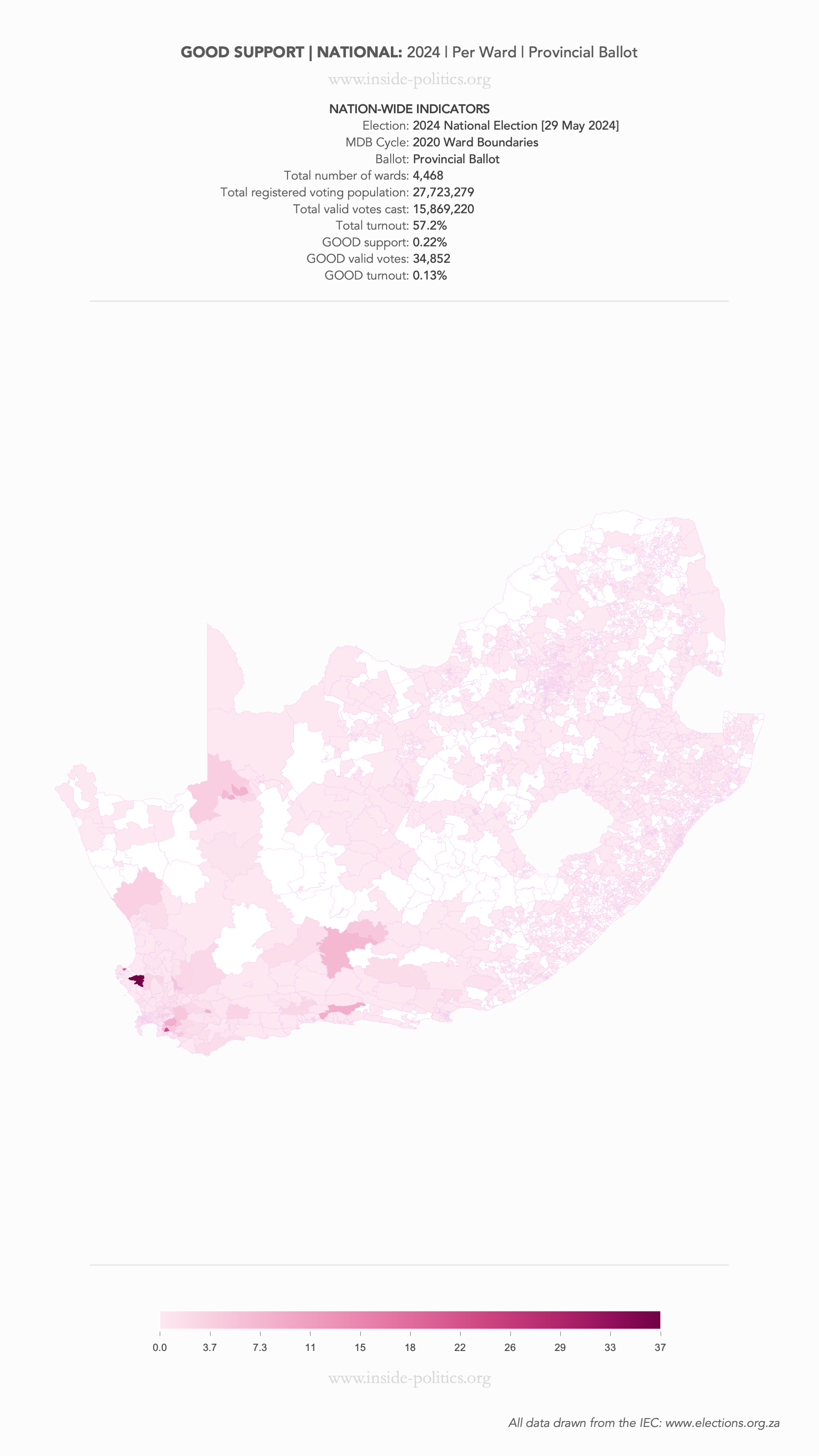
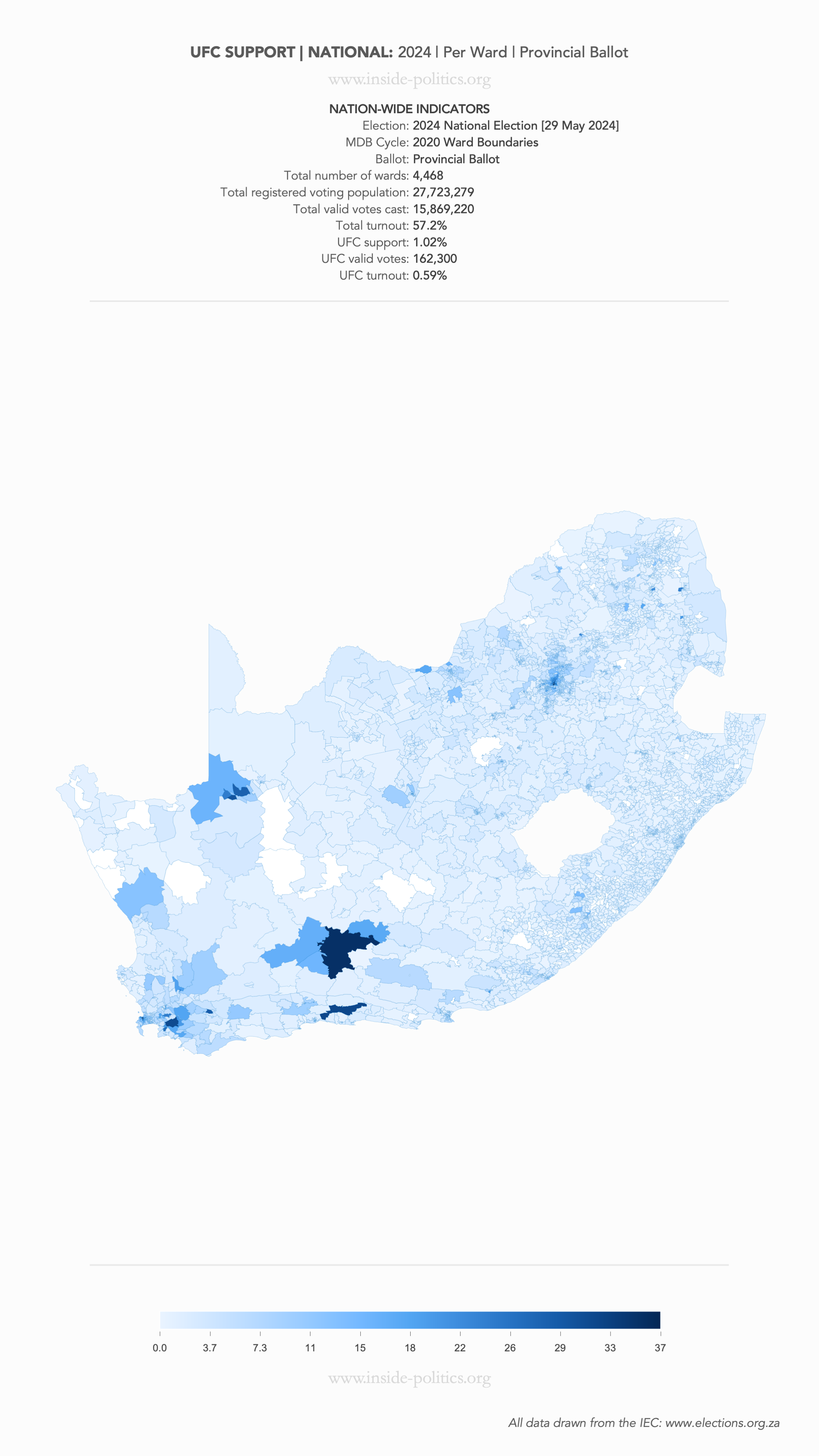
[Note: For the UFC map, I excluded GOOD’s four best wards [Ward 10104007: 36.53%; Ward: 10301010: 22.83%; Ward: 10104012: 20.63%; and Ward 10301014: 15.95%], the reason being that they are outliers, performance wise, and distort the scale. By excluding them the map actually scales from 0% to 9.53% (GOOD’s fifth best ward) and the differences pop much better. Not doing that leaves the map too light to differentiate change.)
Generally spotty performances all round but, you may notice, certainly for RM and BOSA, Gauteng in general and Johannesburg in particular are darker, as is Cape Town. This is most evident on the combined UFC map. In turn, the UFC map comes close to giving the three parties universal coverage, obviously a key consideration in its formation, given each individual party’s limited reach.
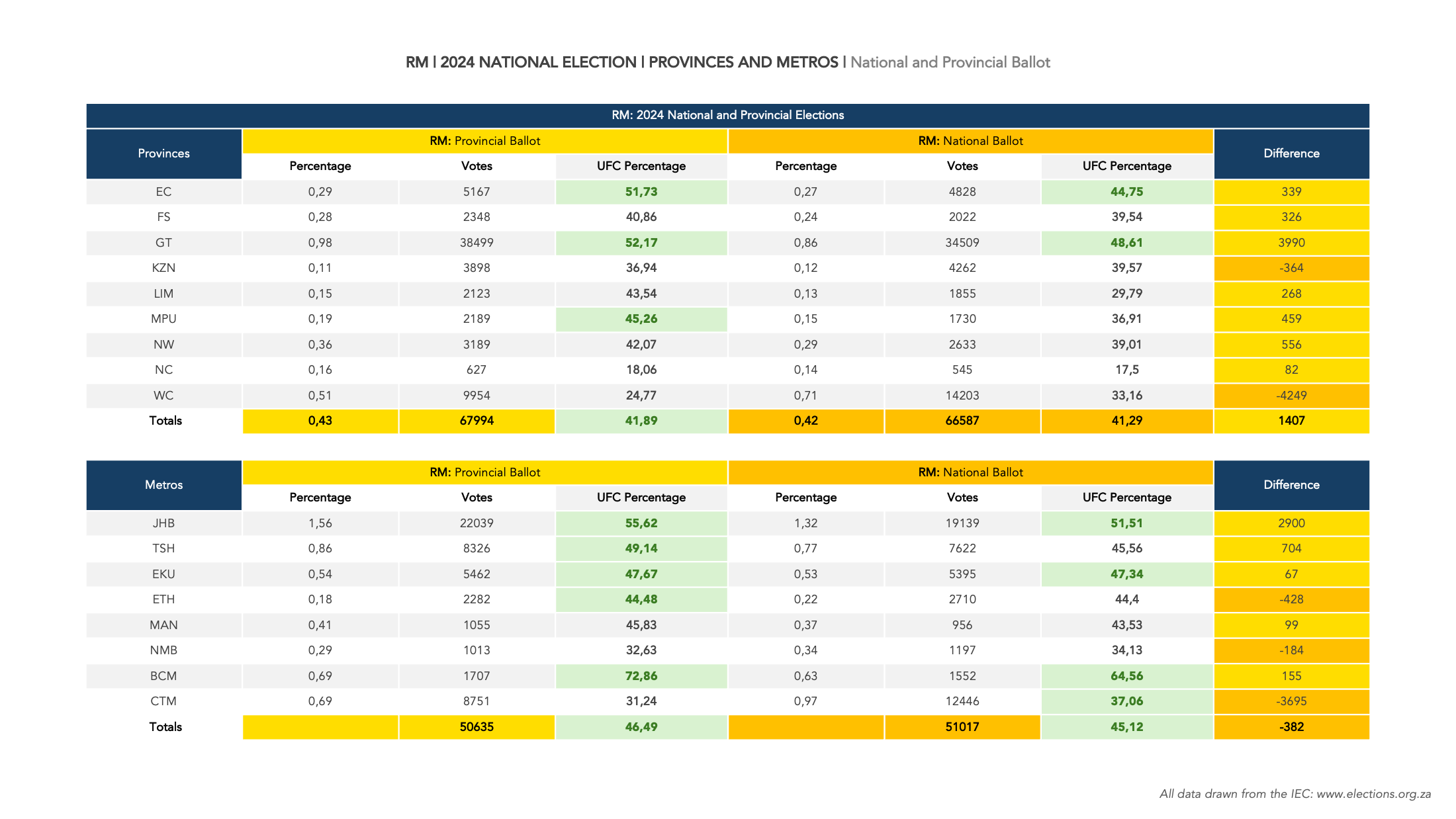
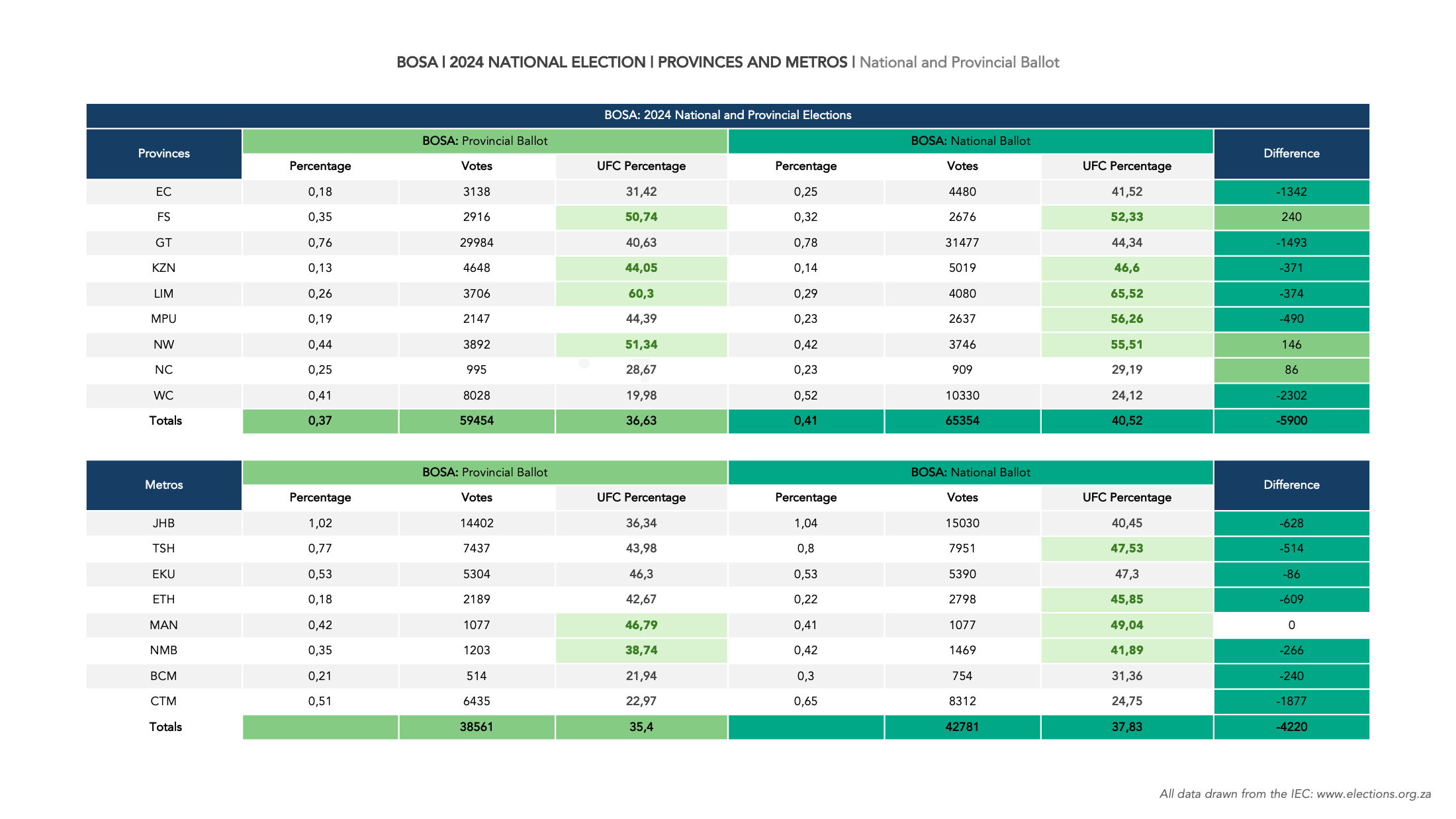
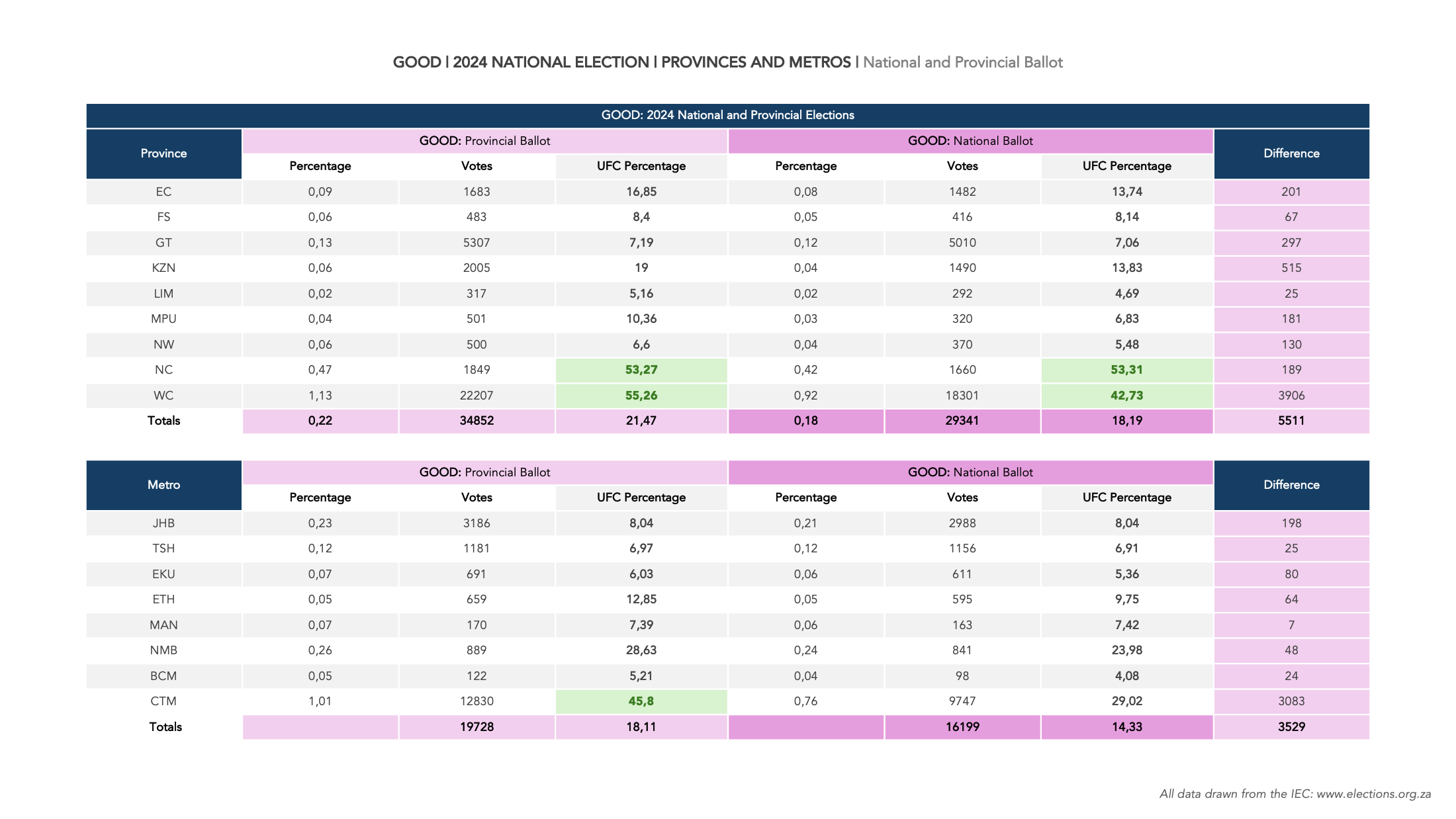
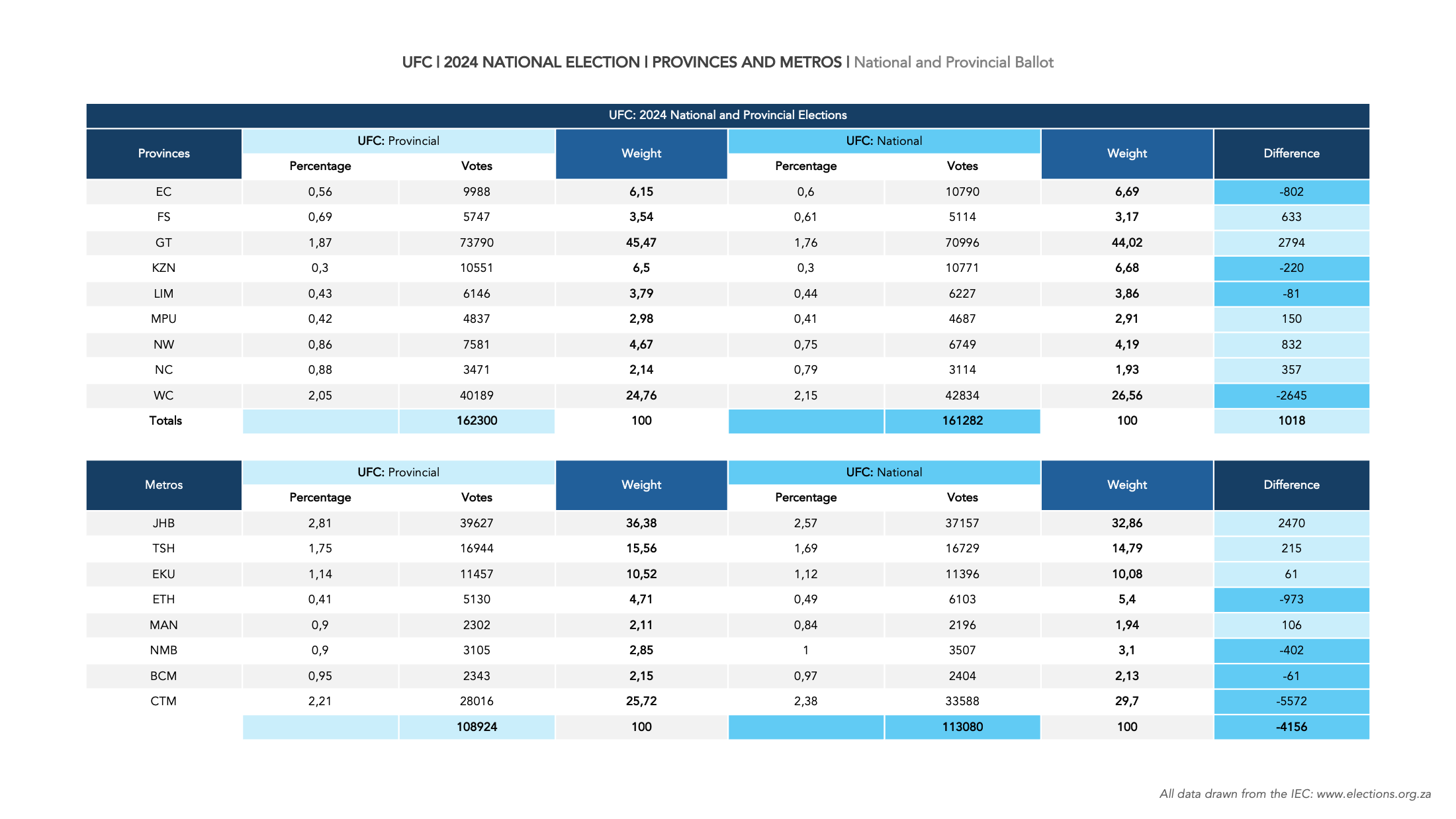
But let as look at the numbers themselves. Below are a set of tables setting out the UFC’s performance in each province and the metros (in lieu of the local government elections). Each table shows how much each party contributed to the UFC total on both the national and provincial ballot (the green blocks are where that party’s contribution was the biggest).
Let’s break those numbers into categories, in summarising what they say.
- Who contributes the most to the UFC provincially? This pattern follows the general party percentages, RM (41.9% on the provincial ballot and 41.3% on the national ballot) is the senior partner in electoral terms, contributing the most, followed by BOSA (36.6% and 44.5%), which is not far behind. Those two are clearly carrying GOOD, the contribution of which, outside the Northern and Western Cape (21.5% and 18.2%), is so minute as to make you wonder why it stands anywhere else.
- Which ballot dominates? RM and GOOD tend towards the provincial ballot, a sign of good on-the-ground campaigning and encouraging for the local government elections. BOSA, on the back of Maimane’s national reputation, tends to do better on the national ballot.
- Where are the UFC’s provincial strongholds? The biggest percentage of UFC support comes from Gauteng (45.5% and 44.0%), followed by the Western Cape (24.8% and 26.6%). Outside of those two provinces it is in single digits. And it fairs much worse in ANC strongholds.
- Where are the UFC’s metro strongholds? Perhaps the most important insight – the UFC is overwhelmingly an urban party. The metros constitute 67.1% of all UFC support on the provincial ballot and 70.1% on the national ballot. Within the metros, as with the provinces, Gauteng and Western Cape dominate. Johannesburg (36.4% and 32.9%), Tshwane (15.6% and 14.8%) and Cape Town (25.7% and 29.7%) deliver the most metro votes for the UFC. Johannesburg+Tshwane+Ekurhuleni deliver 62.5% of all UFC metro support. In JHB the UFC even manages to break the 2% threshold, with a combined support level of 2.8%, which could be all important in 2026, if the party can replicate it. In ANC strongholds, like Mangaung and Buffalo City, the party’s support is far lower.
- Is the UFC’s Gauteng and Western Cape, Johannesburg and Cape Town support disproportionately high? To answer this, we need a new tables, that compares the UFC’s weightings to the total valid vote count, and the number of registered votes.
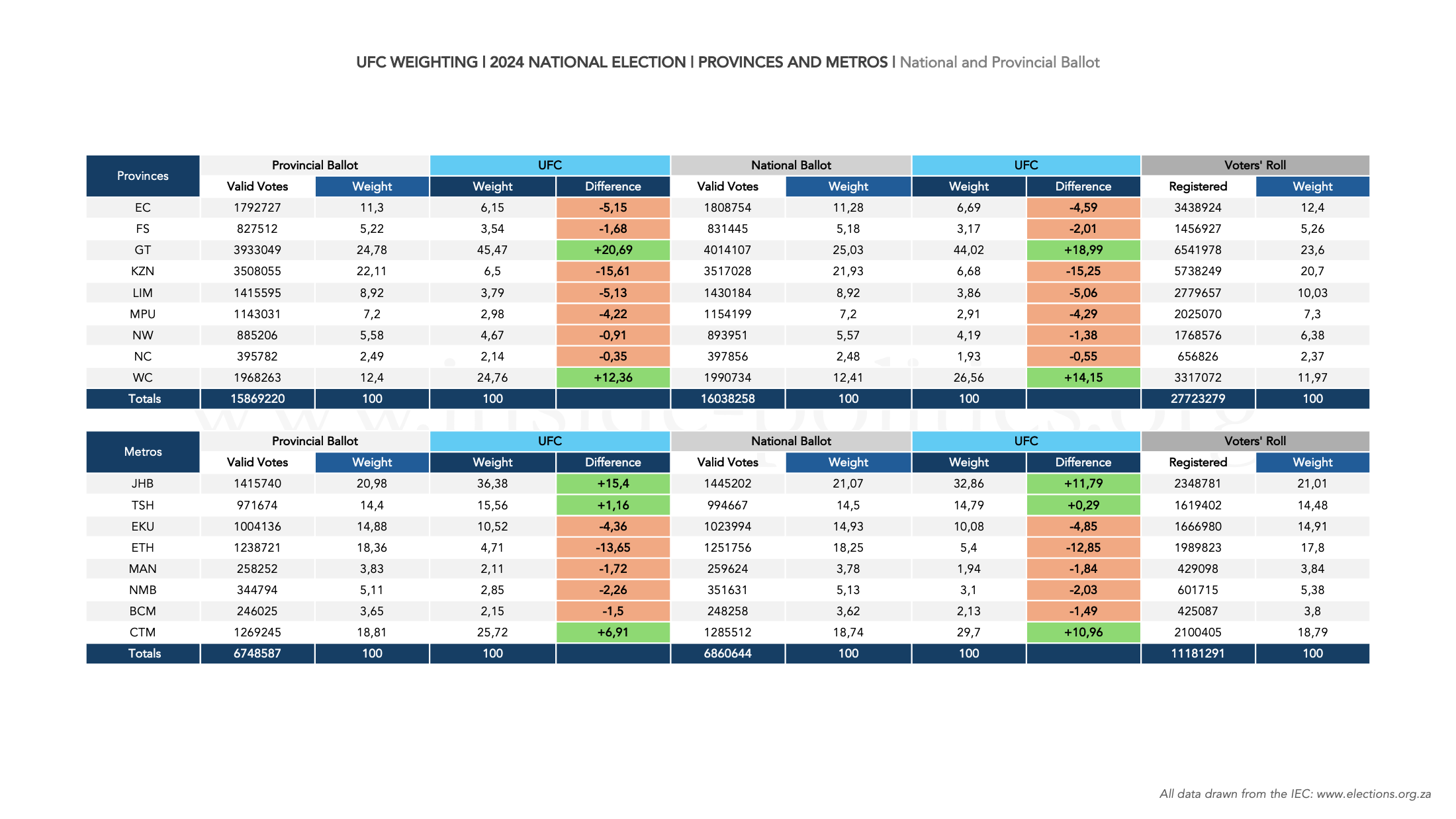
The UFC’s performance in Gauteng (20.7pts higher than the valid votes average on the provincial ballot, 19pts higher on the national ballot), the Western Cape (+12.4pts and +14.2pts), as well as in their respective metros (Johannesburg +15.4pts and +11.8pts and Cape Town, +6.9 and +11pts), is indeed disproportionately high.
In KwaZulu-Natal (-15.6pts and 15.2pts) and eThekwini (-13.6pts and -12.9pts) the party is grossly underrepresented compared to the average, and while it might look like it is closer in the other provinces, bear in mind their proportion is smaller too. So, for example, while it is 5.2pts below in the Eastern Cape, the Eastern Cape as a whole only comprises 11.3% of all votes cast; so, actually, it is under-represented by around 50% there.
The party’s reliance on the metros is also disproportionately high. On the provincial ballot, the metros only constitute 42.5% of all votes, on the national ballot, 42.8%. As you will recall, for the UFC, the figures are 67.1% (+24.6%) and 70.1% (+27.3%) respectively. This is by no means a party of the rural expanse.
The problem with these kinds of splits for any party, is that they become a vicious circle: You recognise you are disproportionately strong in two particular areas, you thus pour a disproportionate amount of resources into those areas, at the expense of others, and so you re-enforce your regional character. It is exactly what has happened to Action South Africa. As Zibi put it in a recent interview, “The advantage that we now have, which was a disadvantage then, we had no idea where our voters are, nobody had voted for us before… so we were a bit shooting in the dark – all new political parties do that – now, we know.”
It’s an odd statement in some respects. Given his target voter profile, his potential voters weren’t exactly hiding. Most of them are exactly where they were last time. What he really means is, he knows where the actual votes are now, and that is something else that entirely.
Given the UFC’s 2024 results, it is highly unlikely to focus on ANC stronghold provinces in 2026, where it performed badly in 2024, but focus rather on Gauteng and the Western Cape, where its potential for growth seems best. So, let us turn our attention to Johannesburg and Cape Town, and have a look at who these UFC voters are, exactly.
Johannesburg and Cape Town
Let’s start with Johannesburg. I am not going to upload the individual party heat maps here, only the UFC’s combined and scaled heat map. [If you want to see each individual party’s map, see here: RM, BOSA, GOOD – the pattern is the same for all of them].
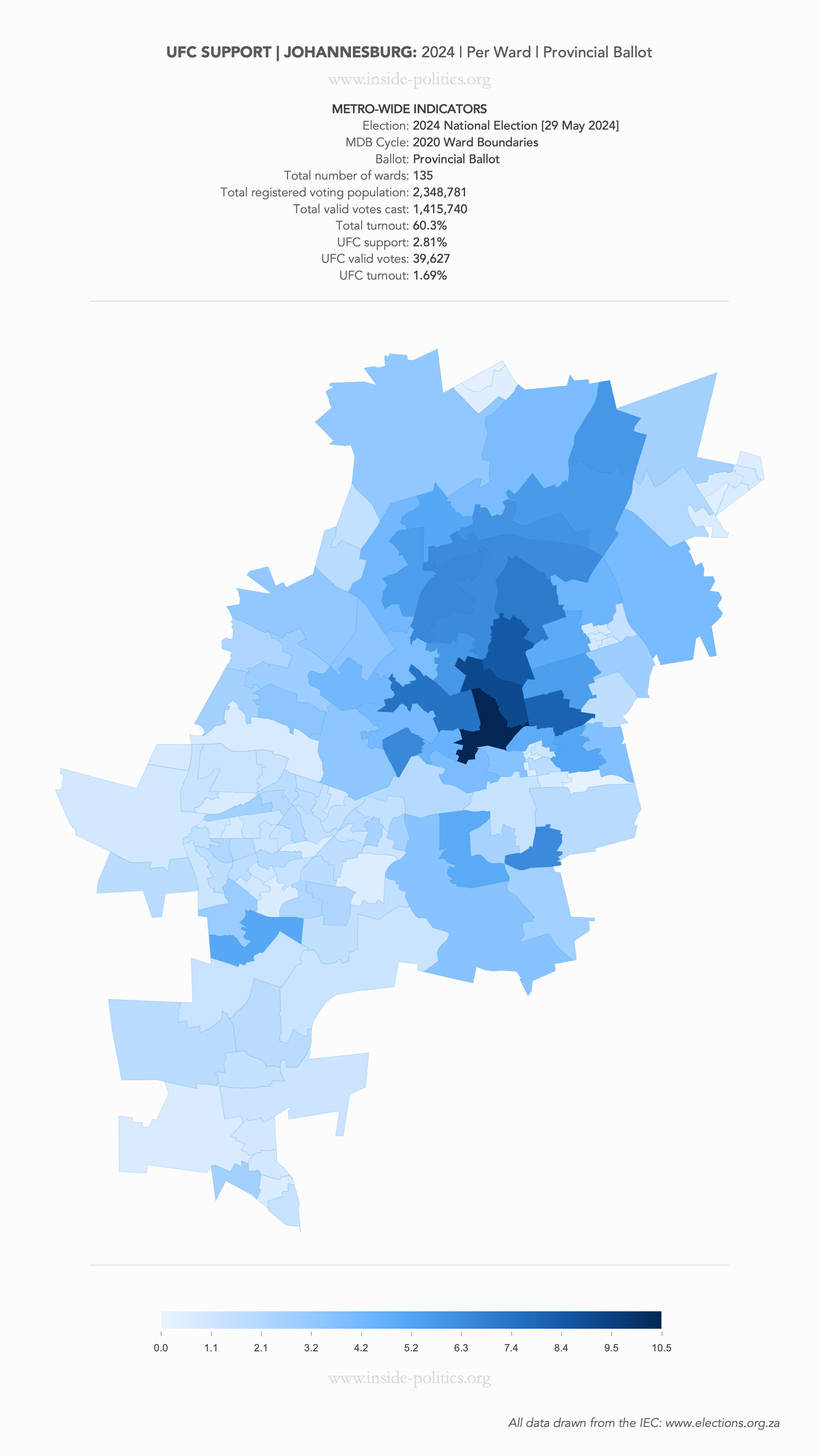
As you can see, the UFC is far stronger in the North, than it is in the South (and remember, these maps are scaled, in this case 0-10.5%; for a ward to be light here, is as close to 0% as one gets). So, are these ANC or DA voters? The best and most obvious way to answer that, is visually. Here are the ANC and DA maps (not scaled, 0%-100%) for 2024, with their respective strongholds circled.
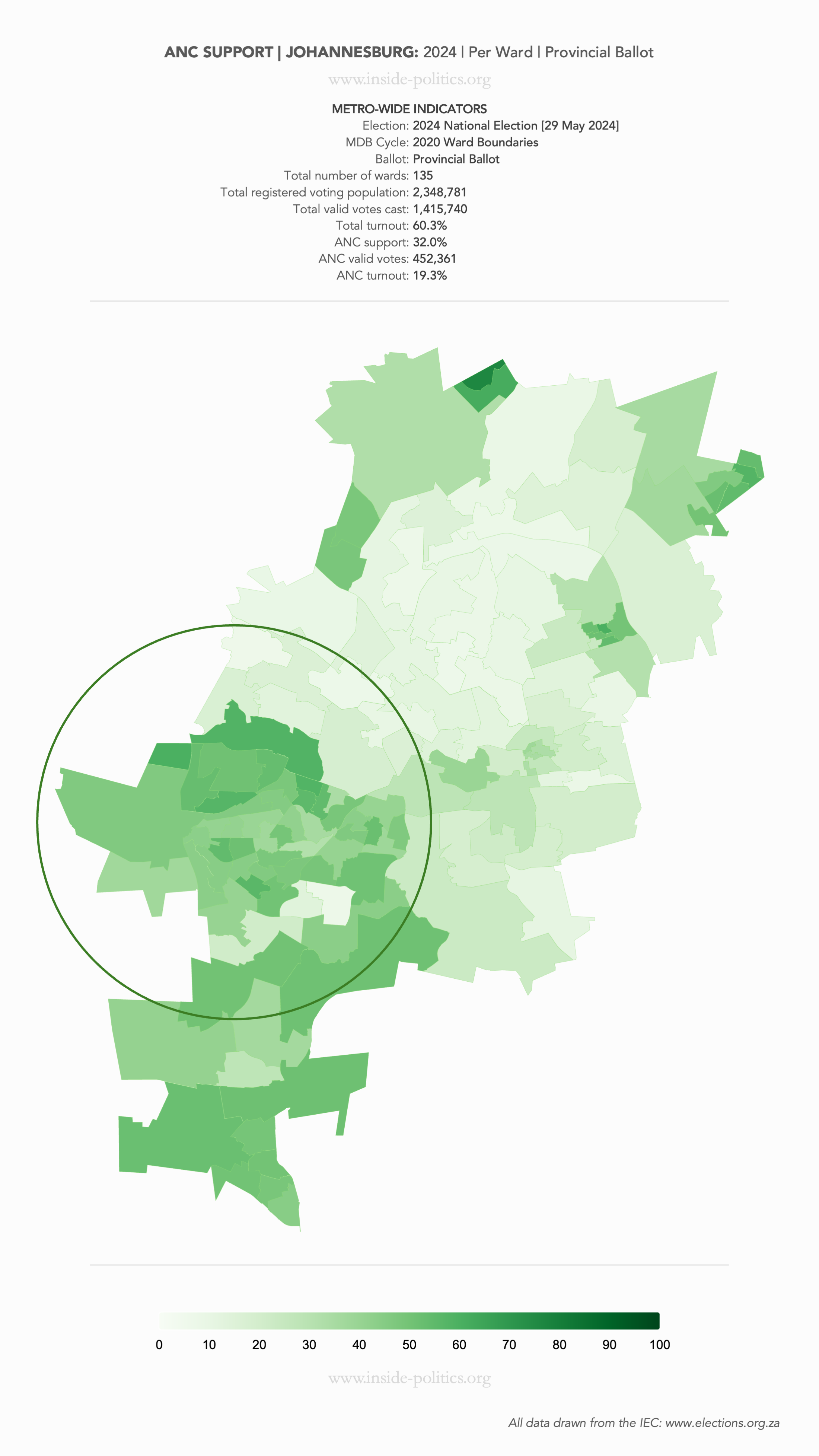
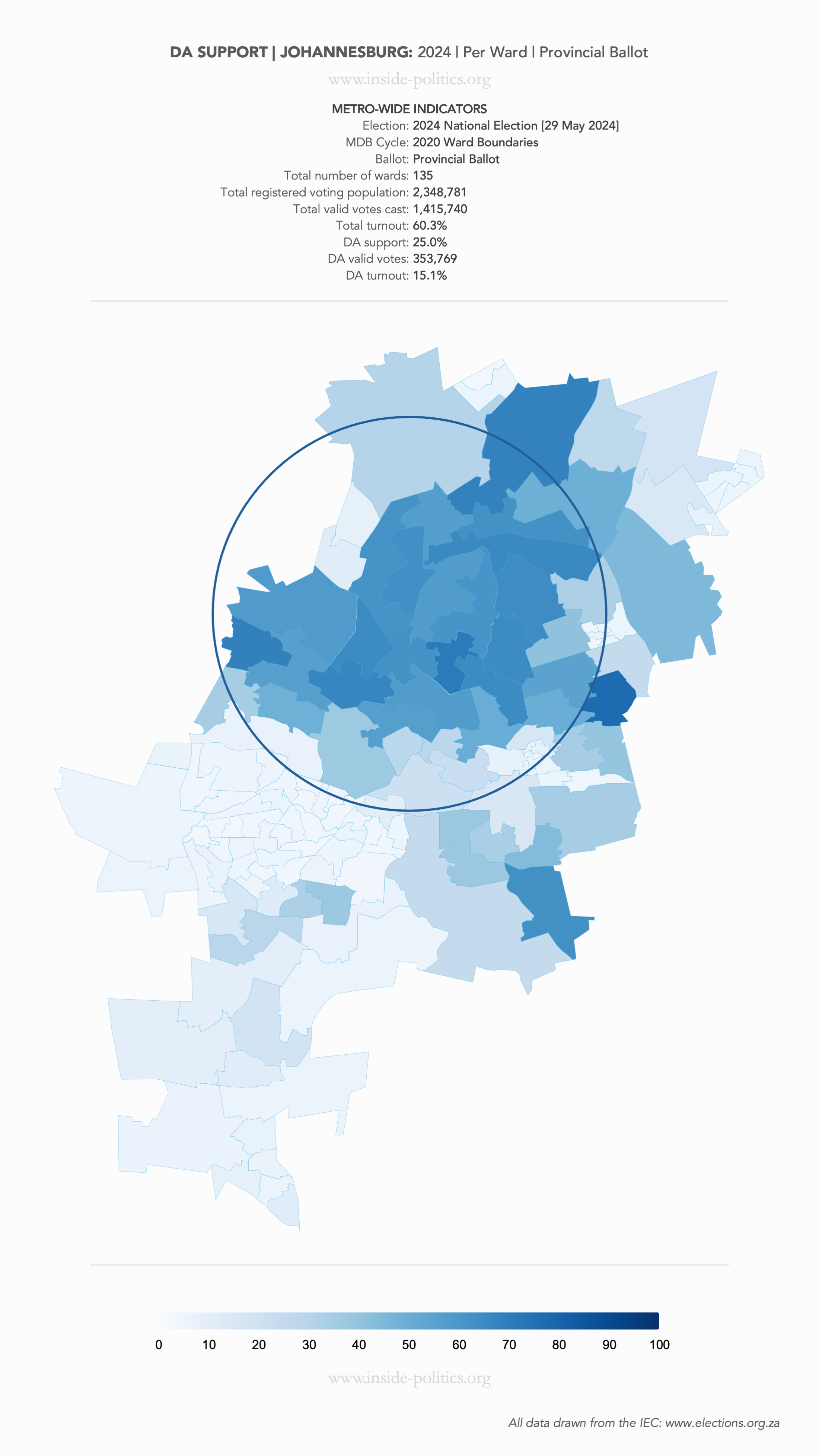
In Johannesburg, the UFC is unequivocally strongest in DA wards, and unequivocally weak in ANC wards. How strong and weak? Well, here are the DA’s and ANC’s top twenty wards each, and the UFC’s performance in each of them.
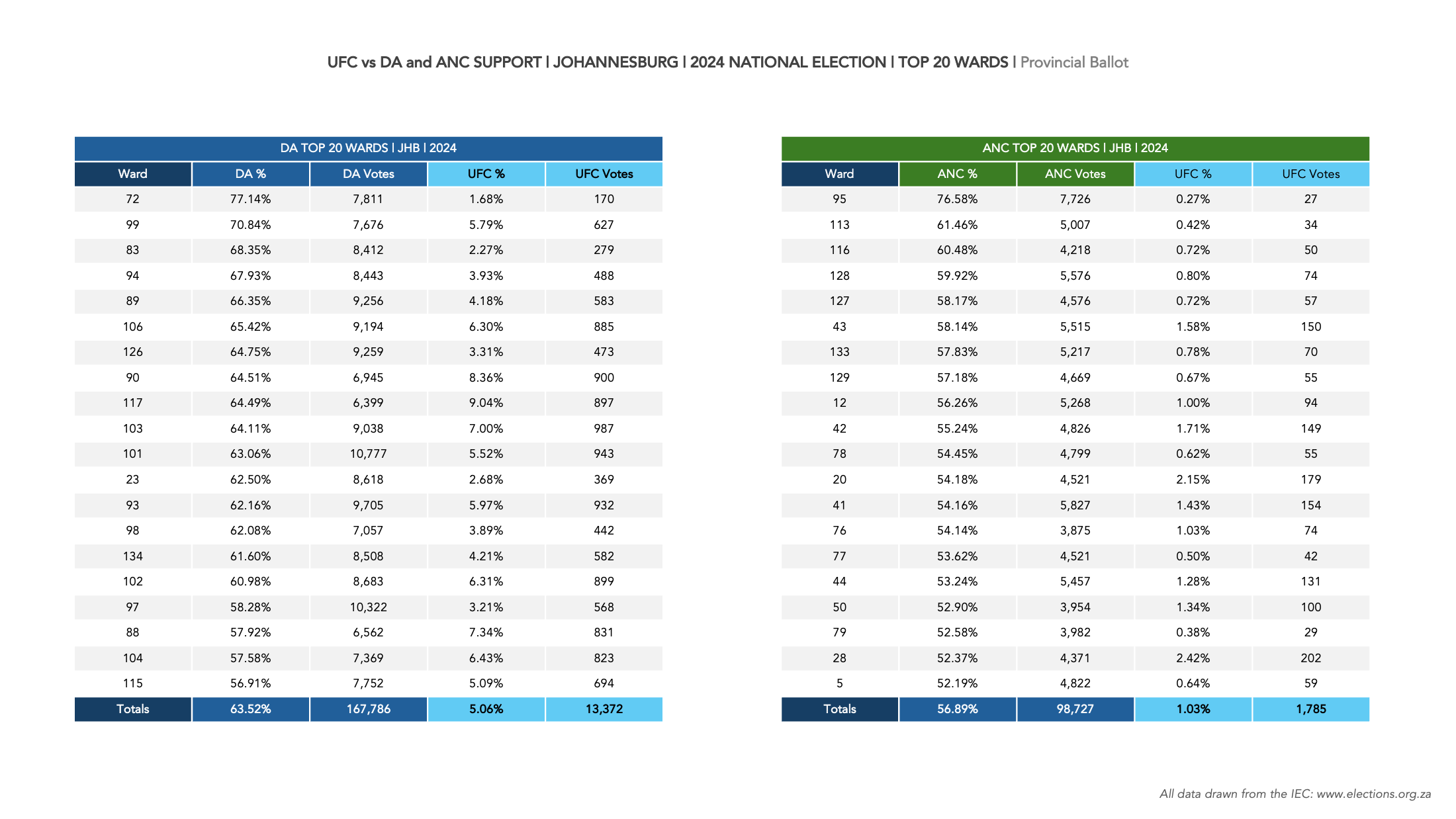
In a nutshell, the UFC is five times as effective in the DA’s top twenty wards (ave of 5.1%), as is in the ANC’s top twenty wards (1%). In fact, the 13,372 votes it got in DA strongholds represents 33.7% of all its support across the metro’s 135 wards (compared to its performance in ANC strongholds, which constitutes just 4.5%.
Here is a fun fact: The DA did better in the ANC’s top twenty wards (8,555 votes at 4.9% – a dismal return compared to 2016) and the ANC did better in the DA’s top twenty wards (25,119 votes at 9.5%) than the UFC did in either of them. So, really, you have to ask what value the party adds to the electoral landscape in Johannesburg?
That question becomes all the more relevant when you look at turnout. In the DA’s top twenty wards, the average turnout level was 67.9%. In the ANC’s top twenty wards, the average turnout level was 55.6%. Remember all three parties said their Raison d’être was to speak to the disaffected and alienated. Those voters generally exist, to a far higher degree, in ANC wards. That is where the UFC’s untapped pool of potential is. So its performance in places like Soweto is profoundly problematic on that front too.
Let us see if the pattern repeats in Cape Town.
As before, I am only going to display the UFC’s combined and scaled heat map. [If you want to see each individual party’s map, see here: RM, BOSA, GOOD – again, the pattern is the same for all of them].
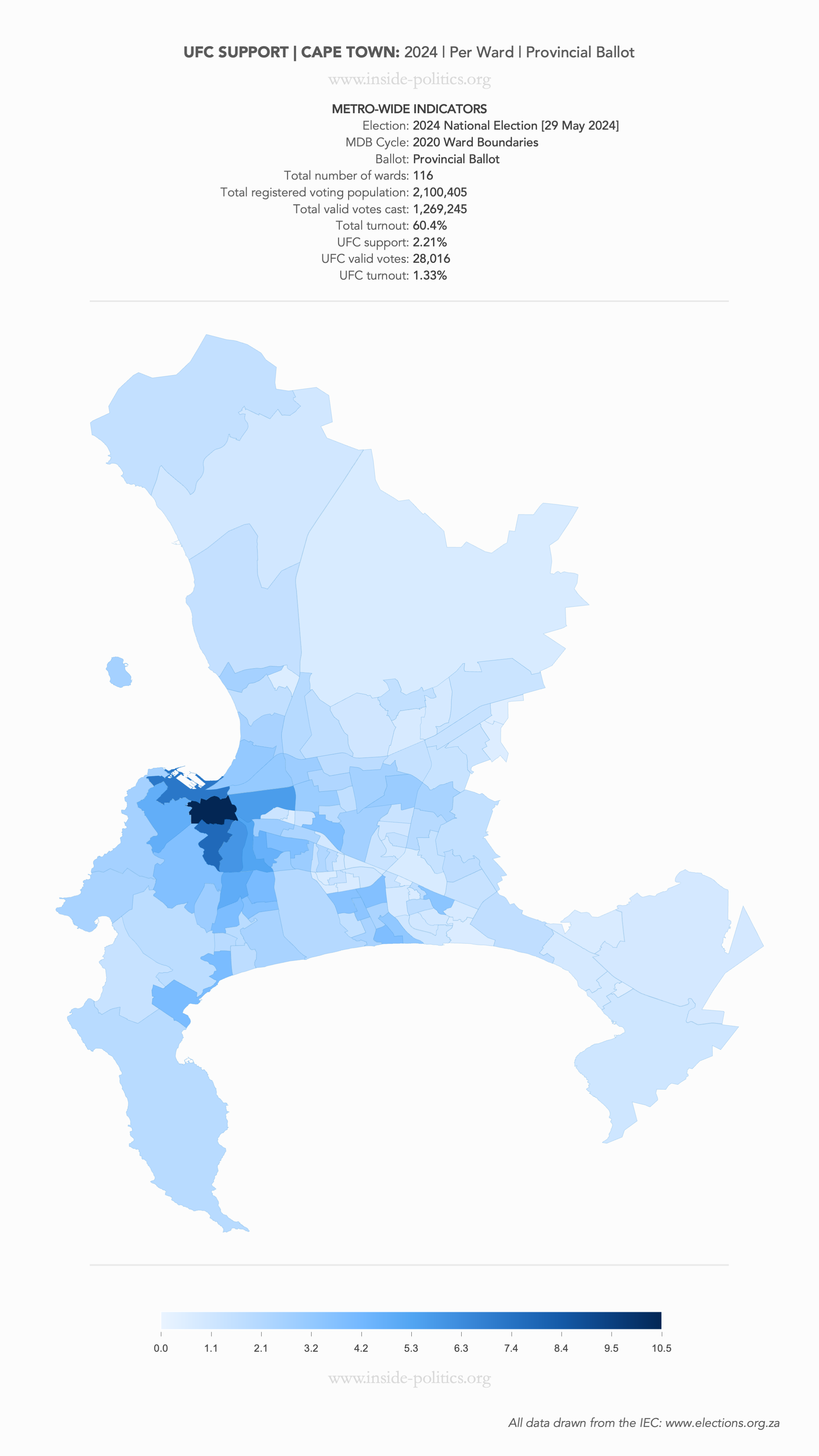
And here are the ANC and DA maps, for comparative purposes.
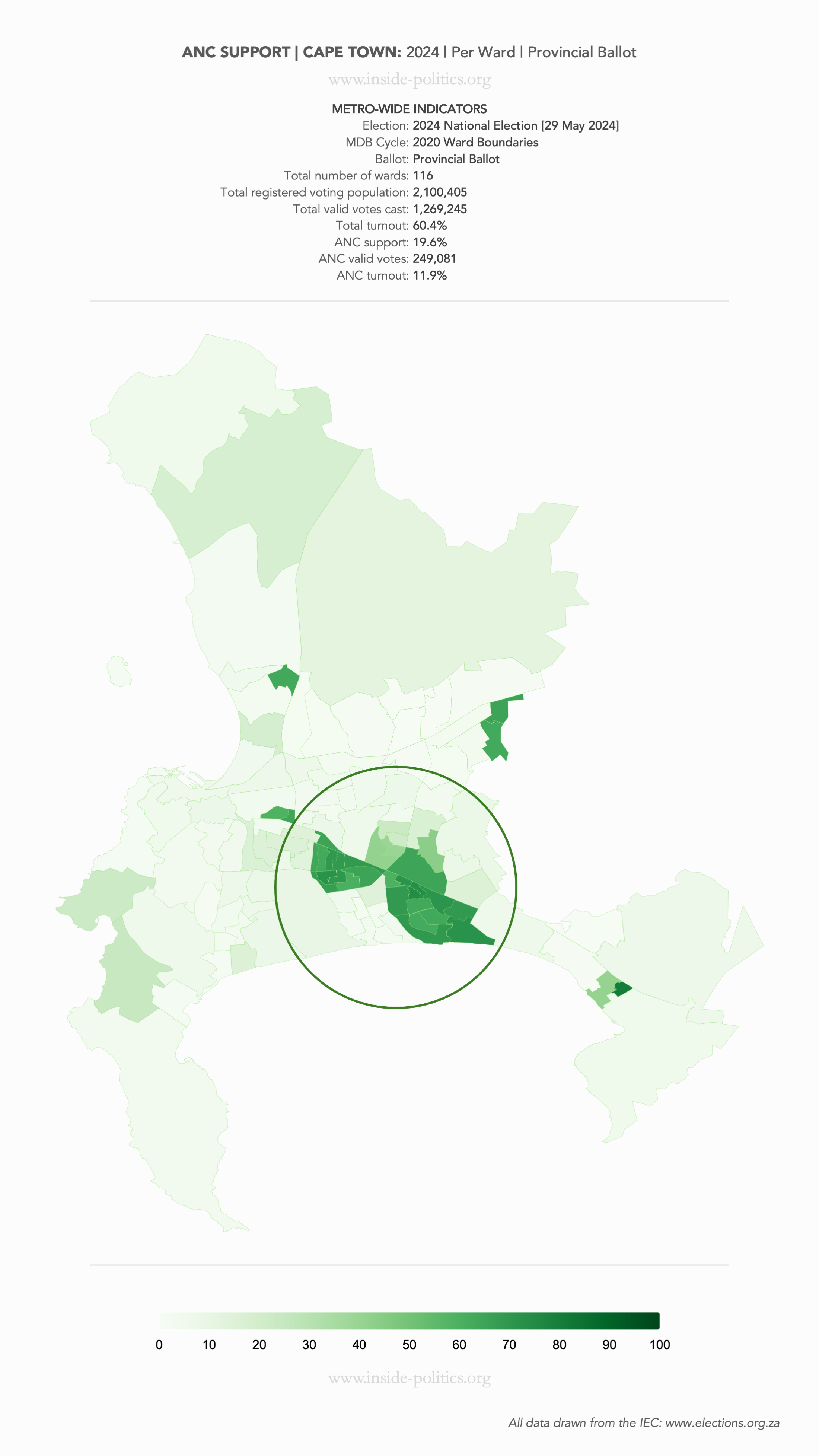
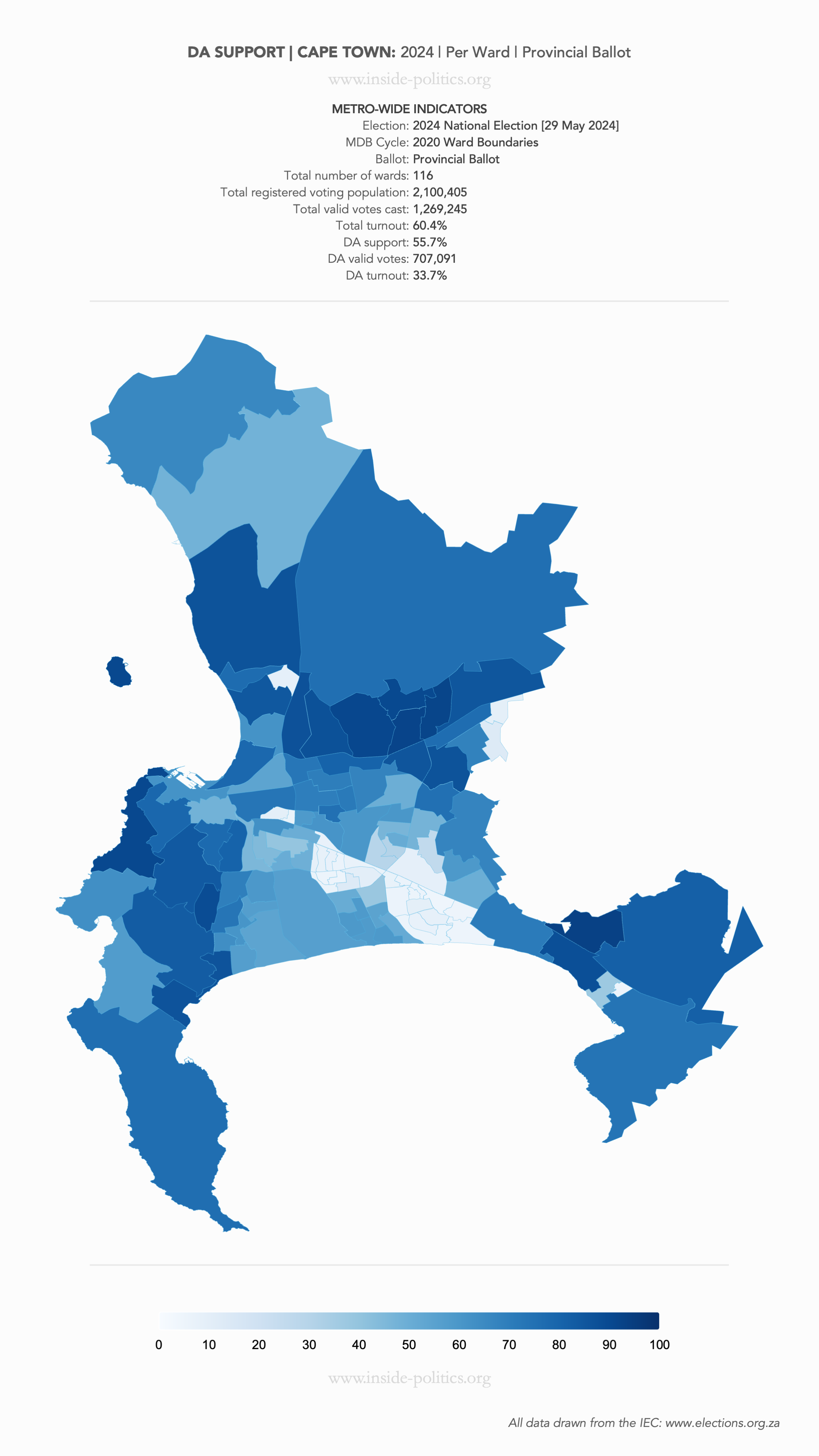
Again, the UFC’s support levels mirror the DA’s voting patterns, rather than the ANC’s. Here are the top twenty wards for each party:
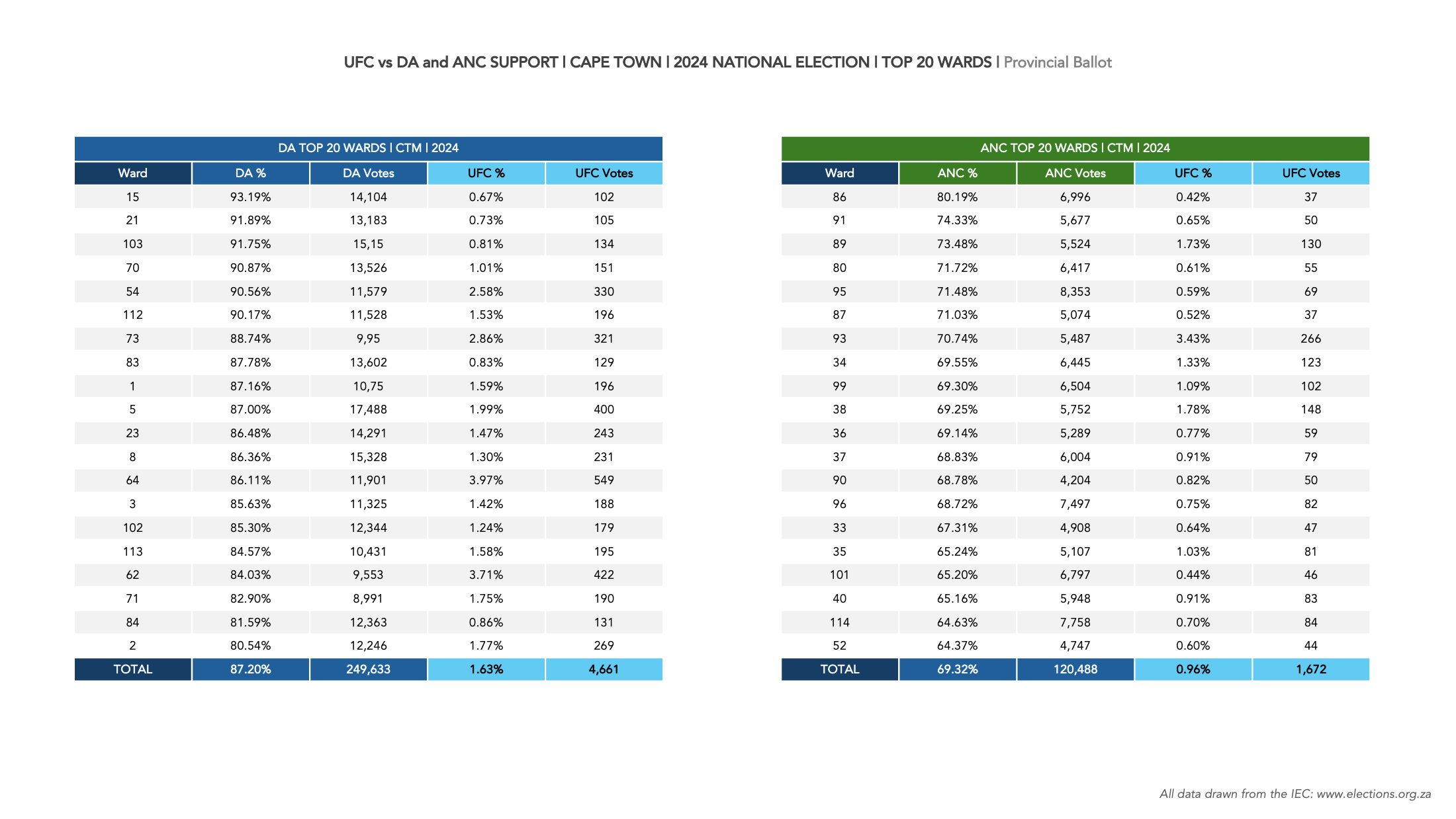
Again, the UFC is on 1% in ANC strongholds. It gets less in DA strongholds (1.6%) than it did in Johannesburg, but the DA is also stronger in Cape Town. If we expand the threshold to the top forty wards in each case to accommodate for this, things become a little clearer: The UFC moves to 2.3% in DA strongholds, but remains at around 1% (1.1%) in ANC strongholds.
Those top forty DA strongholds deliver 12,242 votes for the UFC (or 43.7% of all its support across Cape Town’s 116 wards). By comparison, the ANC’s top forty wards deliver just 3,998 votes (or 14.3% of all UFC Cape Town support).
If we do our inversion test: The DA did better in the ANC’s top twenty wards (11,374 votes at 6.5%) and the ANC did better in the DA’s top twenty wards (6,145 votes at 2.2%) than the UFC did in either of them.
And, again, the turnout differential is significant. In the DA’s top twenty wards, the average turnout level was 72.7% (69.1% in the top forty). In the ANC’s top twenty wards, the average turnout level was 48.9% (50.4%). So, again, the alienated and the apathetic are not where the UFC thrives. It makes next to no impact in those (predominately ANC) areas.
It doesn’t actually matter which metro you look at. Take Buffalo City, one of the ANC’s last metro forts, where it still enjoys a majority as of 2024 (55.9%). Deep in the Eastern Cape, another ANC stronghold, surely this where the UFC would have thrived? It is about as close to a perfect UFC target pool as one gets, given the party’s objectives and character: an urban centre, run into the ground, rapidly declining turnout and ANC support headed steadily downwards.
[Note: Buffalo City is tiny, just 50 wards, so I have limited this to the top ten in each case.]
DA Top 10 Wards
- Total Valid Votes: 54,331
- DA Total Votes: 26,158
- DA Average: 48.15%
- UFC Total Votes: 629
- UFC Average: 1.16%
ANC Top 10 Ward
- Total Valid Votes: 47,101
- ANC Total Votes: 35,809
- ANC Average: 76.03%
- UFC Total Votes: 303
- UFC Average: 0.64%
Conclusion
On the basis of the above, we can say the following about the UFC:
- The party secured 1.% nationally in 2024. Provincially, it faired best in the Western Cape (2%) and Gauteng (1.9%). In the metros, it did best in Johannesburg (2.8%), Cape Town (2,2%) and Tshwane (1.8%).
- RM is the senior partner electorally (responsible for around 41% of the UFC’s support), BOSA is a close second (around 40%) and some distance back, is GOOD (around 20%).
- The party is predominantly urban. Around 70% of its support comes from the metros [which constitute around 42% of all electoral support]
- It is essentially regional. Around 70% of its support comes from Gauteng (45%) and the Western Cape (25%).
- It fairs particularly badly in rural provinces, like Limpopo (0.4%), Mpumalanga (0.4%) and the Eastern Cape (0.6%).
- It is grossly under-represented in KwaZulu-Natal (0.3%) and eThekwini (0.4%).
- Its electoral strength is in DA strongholds, where it does disproportionately well.
- Its electoral weakness is in ANC strongholds, where it does disproportionately badly.
- It is far better at getting votes in wards with relatively high turnout levels, where voters are relatively more engaged and enthusiastic (typically, DA strongholds).
- It is far worse at getting votes in wards with relatively low turnout levels, where voters are relatively unenthusiastic and alienated (typically, ANC strongholds).
- The DA consistently performs better in ANC strongholds than it does.
- The ANC consistently performs better in DA strongholds than it does.
in a recent interview, Songezo Zibi shares a story about Rise Mzansi’s 2024 campaigning, “I’ll share an anecdote with you,” he says, “so you understand the problem: where we could have a meeting of 400 people in KZN, once MKP came, that number became 60.” He estimates his party lost “a seat to a seat-and-a-half” to MK in eThewkini alone. That’s around 40,000 – 50,000 votes (the NFP got the last seat on a fraction, with 19,548 votes).
It’s an important anecdote, because it tells you one thing: given the choice between a moderate version of the ANC, and a radical version, that particular pool of available voters will go for the ANC on steroids every the time. As for the rest, the alienated and apathetic, they seem entirely unmoved by the UFC either way and remain where they were before the party came along – on the sidelines. And besides, the DA does better than the UFC does in ANC strongholds regardless, however poor its returns.
There is a small market for this kind of offer among potential DA voters. Always has been. Agang, the Independent Democrats, Rise Mzansi, Build One South Africa, GOOD, have always managed to persuade some small selection of opposition voters to follow them on the road to social justice. The DA eventually wins them back when, after a few elections, those parties comes to realise the only way they can continue is to become an opposition to the opposition, because the door to ANC votes is firmly bolted shut. Either that, or some form of ethnic or racial populism (ASA, the PA or GOOD – de Lille learnt this lesson years ago).
With the local government elections coming up, the UFC seems locked into this psychological trap. And is structured, by accident or design, to try and exploit it further. As Zibi says, the UFC knows where its voters are now, and they aren’t in Soweto or Khayelitsha.
So it turns out the DA was right to warn about smaller parties. From its perspective, what is the point of the UFC? 2% in JHB might be tiny, but it might be everything in 2026. Why does it have to fight the UFC for votes? Why is the UFC fighting it for votes? Is the DA really the problem with Johannesburg? Surely not. But it will have to battle the DA, and the DA will have to expend resources on the UFC, because DA strongholds are the hand that feeds, and the UFC knows that now.
You do wonder about the donors of these new parties, many of whom are more in the DA’s universe than not. Someone should add up all the money given to the likes of the ID, GOOD, Change Starts Now, RM, BOSA and Agang, and ask, how much value have these parties delivered in terms of actually making inroads into the ANC, as opposed to the DA? Millions upon millions spent. Roger Jardine spent R10m on a survey to work out what voters want, only to decide it wasn’t him. That’s about as close to reality as any of these parties have come.
If the UFC is true to the underlying purpose, that inspired all of its founding leaders to get into politics in the first place, it will have to offer something fundamentally different in 2026. It won’t though. It now knows what works (all things being relative), and it’s the very thing the DA warns against.
This essay is the 17th in an on-going series on Election 2026/7, for all other editions of this series, please click here: Election 2026/7
Discover more from inside politics
Subscribe to get the latest posts sent to your email.
 inside politics
You must be logged in to post a comment.