
Election 2024 [5]: Scenarios: Why it is so difficult to get the ANC below 50%
by The Editor

A thread: “Scenarios: Why it is so difficult to get the ANC below 50%”. This thread looks at approximately 500 national turnout scenarios, with a view to determining how easy or difficult it is the for ANC to get to 50% nationally.
Scenarios: Why it is so difficult to get the ANC below 50%
By: Gareth van Onselen
Follow @GvanOnselen
13 January 2024
This essay is the 5th in an on-going series on Election 2024, for all other editions of this series, please click here: Election 2024
This thread is complex and requires some methodological explanation as to what a turnout scenario is, as there are a few components.
Let’s start with turnout itself. Turnout is the proportion of the current number of registered voters according to the IEC (26,931,132) that would actually vote on Election Day. In 2019, national turnout was 66%.
(Obviously, more people will register before the election, so the IEC number will increase, this is all based on the idea that an election would be held tomorrow.)
So, say you project 70% turnout in 2024, now there is a simple sum: Take the total number of currently registered voters (26,931,132) and work out 70% of that figure. You get 18,851,700. Therefore, if an election was held tomorrow, and turnout was 70%, 18,851,700 voters would actually vote.
Once you have that number, you can work out what percentage the ANC would get for any given number of votes it wins. If, say, it gets the same number of votes it got in 2019 (10,126,475), then as a percentage of 18,851,700 the ANC would get 53.1% of the national vote.
To put it all together: If an election was held tomorrow, turnout was 70%, and the ANC got the same number of votes it got in 2019, it would get 53.1%. That is a turnout scenario.
Of course, we don’t know what turnout will be. And we don’t know how many votes the ANC will get. So, we need to provide a spread. The table below provides 500 or so turnout scenarios. It has 16 turnout possibilities (from 70% down to 55%) and 31 ANC vote possibilities (each in increments of 100,000, from 500,000 more votes than its 2019 result, to 2,500,000 less votes than its 2019 result. Read against each other, there are around 500 turnout scenarios for the ANC in 2024.

There are more ANC vote share possibilities with the likelihood it will lose votes rather than gain votes from 2019. And similarly there are more national turnout possibilities with the likelihood it will drop rather than increase from 2019.
Here is a version of that table, that explains every indicator on it. Essentially, along the top, you have the national turnout possibilities (with the absolute number of voters it equates to below it), and down the left you have all the ANC vote possibilities (with the total number of ANC votes it equates to at that scenario, to the right of it).

All the percentages in the bulk of the table are the ANC’s possible results, or turnout scenarios. The yellow line indicates the 50% threshold – below that line the ANC gets less than 50%; above that line, it gets more than 50%. So, at the very least, this table will tell you what needs to happen for the ANC to drop below 50% at each turnout scenario.
Now that we have this table, we can look at what some of the most plausible outcomes for the ANC could be.
But let us start with where the latest polling puts the ANC, on this table. The SRF commissioned a national poll of 1,400 registered voters in November 2023 (disclaimer, I am the CEO of Victory Research, which conducted the poll). That poll, with a margin of error of 5%, put the ANC on 45% at 66% turnout.
So, let’s generalise that a result a bit, to give us some wiggle room. We take the 66% turnout possibility on our table, and the turnout possibility each side (65% and 67%), then find 45% on the table and put a circle around it, we get the below. We can then see how that 45% relates to the ANC’s total votes (in the two left-hand columns).

Basically, what the SRF poll found is, as of November, the ANC was down around -2,000,000 votes.
Now, a few things. 1. The ANC has, since then, been campaigning around the clock and with an intensity not seen for a long time, certainly not this far out of an election. The impact of this has yet to be seen. 2. The ANC vote share typically ticks up towards an election. 3. It is most likely national turnout will drop below 66%. But the SRF poll is incredibly helpful because it gives us a realistic starting point, to generate our own scenarios.
Here are three we can generate, from the ANC’s perspective:
- STABLE: A relatively “good” ANC election. Here the ANC vote would remain stable, maybe grow a small amount; and turnout would remain stable, maybe drop a small amount.
- POOR: A poor ANC election. Here the ANC vote would decline at the same rate it did in 2019, as would turnout. It would lose 1.4m votes, as it did in 2019, and turnout would drop 7pts, as it did in 2019.
- BAD: A bad ANC election. Here the ANC vote share would drop dramatically, beyond the 1.4m it lost in 2019, and turnout would decline dramatically, beyond the 2019 drop.
The ANC could get any result between these scenarios, but these are helpful general assumptions.
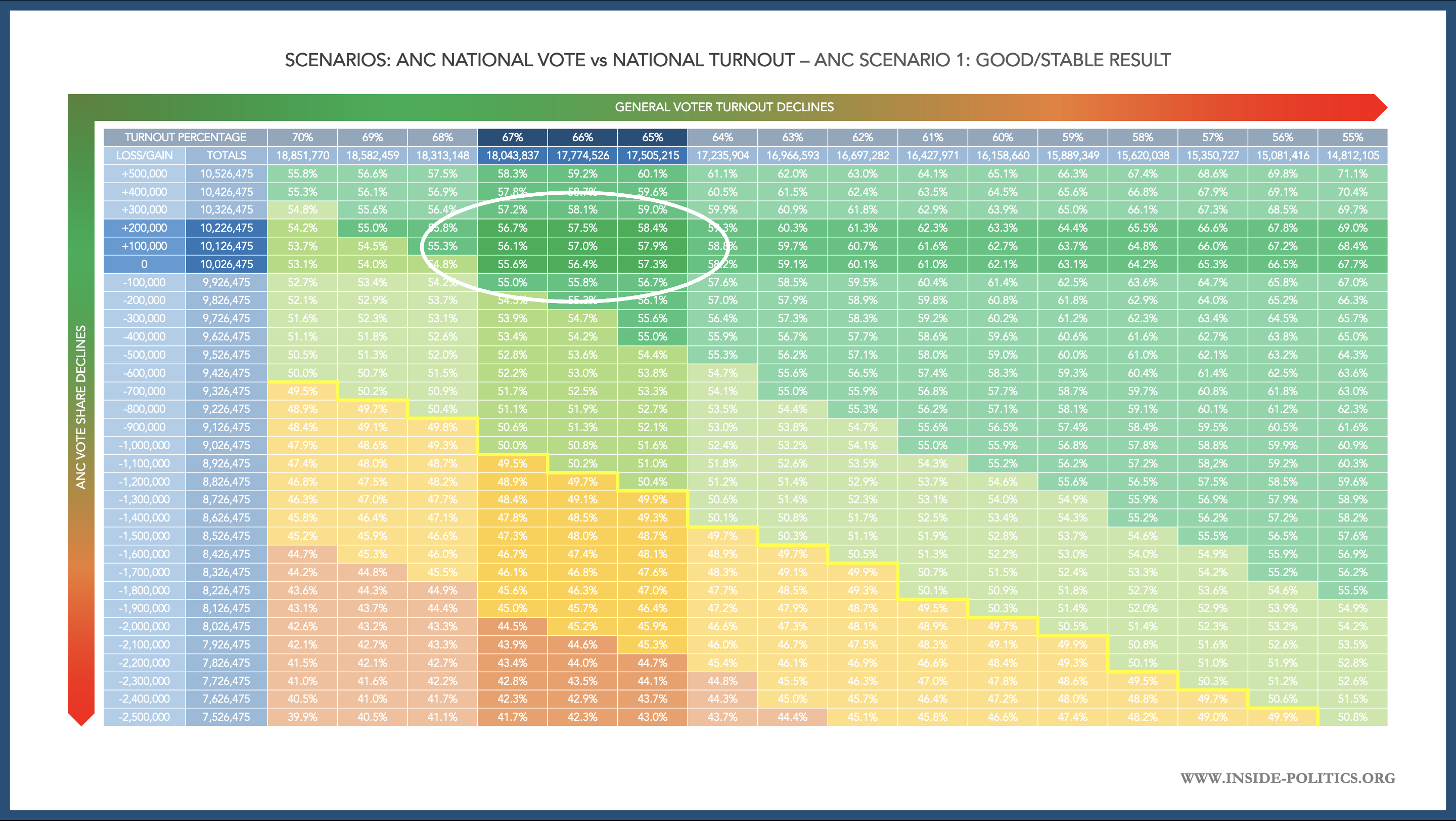
Let us apply those to our table and see what comes out. First, ANC Scenario 1: STABLE. The circle on the table below illustrates this scenario: turnout would be around 67%-65%, the ANC vote share would around its 2019 figure, maybe a little up. At this scenario the ANC would get around 56%-57%.
Second, ANC Scenario 2: POOR. The circle on the table below illustrates this scenario: turnout would be around 59%-57%, the ANC vote share would be around -1.3m to -1.5m votes down from 2019. At this scenario, the ANC would get around 54% to 55%.

Third, ANC Scenario 3: BAD. The circle on the table below illustrates this scenario: turnout would be around 58%-56%, the ANC vote share would be around -1.9m to -2.1m votes down from 2019. At this scenario, the ANC would get around 52% to 53%.

The first key takeaway, then, is that it is going to be incredibly hard to bring the ANC below 50%. There is no scenario in which the ANC drops below 50%. In fact, the party can lose 2m votes, and turnout can drop 10pts to 56% and the ANC still comes out above 50%.
But those scenarios are from an ANC perspective. What would be a good election for the opposition? For the opposition to have a great election, three things must happen: 1. ANC voters must stay away, and the ANC’s vote share must therefore drop significantly from 2019. 2. By comparison opposition voters must all come out, to a significantly large degree, and vote. Thus, 3. Turnout does not drop too much, because opposition voters make up somewhat for ANC voters staying away.
Plug that into our table, and the circle on the table below illustrates that scenario: turnout would be around 64%-62%, the ANC vote share would be around -1.7m to -1.9m votes down from 2019. At this scenario, the ANC would get around 48% to 49%.
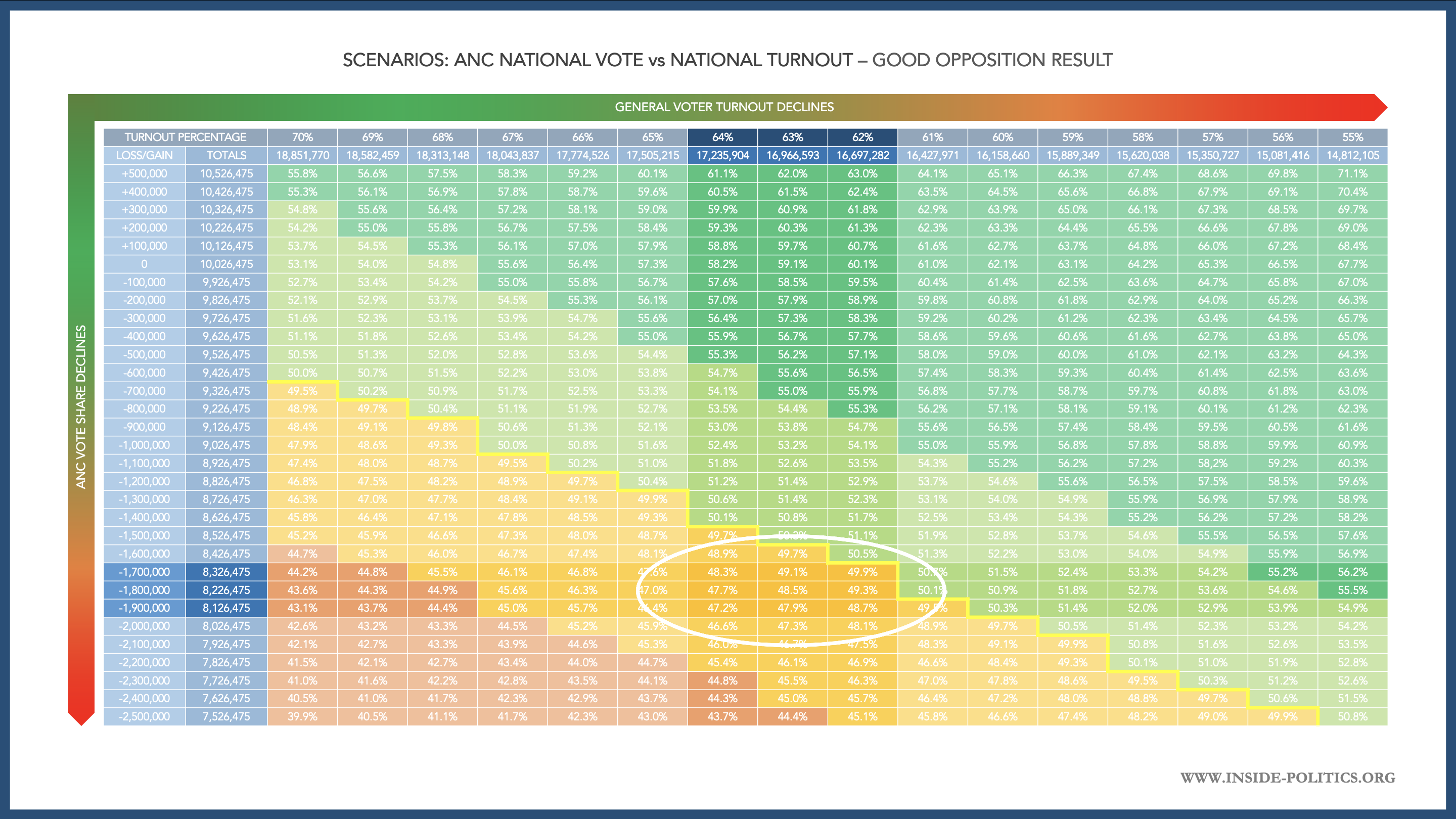
Obviously, this is the scenario the ANC most dreads, why it is campaigning so intensely so early and why it is so desperate all its communication focus on its “good story to tell”. It simply has to convince ANC voters to vote. To do that, it must convince them its difficulties are behind it, that is has reformed or is credibly reforming, and provide compelling evidence for all of this.
It is helped by four big factors: 1. The commission of inquiry into state capture is over. 2. Covid is over. 3. Load-shedding is at a generally low level. 4. It is has no fundamental national crisis unfolding (of the scale of Nkandla, Life Esidemeni or Marikana – there are of course endless smaller crises). These give it some space to talk about what it wants to talk about for a change, instead of being entirely on the back-foot.
Against it are the following five factors: 1. Its brand, which remains fundamentally associated with corruption and incompetence. 2. General economic decline (including huge unemployment rates). 3. A dire service delivery record, which prevents any contemporary successes it can point to (and makes it reliant on a long term historical perspective). 4. The lack of any compelling leadership or vision. 5. Long term attritional decline of its core support base, which has never been renewed with new voters.
We shall have to see which of these two sets of factors has the biggest impact.
In closing, below is a table that summarises all the scenarios, for ease of reference.

The ANC turnout table will prove incredibly helpful as the election gets closer, and we have more data – about the number of IEC registrations, more credible election polling and a better idea of where the ANC is at in 2024. I shall also produce similar tables for the DA and the EFF.
The key takeaways from this analysis are:
- We need to see what effect ANC campaigning, which is in full swing, has had on ANC support since 2023.
- Regardless, it is going to be very difficult to bring the ANC below 50%.
- That would require three things working together: A. ANC voters to stay away/not vote for the party in significant numbers, thus driving down its vote share. B. Opposition voters turning out in significantly disproportionate numbers. C. This would result opposition voters limiting how far turnout drops.
- All of these must happen on a large scale. The same trends can play out on a small, even medium scale, and the ANC seems to have enough in the bank to still clear 50%. Put another way, as things stand, it appears the ANC must lose more than the 1.4m votes it lost in 2019 – in other words its decline must accelerate – for it to drop below 50%.
- The ANC can afford to lose 2m votes, and for turnout to drop 10pts to 56% and it can still secure a majority. Thus, both the ANC’s and the opposition’s result will be fundamentally influenced by who best can turnout their voters on Election Day.
All numbers in this essay are drawn from the Independent Electoral Commission website: https://www.elections.org.za/pw/
This essay is the 5th in an on-going series on Election 2024, for all other editions of this series, please click here: Election 2024
Discover more from inside politics
Subscribe to get the latest posts sent to your email.
 inside politics
You must be logged in to post a comment.