
Election 2024 [1]: Why turnout is critical and its relationship to the ANC’s vote share
by The Editor

A thread: “Why turnout is such a critical factor” The following thread looks at turnout and its relationship to the ANC’s vote share, which I think is a critical factor ahead of the 2024 election, and not properly thought about.
Why turnout is such a critical factor
By: Gareth van Onselen
Follow @GvanOnselen
21 December 2023
This essay is the 1st in an on-going series on Election 2024, for all other editions of this series, please click here: Election 2024
First, a basic definition: Turnout is the percentage of registered voters, who vote on Election Day. In other words, X number of South Africans are registered to vote; Y number will actually vote. Y is the turnout percentage.
Here is a graph (below) that shows all the turnout percentages for each national and local government election since 1999. As you can see, turnout fluctuates dramatically.

This is the same graph (below), but with the local election turnout percentages in light blue, and the national election percentages in dark blue. You can see both are declining, but local elections are always worse. South Africans just don’t care as much about local elections.
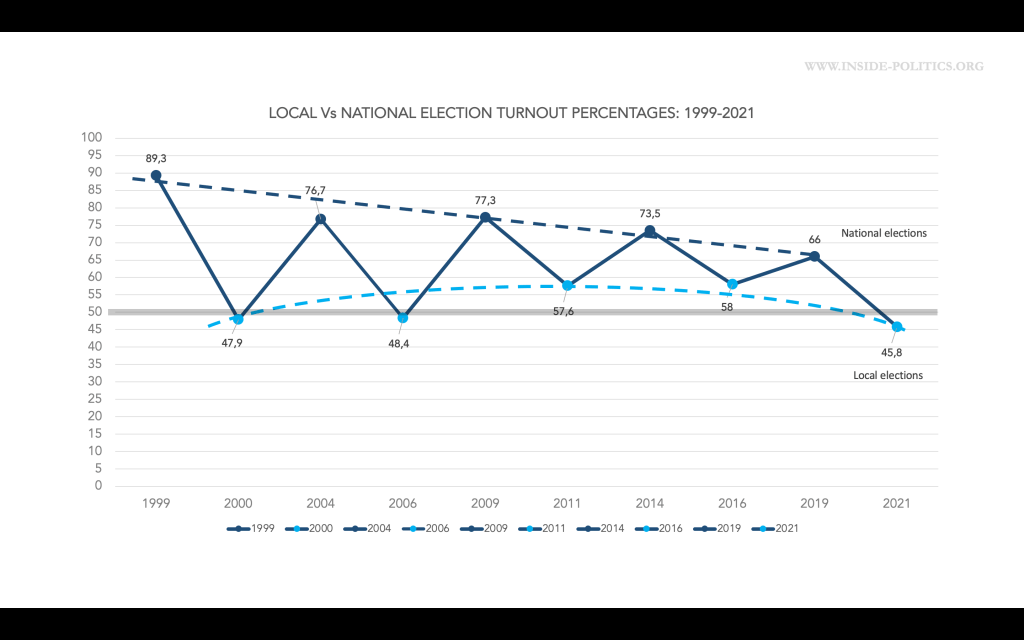
Turnout tends to drop generally, for most democracies, over time. Nevertheless, since 1999 (89.3%) ours has dropped a staggering 43.5 pts, to 45.8% in 2021, the lowest it has ever been, and the decline does not seem to be turning a corner.
How does this relate to the ANC’s vote share? Well, the ANC has always dominated the electoral landscape. So, it makes sense that, in general terms, when turnout drops, the ANC’s vote share also drops – as most voters are ANC.
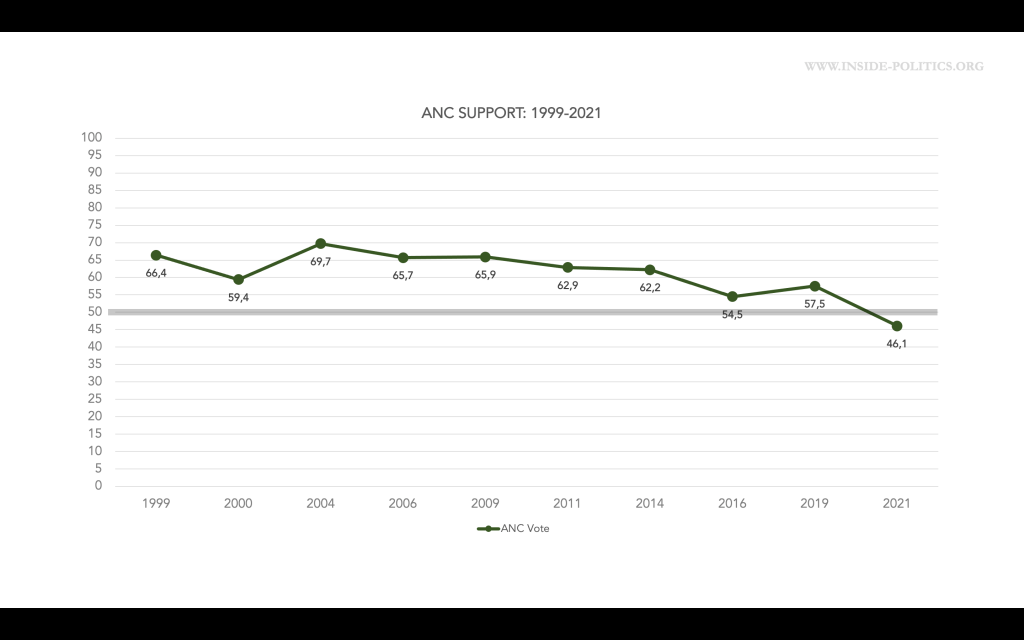
Here is a graph (below) of the ANC’s vote share for each national and local government election since 1999 (using the national and PR ballots). Support for the ANC has also dropped to its lowest point: 46.1% in the 2021 local government elections. Its high point was in 2014 (69.7%). Since then, it has lost 23.6 pts.
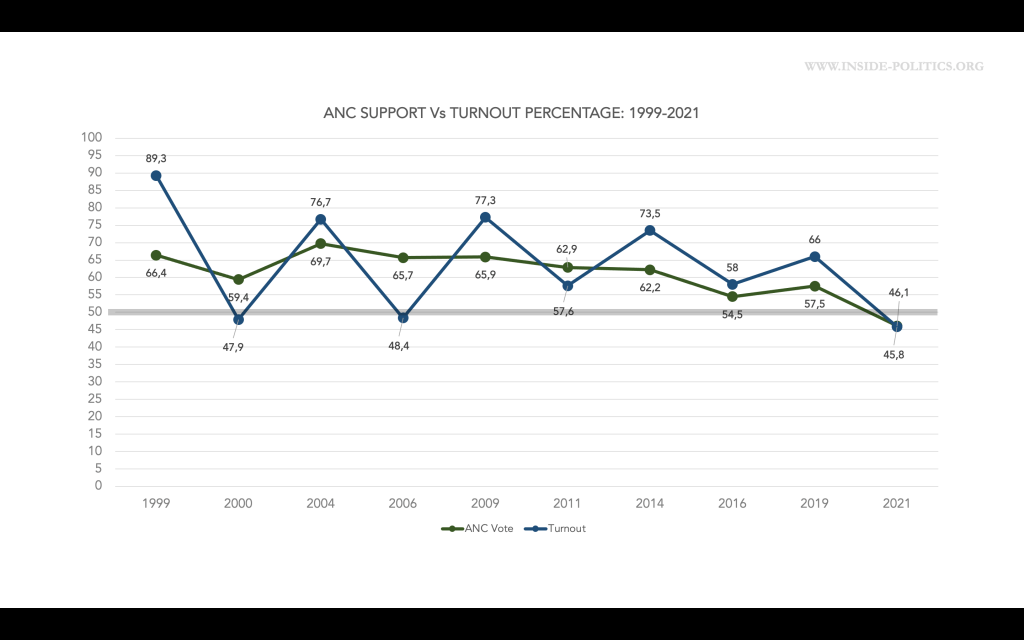
If we overlap the two, as in this graph (below), you can see the downward trend in turnout generally mirrors the decline in the ANC’s vote share; to the point where, in 2021, they basically met for the first time, at around 46%.
But in 2024 we will have a national election, not a local one. And as we have seen, turnout varies dramatically between the two. The relationship between national turnout and the ANC’s vote share is a bit different. If we drop the local election results, we get this graph (below).
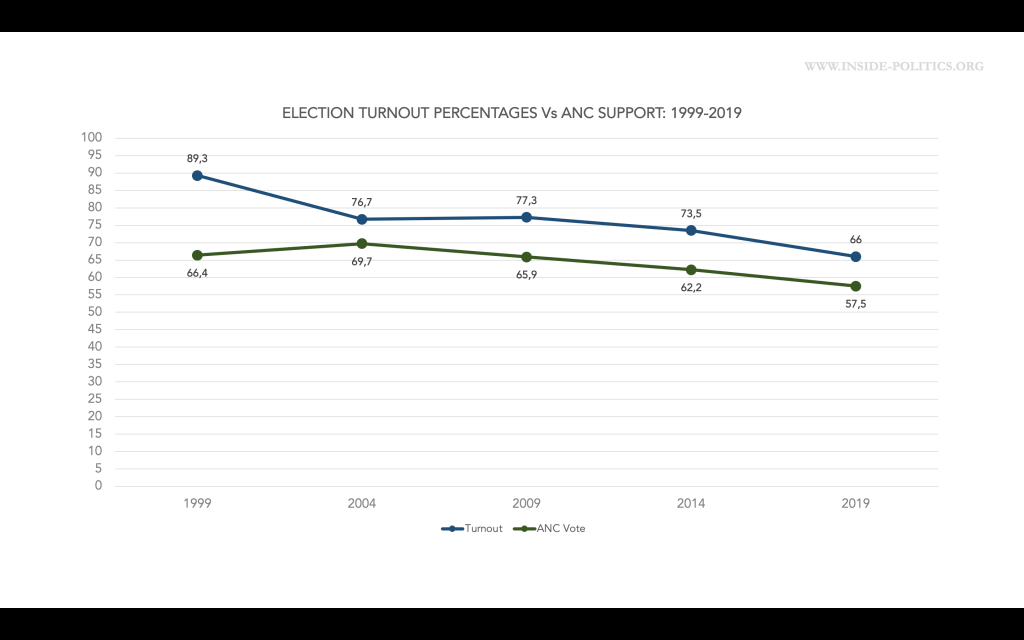
As you can see, the decline in national turnout has not yet caught up with the ANC’s decline. It maintains a steady line below it. For the ANC to drop below 50%, you really need a lot of ANC voters to stay away. The party lost 1.4m votes in 2019 and still got 57%.
The assumption out there, in many circles, is if more people voted, the ANC would lose its majority. It might well be untrue. We don’t know if previous ANC voters, who now don’t vote, have changed allegiance. We just know they are staying away in growing numbers.
There is another way of looking it: What does the ANC’s vote share look like when compared it to all registered voters. Here is a graph (below) that demonstrates that – it compares the ANC’s total votes in each national election since 1999 to the total number of registered voters.
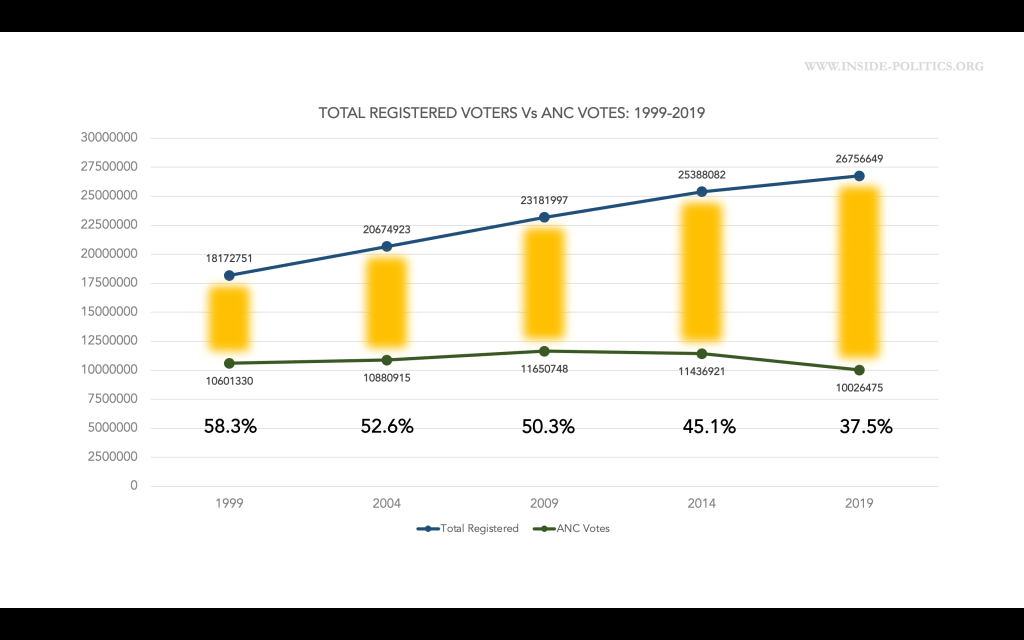
In 1999, all ANC votes represented 58% of all registered voters. By 2019, all ANC votes represented 37% of all registered voters. So, either there is a vast pool of non-voting, non-ANC voters out there, or there is not. Unless they vote, we will never know.
All of this allows us to produce some 2024 scenarios – and guys, please, these are scenarios, not predictions. We can look at where turnout is headed, what is happening to the ANC’s vote in absolute numbers, and as a % of all registered voters, and see what comes out.
Here are six 2024 election scenarios, using the current number of registered voters according to the IEC (around 26.9m). We start with Scenario 1: 2019 turnout (at 66%) and systematically drop turnout to Scenario 6 (at 56%).
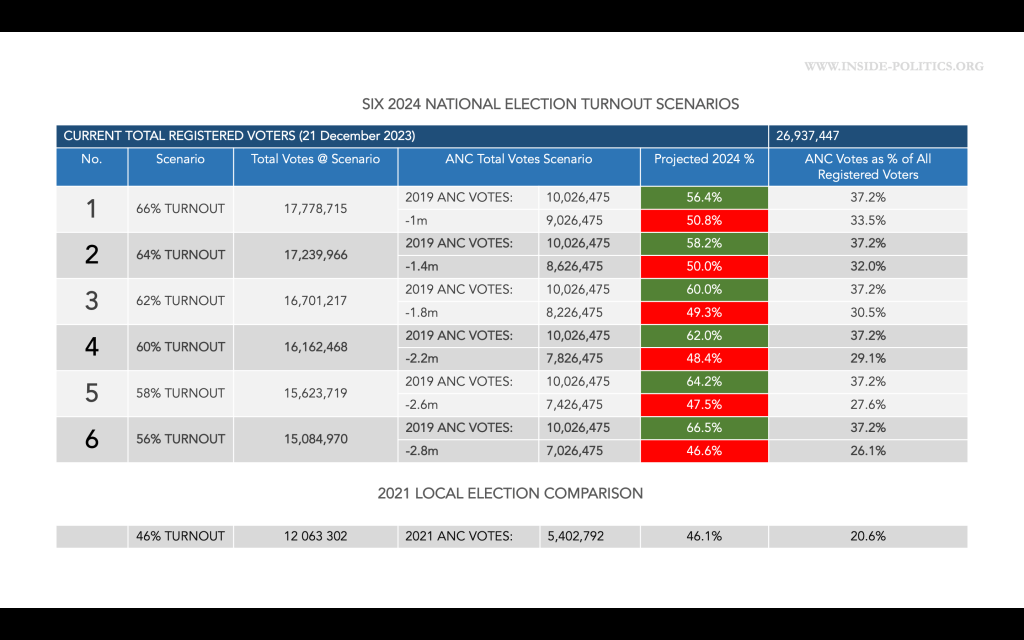
For each scenario, there is a “good” path (green) for the ANC – it manages to get the same number of votes it got in 2019 (this is being very generous, but a helpful benchmark) and a “bad” path (red) – where it loses votes in a systematic fashion, as turnout declines.
There is a comparison to where that ANC scenario relates to all registered voters. Finally, at the bottom, there is a comparison to what happened to the ANC in 2021 (just to show how low the ANC could theoretically go).
Obviously, the total number of registered voters will increase before the election. So, this is all assuming an election tomorrow, on current numbers.
So, what does this show. Well, the “good” path (massively unlikely) shows the ANC vote share systematically increasing from 56% at 66% turnout, to 66% at 56% turnout. The ANC would need a miracle for this to happen.
The “bad” path demonstrates, as we have seen, a relationship between lower turnout and lower ANC support. For each 2pt turnout drop, the ANC loses 400,000 extra votes, from a base loss of 1m. That sees it drop from 50% at 66%, to 46% at a 56% turnout scenario.
It also sees the ANC’s percentage of all registered voter drop from 33% to 26% (and seeing as it only got 20% of all registered voters in 2021, 26% doesn’t seem that bad).
This is the more realistic path. But it also demonstrates just how hard it is to get the ANC below 50%. Scenario 6, the worst-case scenario for the ANC, has it drop of some 2.8m voters from 2019, and a 10pt drop in turnout down to 56%, and it still gets to 46% nationally.
So, what are the key takeaways from all this? Here are four. 1. Differential turnout for opposition parties (that is, their ability to get all their voters to actually vote, while many ANC voters stay away) is going to be absolutely essential to bringing the ANC below 50%.
2. In the other direction, if the ANC wants to avoid losing its majority, it simply has to motivate all those ANC voters who have stayed away to vote; and to hope they are, in fact, still ANC. And I don’t think the ANC’s “good story” is a vaguely credible way to do it.
3. The data, however, suggests the opposite: turnout will decline, with it the ANC’s vote share and its percentage of all registered voters. Is the ANC’s national decline exponential or steady? We do not know. But all evidence suggests a decline regardless.
4. The final and key takeaway: this election is all about turnout. It will be a determining factor. The smaller the turnout, the more it hurts the ANC. It hurts SA’s democracy too, but the ANC first. If you made it to the end, well done.
All numbers in this essay are drawn from: https://www.elections.org.za/pw/
This essay is the 1st in an on-going series on Election 2024, for all other editions of this series, please click here: Election 2024
Discover more from inside politics
Subscribe to get the latest posts sent to your email.
 inside politics
You must be logged in to post a comment.