
Election 2024 [4]: The Western Cape and the rise of the small parties
by The Editor

A thread: “The Western Cape and the rise of the small parties”. The following thread looks at the DA’s electoral record in the Western Cape, the ANC’s collapse, and a new threat to both, from smaller parties in the province (with nice graphs!)
The Western Cape and the rise of the small parties
By: Gareth van Onselen
Follow @GvanOnselen
8 January 2024
This essay is the 4th in an on-going series on Election 2024, for all other editions of this series, please click here: Election 2024
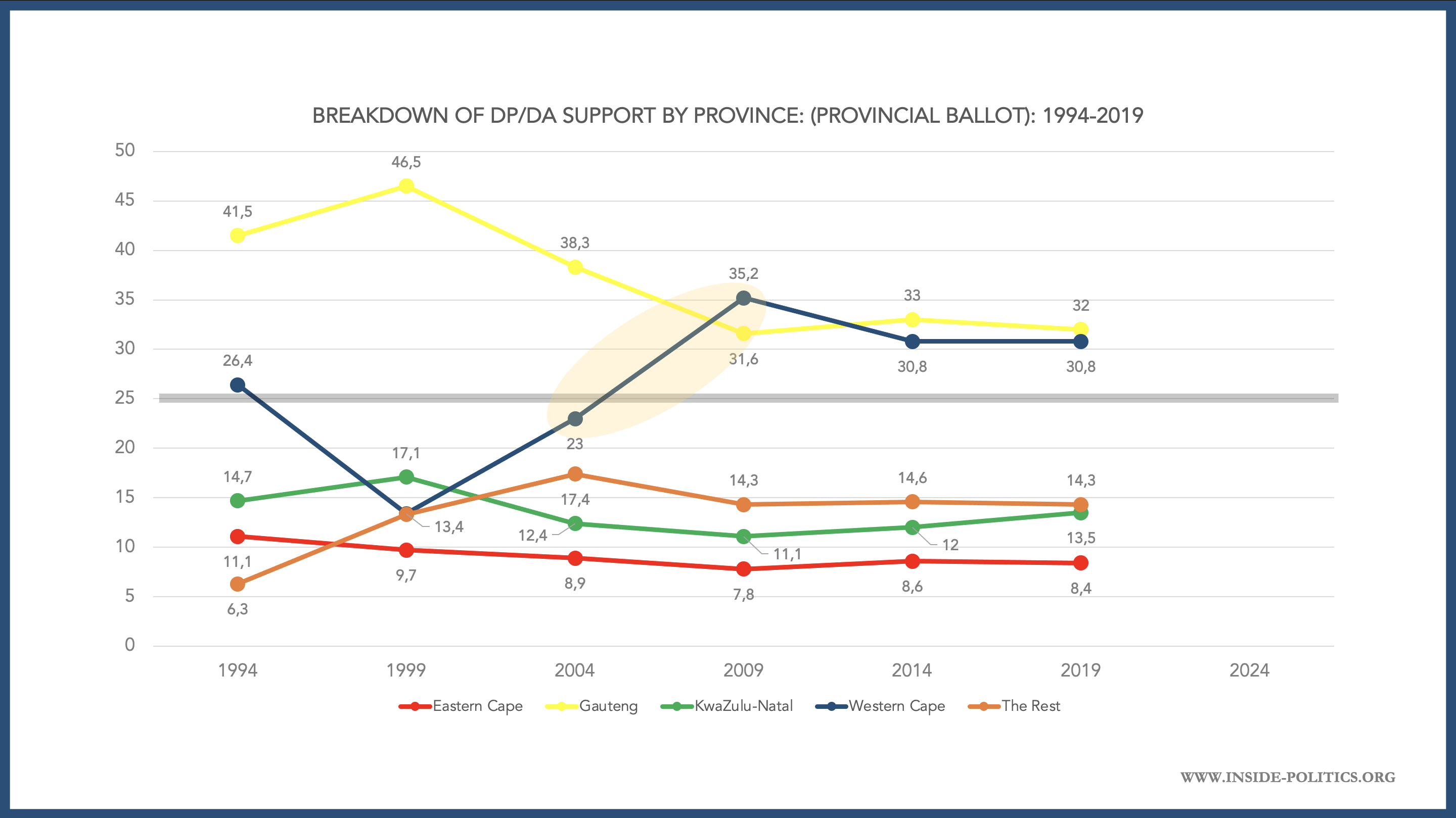
The big picture: The Western Cape (along with Gauteng) is critical to the DA’s total support. The graph below sets out the proportion of total DA support, the Western Cape (31%), Gauteng (32%), KwaZulu-Natal (14%) and the Eastern Cape (8%) each comprise.
From 99 to 2009, DA support in the Western Cape grew exponentially. As it did, it dragged up the DA’s national vote, as per below. The growth in the Western Cape not only took the DA to a 50% majority in the province but it was also what took the DA to 20% plus nationally.

How did the DA do this? The answer is the “Coloured vote”. Coloured South Africans comprise around 48% of the province (Census 2016). The DA systematically consolidated that demographic from 99 onwards, from 24% in 2004 to 78% in 2014. With that, came a majority.
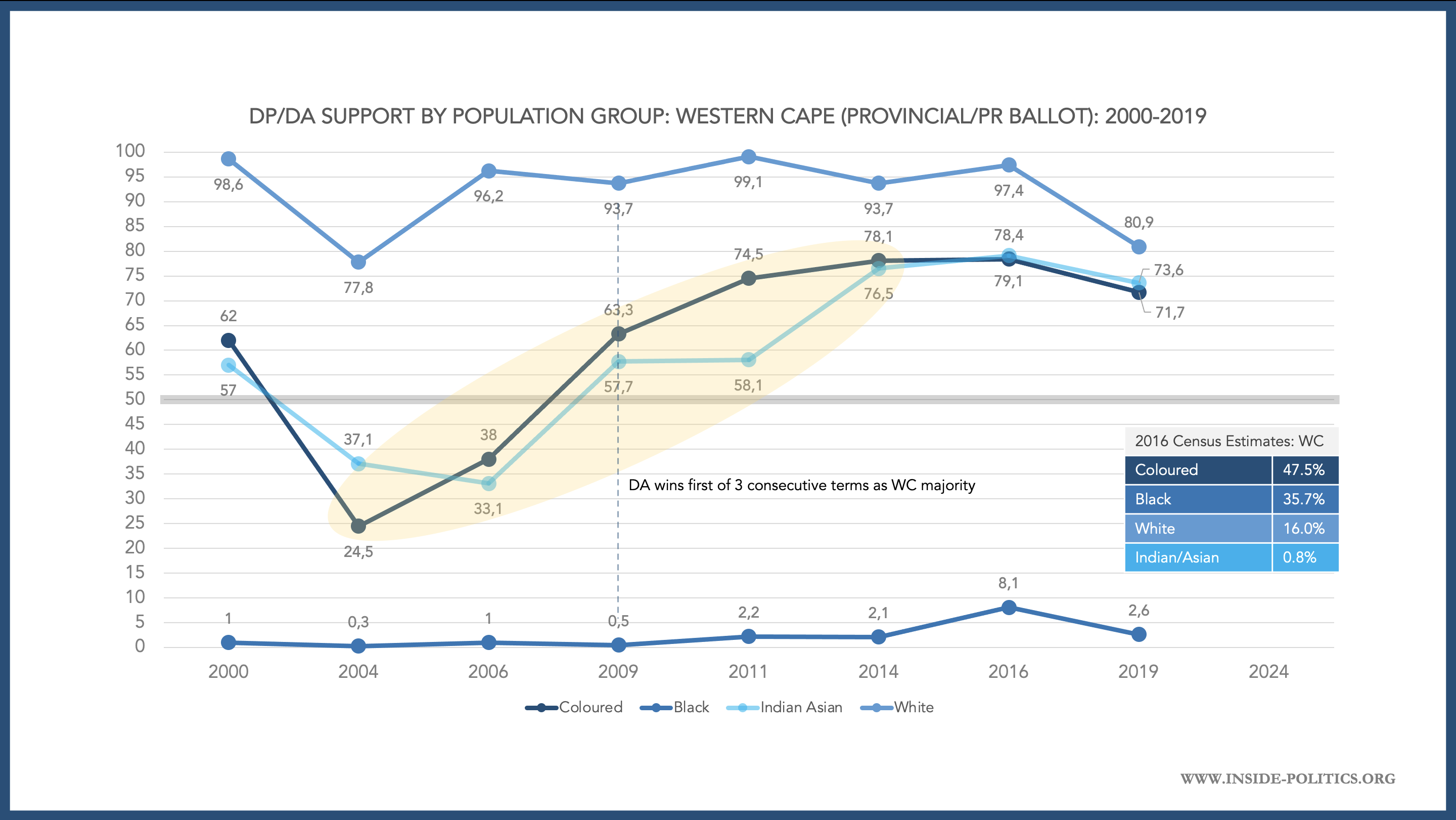
There was a time when the “Coloured vote” split three ways. 1/3 were die-hard ANC, 1/3 die-hard DA and 1/3 undecided. The undecided 33% were the difference between a majority or not. But they have, for some time now been more-or-less consolidated under the DA.
There is more to say about this graph, but let’s do that towards the end. Let us now turn to the Western Cape itself. Below is the DA’s, NNP’s and ANC’s electoral record in the province, for each national and local election since 1994.
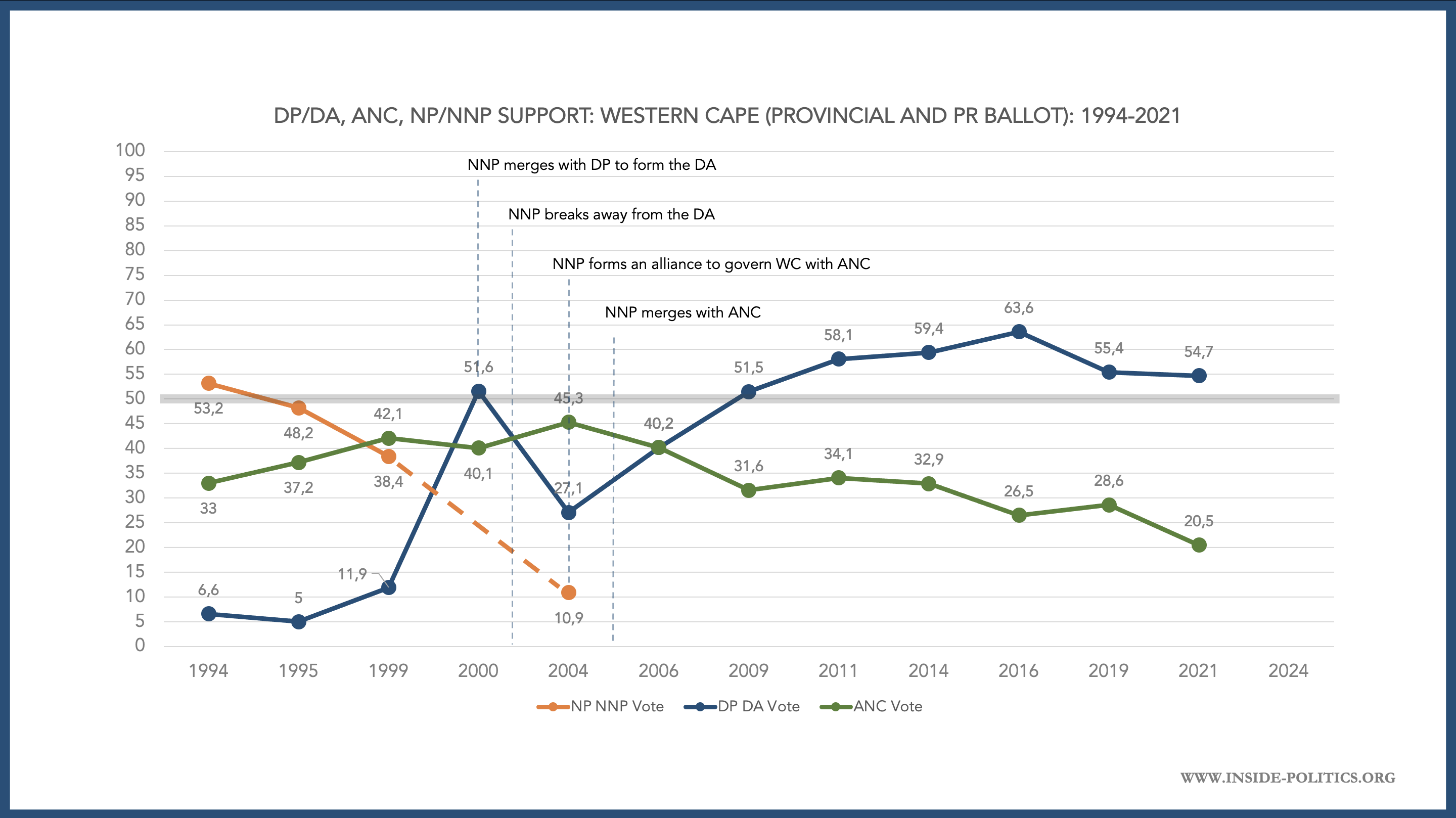
There was a lot of messiness between 99 and 2004, when the NNP merged with the DP to form the DA, left the DA, then merged with the ANC. But once that was done, it became a two-horse race. The DA has generally remained stable above 50%. The ANC, as everywhere, has declined.
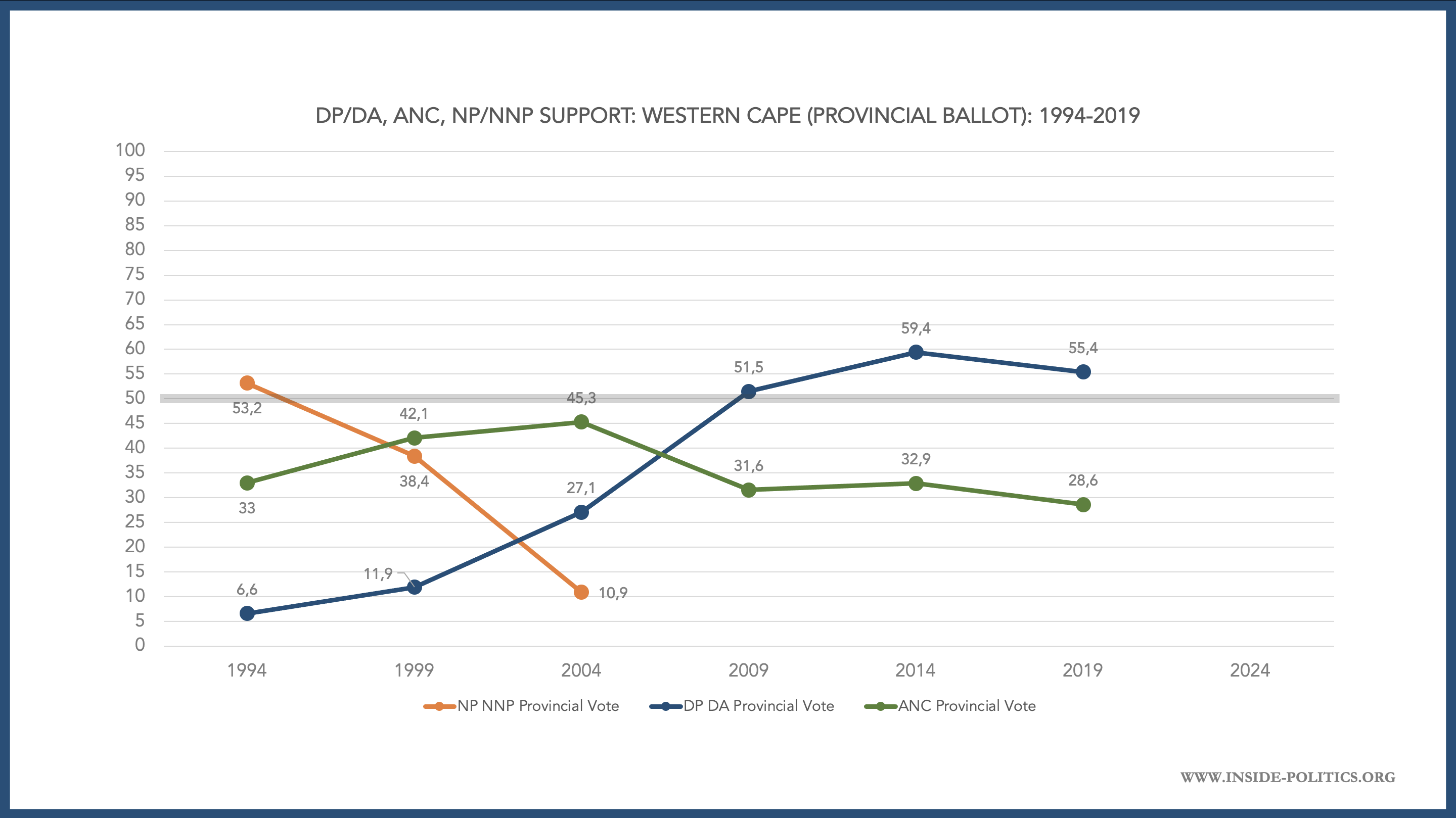
Below is what their support looks like, looking at only provincial elections, since 1999. Both parties declined in 2019. That will be of real concern to the DA going into 2024. But, if both parties declined in 2019, where is that support going?
The graph below includes support for smaller parties, who have won at least 1% or more, outside of the DA and ANC (48 parties contested the provincial ballot in 2019, but 1% or more is a generally good rule of thumb, for winning a minimum of 1 seat in the legislature).
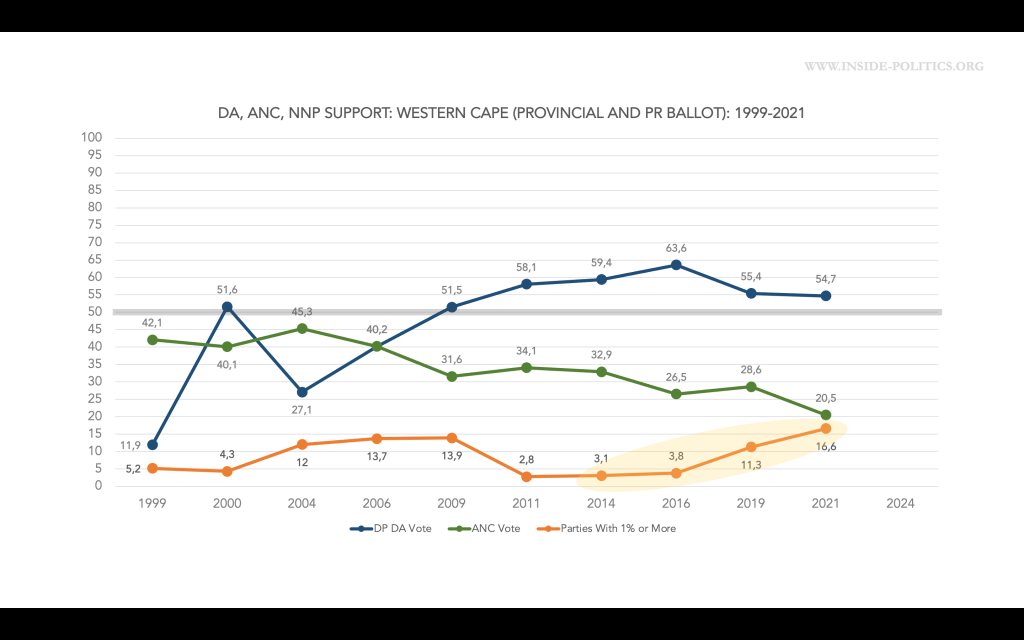
From 2014 to 2019 the consolidated proportion of the vote won by these parties steadily increased. If we “zoom in” on the bubble in the previous graph, we get the below. In 2019 six parties, comprising 16.6%, all won 1% or more, and they are eating into the DA and the ANC.
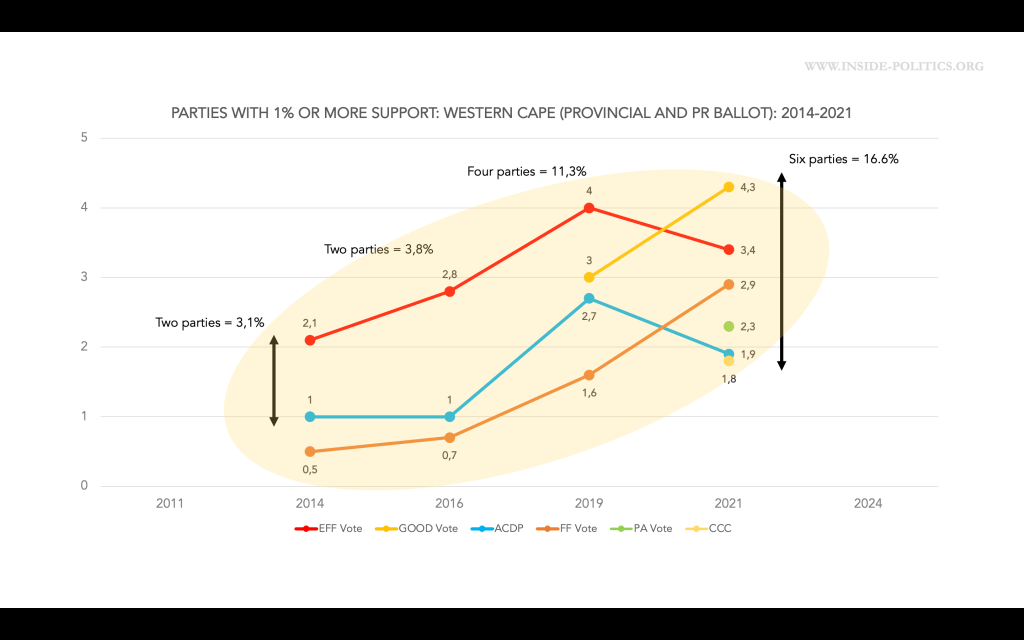
Some of these compete primarily with the DA (FF Plus, ACDP, GOOD), some primarily with the ANC (EFF), and some with both (PA, CCC) to one degree or another. The bulk of them are more ethno-nationalistic than not (EFF, PA, CC, FF Plus, GOOD).
The map below shows how support for second biggest party is distributed across the Western Cape on the provincial ballot, in 2019. As you can see, along the East and West coast, and outside the Cape Town metro, parties like the FF Plus are prominent. Inland, the PA has some wards.
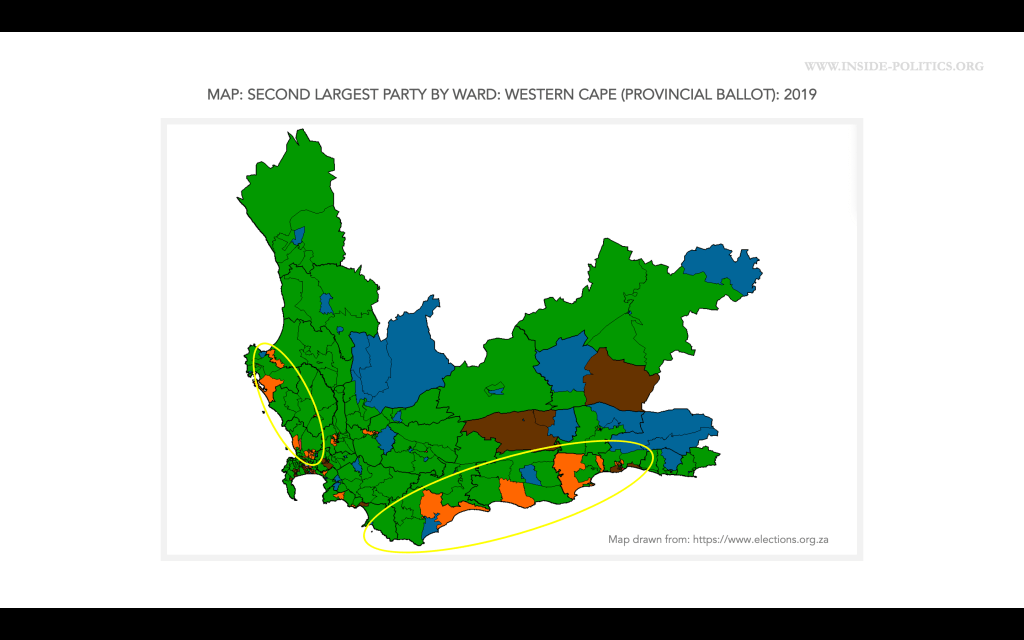
A lot of these parties are after those 1/3 of Coloured voters who are relatively fluid (and mostly DA). This onslaught of racial populism is extremely difficult for the DA to counter with its “for all” message, without compromising its values, which all these parties know.
As for the ANC, analysis of its ambitions or plans are pointless. It is effectively moribund. If the Western Cape is a political laboratory, where everything is inverted, one thing has been made clear: if the ANC unequivocally gets into opposition, it cannot sustain itself.
The ANC has lost more than half its support, or 24.8pts on the provincial ballot, down from an electoral high of 45.3% in 2004 to an all-time electoral low point of 20.5% in 2021. That is some 403k votes gone in absolute terms, and all its indicators are headed down.
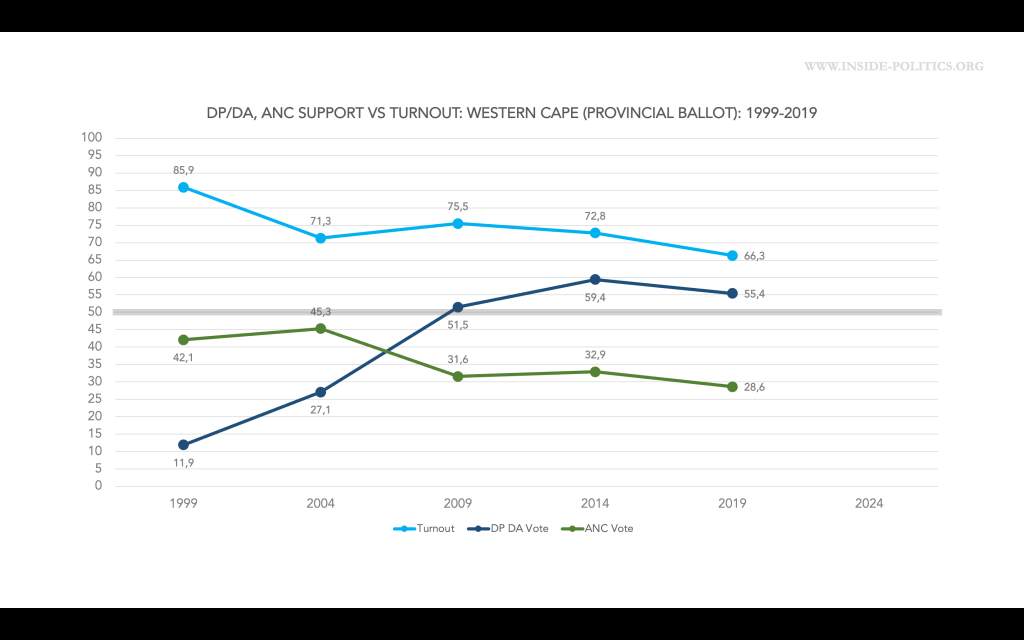
If we look at turnout in the province, the graph below shows us two things. 1. As elsewhere, lower turnout mirrors lower ANC support. 2. The DA did exceptionally well to outperform the lowest ever turnout (48.5%) in 2019.

This graph below shows the turnout levels for only the provincial elections since 1999. One sign of a healthy, growing party, is when it is narrowing the gap between its support and turnout, as the DA does consistently from 99 to 2014. The slowing down of that trend will worry the party.
This map below helps shows why lower turnout overall, is less of a problem for the DA than the ANC. ANC support tends to increase as you move inland, but turnout also tends to drop (the lighter coloured wards).
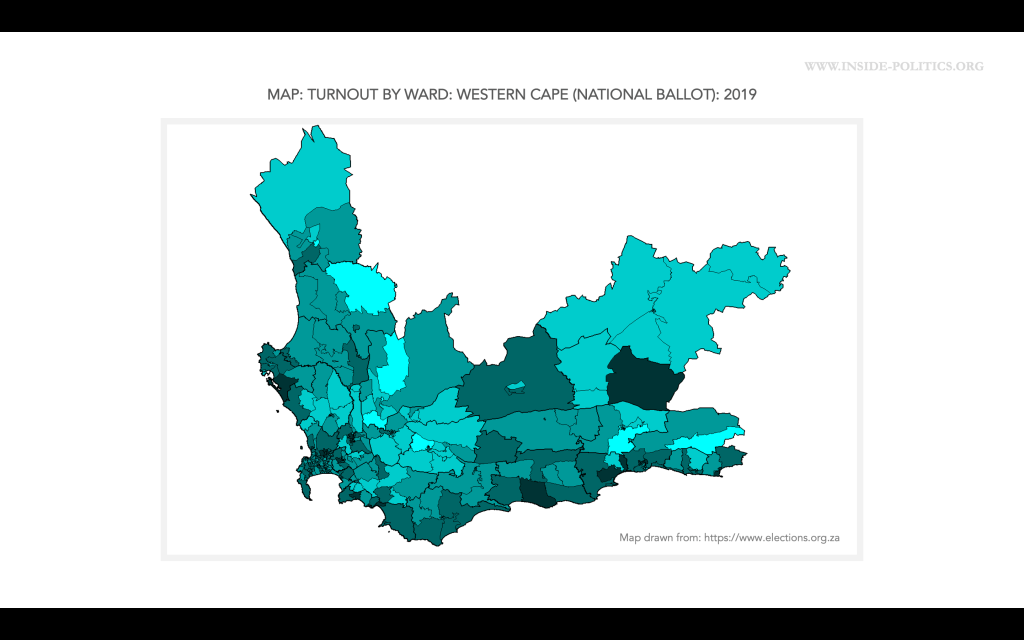
The darker the shade, the higher the turnout, and dense urban areas, typically DA, in CT and along the coast tend to be dark. So, although turnout dropped everywhere in 2019, the DA still got out disproportionally more of its voters; hence held at 54%.
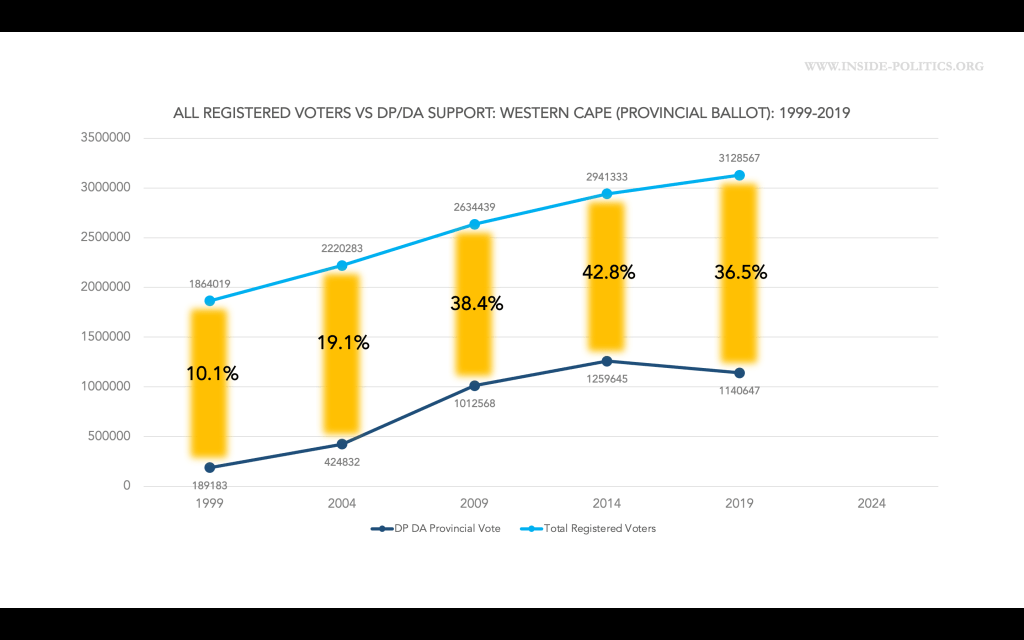
The next two graphs show also illustrate the points above. The first, below, shows the DA’s total provincial vote share, as a percentage of all registered voters in the province. Again, the DA’s growth is reflected in how it has grown its share, from 10% in 1999 to 43% in 2014. But 2019 will be a concern.
The second, below, shows the disaster zone that is the ANC in the Western Cape. As with other provinces, along with actual electoral illegitimacy, it is now at an absurdly low percentage of all registered voters, down from 36% in 1999 to just 18% in 2019.
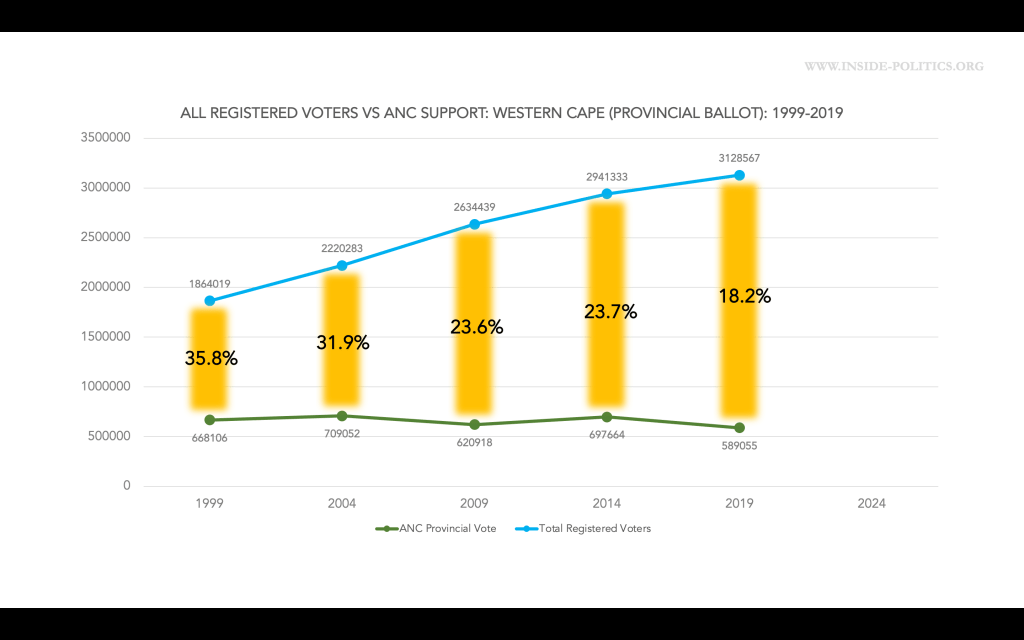
As in Gauteng, the ANC seems to have a band of very loyal voters (of around 600,000 in the case of the Western Cape). But it seems incapable of attracting new support, and as with Gauteng, a number of them bleed off each year, as the total voting population grows, making them worth less and less.
Finally, some DA 2024 scenarios, using the current number of registered voters in the province, according to the IEC (around 3.2m). The total number of registered voters will increase before the election. So, this is all assuming an election tomorrow, on current numbers.
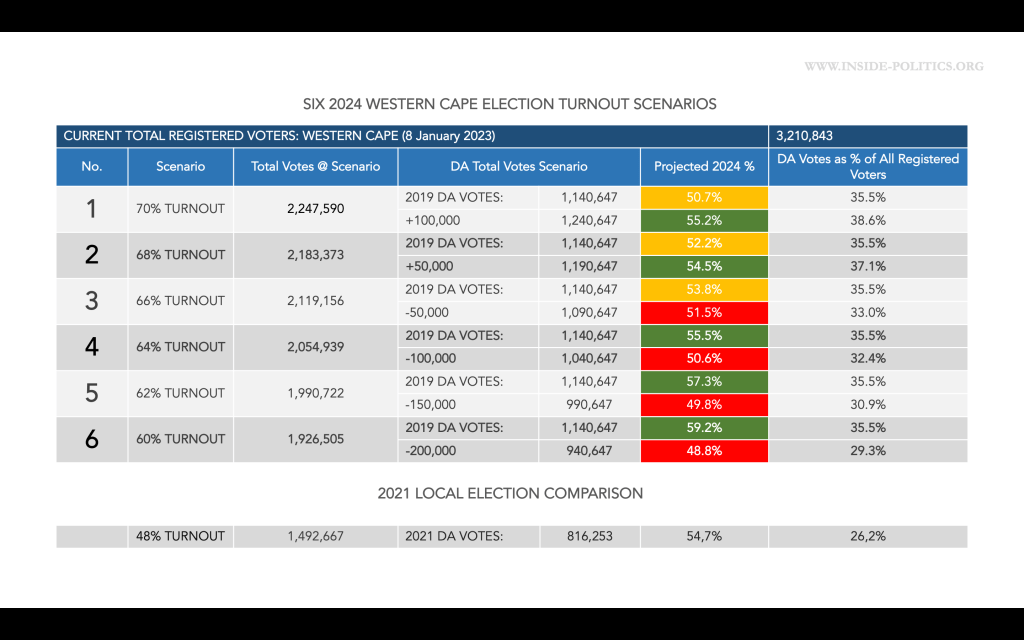
The DA in the Western Cape requires something different to the ANC. It might well turn its decline round. Its ability to generate differential turnout means one must account for that. So, Scenario 1 is set at 70% turnout, through to Scenario 6 at 60%. In 2019 turnout was 66%.
For each scenario, there two DA paths. On one, it retains it 2019 total vote share. On two, it gains (if turnout goes up) or loses (if turnout goes down) 50,000 votes, per 2pt change in turnout.
Then, there is a comparison to where that DA scenario relates to all registered voters. Finally, at the bottom there is a comparison to what happened to the DA in the Western Cape in 2021 (just to show how low the DA could theoretically go).
Path one shows the DA vote share systematically increasing from 51% at 70% turnout, to 59% at 60% turnout. It demonstrates that if the DA can just hold on to the number of voters it got in 2019, its majority should be relatively safe, whatever happens to turnout.
Path two shows that if the DA could grow its vote share, even by just 50,000 votes, it should stay comfortably above 50%. But, if it drops votes, and turnout drops, it starts to push below 50% at around 150,000 votes lost and 62% turnout.
The long and the short of it, is the DA majority will be hard to break. Much of it depends on how well smaller parties do, as they continue to primarily target the DA rather than the ANC. But history shows the DA Western Cape turnout machine is formidable.
An addendum, returning to this graph, below. The low amount of “black support” in the Western Cape is becoming harder to explain for the DA – just 2.6% in 2019. The DA’s grand offer to South Africans is essentially: we govern best – a clean, efficient, fair administration for all.
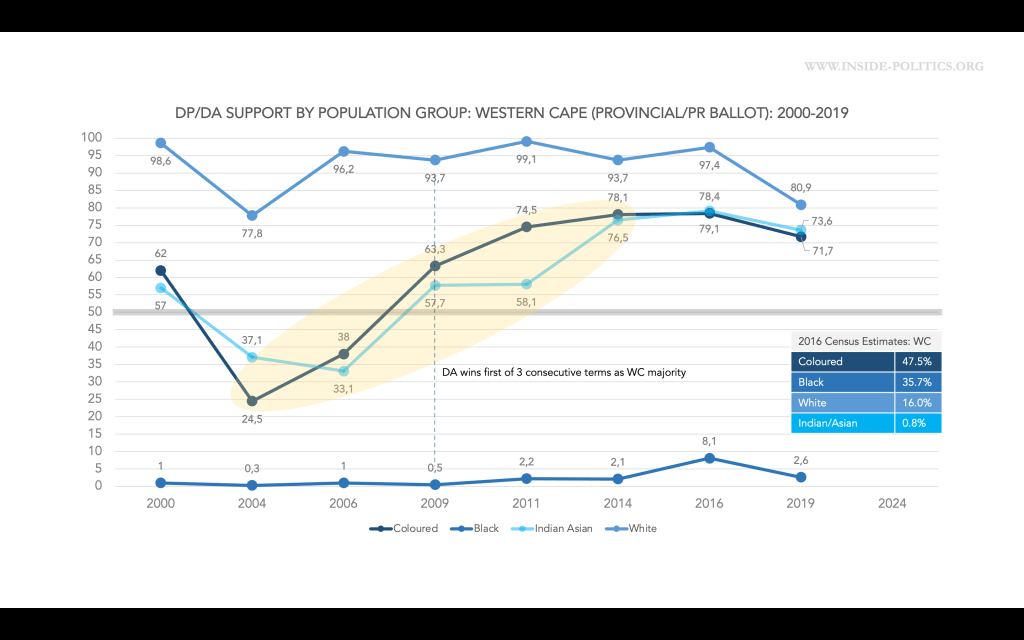
The Western Cape is supposed to be the test of that. An exemplar of what life under the DA is like. In 2024 the DA will have had three consecutive provincial administrations. We don’t have 2021 results by race but you can be sure DA black support is still below 4%.
Even with the necessary provisos (change takes time, not all voters of any race are available to the DA, ANC racial scaremongering), this still seems a dismal return. At the very least, you hope to see by now substantial vote splitting in ANC strongholds in local elections. But no.
The DA will continue to have fight for its majority tooth and nail for many elections to come, in a bun fight with smaller parties, unless it can start to consolidate a greater proportion of black voters under its banner. The question it needs to answer is: how?
Perhaps the answer isn’t to be found in race at all. And the DA needs to develop a class analysis. South Africa is not the same place it was and given how diverse the Western Cape, that might be a good place to start.
The key takeaways from this analysis are:
- Historically the growth of the DA in the Western Cape has substantially helped its growth nationally. It has held a reasonably secure majority, and the ANC has collapsed in opposition, but the rise of a number of small parties are starting to arrest its gains.
- The DA obtained its majority in the Western Cape primarily by consolidating the “Coloured vote” in the province, over the course of a decade.
- Between 2014 and 2021, the number of small parties with 1% or more has grown from 2 (and a combined total of 3.1%) to 6 (and a combined total of 16.6%). They are hurting both the DA and the ANC.
- Many of these smaller parties are driven primarily by racial identity politics or racial populism, and are difficult to counter. They are winning votes, in particular, along the coast, and outside the metro.
- One of the DA’s greatest strengths in the Western Cape, is its ability to disproportionately turn out its voters to a greater degree than its opposition. It was this, more than anything, that helped it stabilise its decline in 2021, and buck a lowering turnout trend.
- The DA still has a healthy share of all registered voters, and has kept track, more or less, with the growing total registered voters pool, but that trend too is starting to head in the wrong direction, and the DA needs to win new voters as much as it needs to bring out its base.
- 2024 election scenarios suggest it is going to be hard to break the DA’s majority but it is possible if things go badly wrong for the party.
- The battle between the DA and smaller parties (barring an ANC rejuvenation miracle) seems set to be the story of many elections to come, unless the DA can expand its support, particularly among “black voters”.
- To this end, it will be disturbing for the DA, that 15 years of the best governance in the country – an objective fact, and the DA’s primary offer to South Africans – has not resulted in more support among many “black” and former ANC voters in the Western Cape.
All numbers in this essay are drawn from the Independent Electoral Commission website: https://www.elections.org.za/pw/
All numbers concerning the DA’s support by race are drawn from Politicsweb: https://www.politicsweb.co.za/home?code=RTVWbExVaE1nNlovTTJtZ3VmdGFtZz09&state=
This essay is the 4th in an on-going series on Election 2024, for all other editions of this series, please click here: Election 2024
Discover more from inside politics
Subscribe to get the latest posts sent to your email.
 inside politics
You must be logged in to post a comment.