
Election 2026 [20] How successful was ASA’s 2026 election?
by The Editor

One of the prominent stories emanating from the 2026 election was the strong performance of Action South Africa (ASA), particularly in the three Gauteng metros: Johannesburg (JHB), Tshwane (TSH) and Ekurhuleni (EKU). So, it is worth examining ASA’s performance in detail, to better understand where it grew and how it grew.
How successful was ASA’s 2026 election?
By: Gareth van Onselen
Follow @GvanOnselen
14 November 2026
This essay is the 20th in an on-going series on Election 2026/7, for all other editions of this series, please click here: Election 2026/7
One of the prominent stories emanating from the 2026 election was the strong performance of Action South Africa (ASA), particularly in the three Gauteng metros: Johannesburg (JHB), Tshwane (TSH) and Ekurhuleni (EKU). So, it is worth examining ASA’s performance in detail, to better understand where it grew and how it grew.
The big picture
After a dire 2024 election, in which ASA contested all of South Africa, it dialed back its participation in 2026, to just 79 municipalities (71 Category B municipalities and 8 metros). This was substantially more than 2021 (2 Category B and 4 metros) and constituted 37% of all municipalities (213). Its performance within this subset of 79 fluctuates significantly, as the table below illustrates.
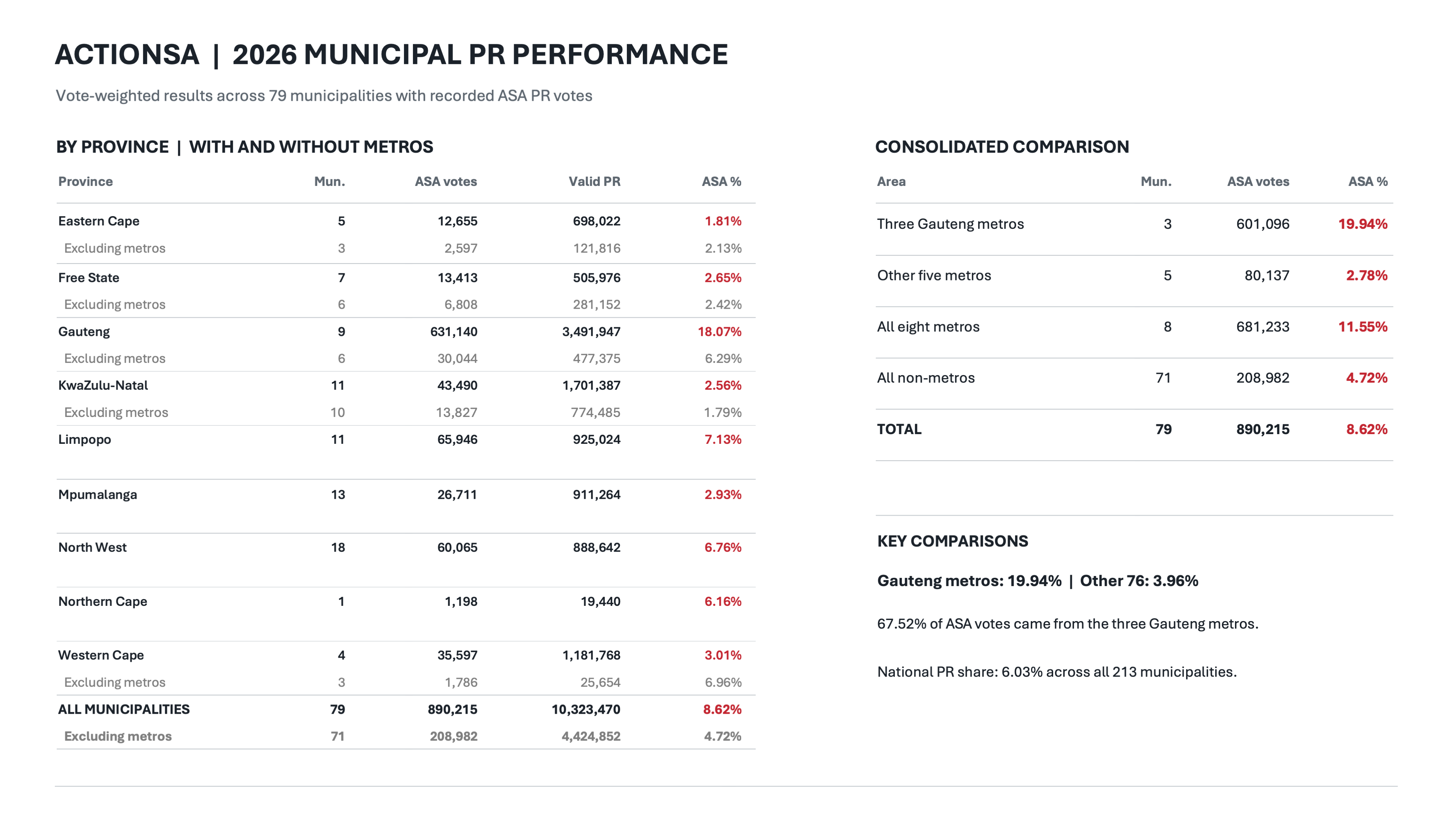
The first thing to note is how reliant the ASA vote share is on the three Gauteng metros. 67.5% of all its support comes from JHB, TSH and EKU. In them, it averaged 19.9%. Outside of those three, however, it averaged 3.9% (in fact, within Gauteng, the party averaged only 6.3% outside of the metros). Even within the eight metros, it was the three Gauteng metros that drove its growth: it averaged just 2.8% in the other five.
Nevertheless, this was a very successful result for ASA. Within the 79, it averaged 8.6%. Because the IEC works out numbers nationally, its final PR number was 6.0% but, either way, significant growth from 2021 (2.6%).
Provincially, the party will be pleased with Limpopo (7.1% in 11 municipalities contested) and the North West (6.8% in 18) but disappointed with Mpumalanga (2.9% in 13) and KwaZulu-Natal (2.6% in 11). Those four provinces were where it poured most resources into outside the metros. 53 or 67% of all municipalities it contested came from those four provinces. Outside of them, ASA’ support was either negligible or too small (it contested 1 municipality in the Northern Cape) to read too much into.
Limpopo and the North West will be encouraging footholds for the party, but ASA remains an entirely regional party, wholly reliant on Gauteng in general and the three Gauteng metros in particular. Like the UDM in the Eastern Cape, or the IFP in KwaZulu-Natal, ASA’s fortunes remain inextricably bound to Gauteng.
The limited data set on ASA in 2021, forces some 2024 comparisons. That makes it possible to compare all 79 municipalities. A fair way of doing this (the two being different election types) is to see how those 79 broke down in terms of their contribution to ASA’s total vote share in 2024 versus 2026. The table below sets that out.
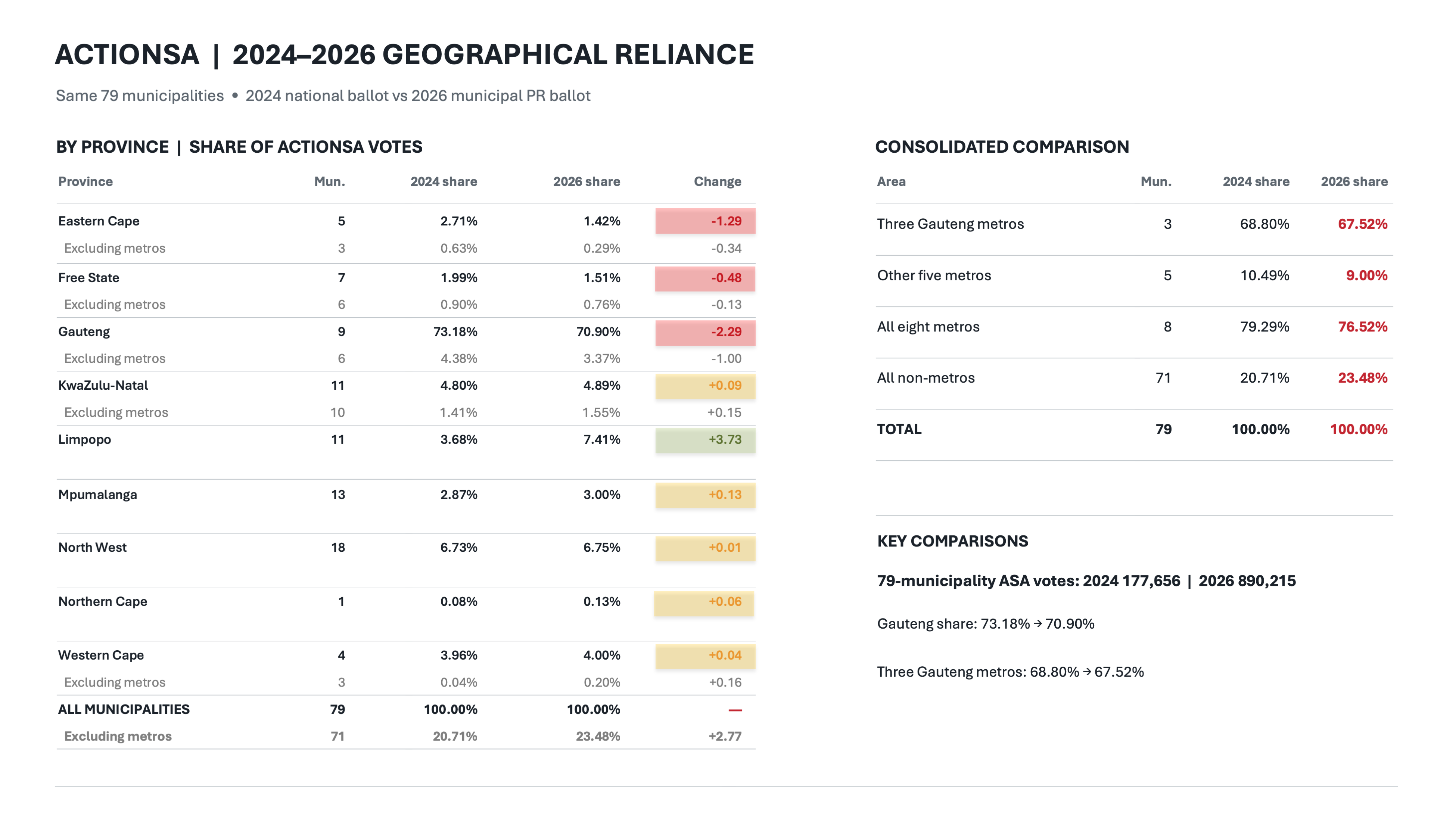
Seen in this light, the results will be disappointing to ASA. Except for Limpopo, which increased by 3.7pts, all other provincial municipalities pretty much delivered what they did for the party in 2024. In fact, remarkably, most of the provincial contributions were within 0.09 pts of what they delivered in 2021 (orange blocks). Three provinces declined in terms of their contribution. Therefore, ASA’s reliance on the three Gauteng metros did not change either (68.8% versus 67.5%). So no real expansion of ASA’s footprint from 2024.
In the big picture, then, ASA’s 2026 results delivered little proportional change, and any full understanding of its growth, must be limited to Gauteng, and its three metros, which is what we will turn to now. Even then, as we will see, not all three are alike and, in truth, just two of them delivered real and meaningful growth: TSH and EKU.
The three Gauteng metros
Here is ASA’s top line performance in JHB, TSH and EKU:
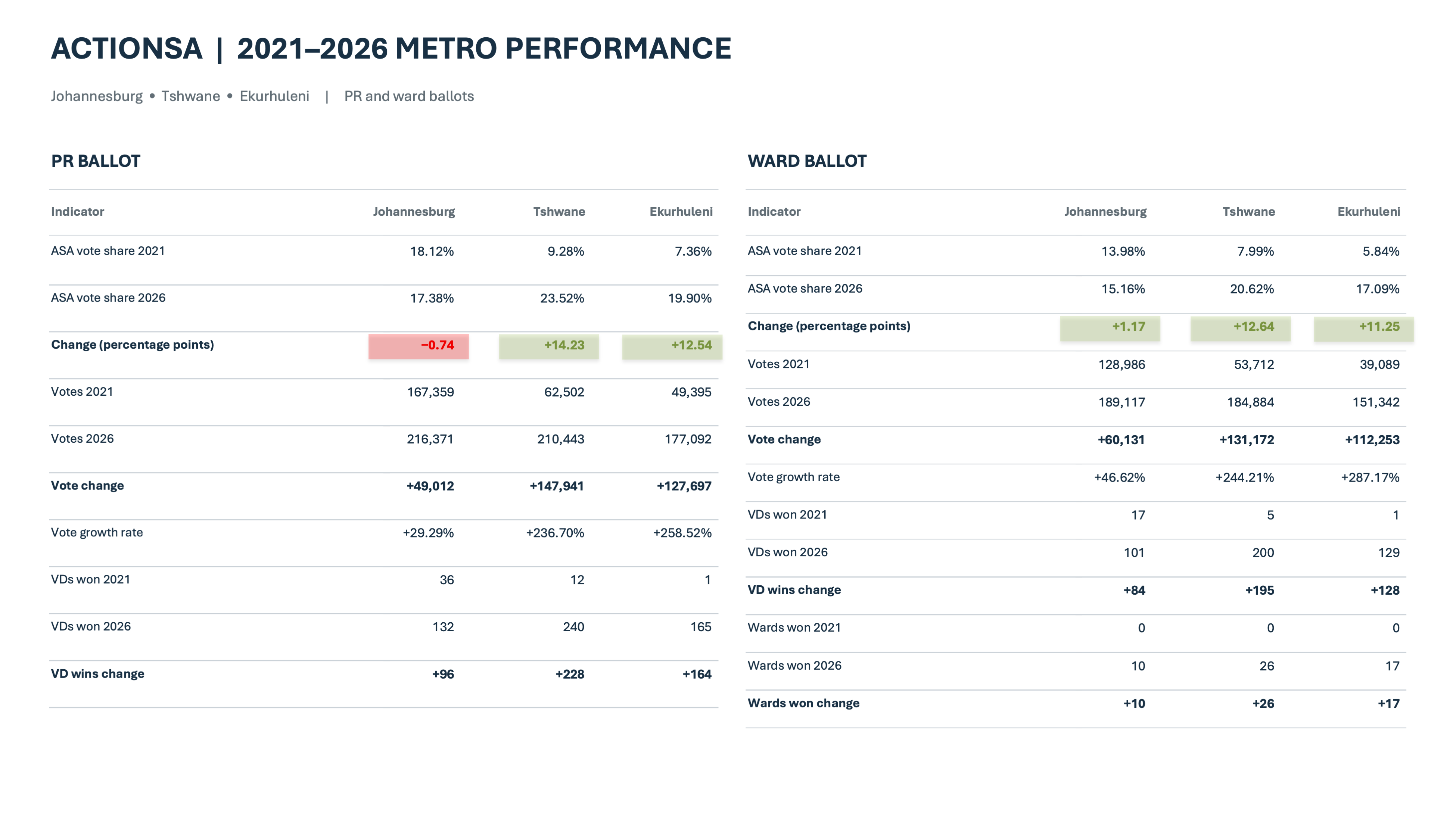
This table is deeply significant. It illustrates that ASA’s growth on the PR Ballot was carried essentially by two metros: TSH and EKU, where it grew by 14.2pts and 12.5pts respectively. In JHB the party declined marginally, by 0.74pts.
While ASA did grow on the Ward Ballot, in all three metros (by 1.2pts, 12.6pts and 11.3pts respectively) again JHB lagged significantly behind the other two.
One could argue that this is due to the fact that ASA in JHB had, in 2021, already established a strong presence, and so there was less room to grow. But the facts do not support that. ASA in TSH and EKU did not just catch-up with JHB, they overtook it: in TSH most significantly (by 5.1pts) and in EKU (by 2.4pts). So, whichever way you cut it, TSH and EKU were ASA’s powerhouses in this election, nor did they just grow, they did so exponentially and in a way JHB did not.
The splits between ASA’s PR and Ward Ballot results tell another story.
In general terms, the PR Ballot is a measure of party support, the Ward Ballot of local candidate support; thus the former is more associated with the mayoral candidate, the latter with the ward candidate. Here is how they split in the three metros:
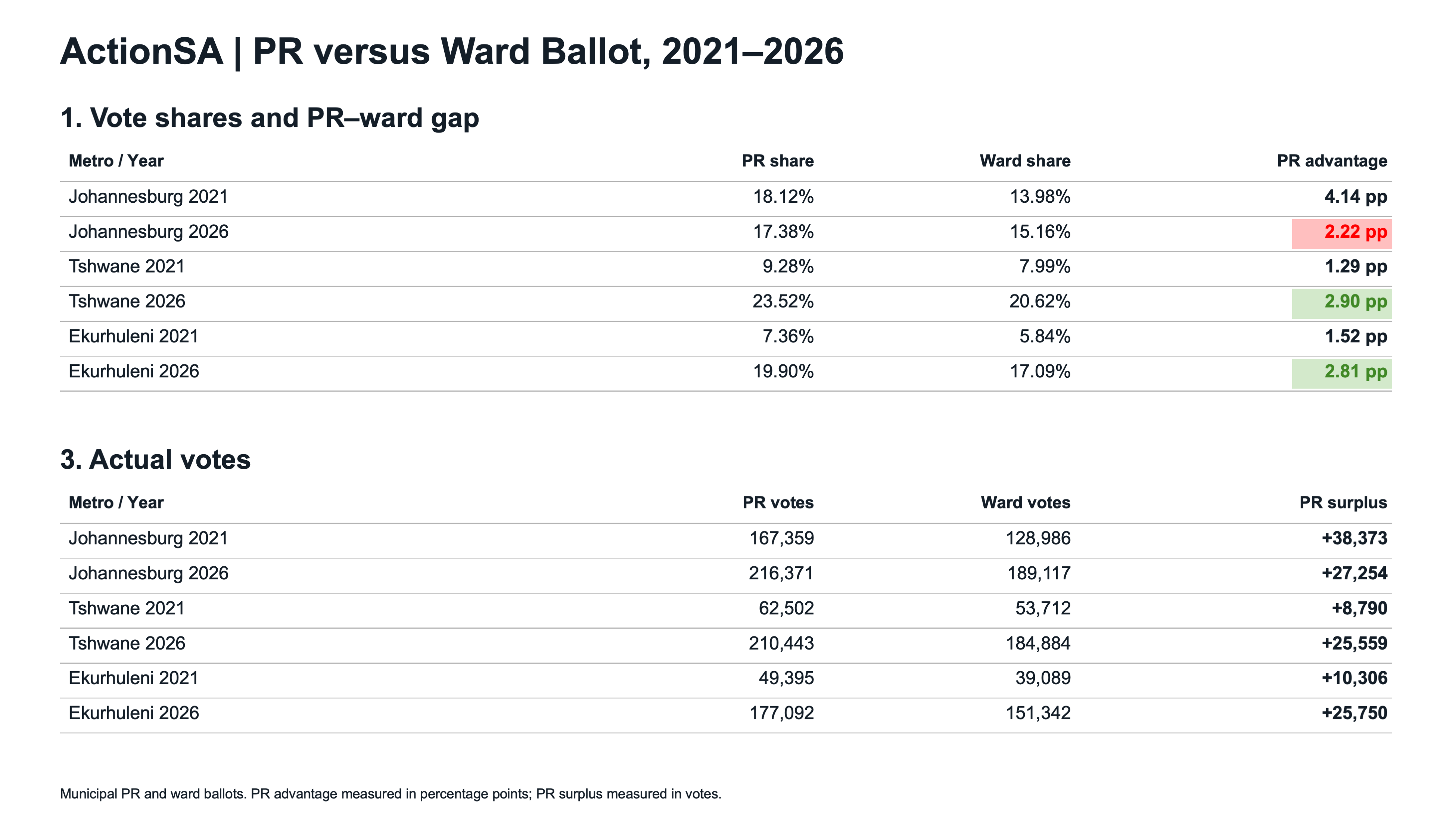
In 2021, ASA was heavily reliant on its mayoral candidate in JHB. Back then, its PR vote was 4.1pts bigger than its Ward Ballot. But, in 2026, ASA shrunk on the PR Ballot and grew on the Ward Ballot, reducing the gap to 2.2pts. This suggests ASA’s 2021 JHB mayoral candidate lost a significant amount of appeal, and what growth there was, was carried by local ASA ward candidates.
In stark contrast, in TSH and EKU, ASA grew its PR advantage, by 1.6pts and 1.3pts respectively, which suggests it was the mayoral candidate underpinning growth to a greater degree than Ward candidates (although they too contributed) in those two metros.
The consequences of this performance, is that JHB’s relative share of ASA’s vote in the three metros dropped significantly.
Contributions of the three metros to ASA’s vote share:
Johannesburg: 54.66% (2021) – 24.13% (2026) = −30.53pts
Tshwane: 20.41% (2021) – 23.47% (2026) = +3.05
Ekurhuleni: 16.13% (2021) – 19.75% (2026) = +3.62
There is an obvious calculation that follows: how reliant was ASA on TSH and EKU alone, for its 2026 growth. Had those two metros stayed at the same percentage level as 2021, ASA would have received around 4.4% on the PR Ballot.
Where did ASA growth
This set of maps shows ASA growth and decline per VD in all of the Gauteng metros.
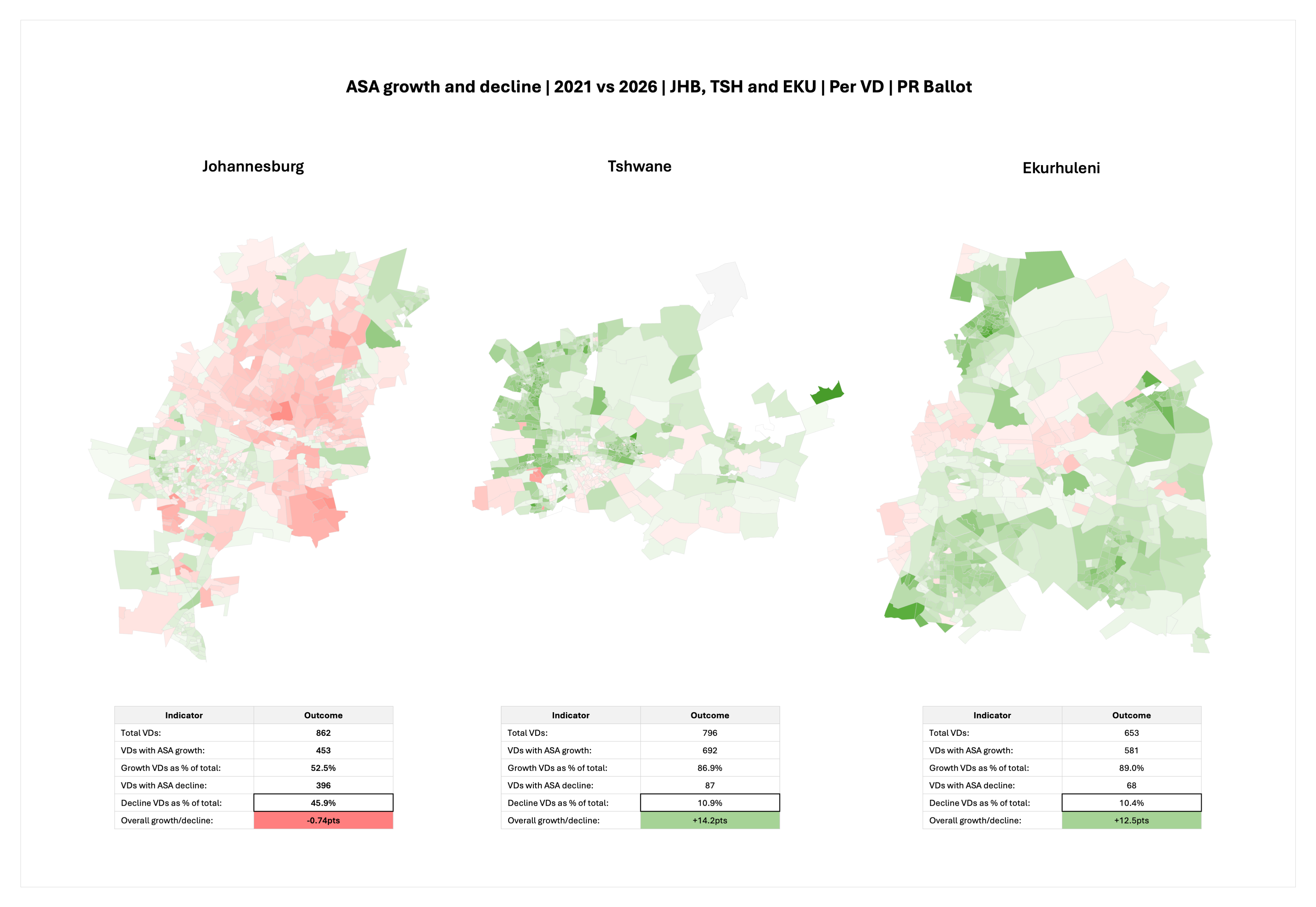
ASA’s growth in TSH and EKU was almost universal. Just 10.9% and 10.4% of VDs in each showed a decline, while 86.9% and 89.0% of VDs showed growth, respectively. JHB was quite different. There ASA saw significant declines all across the North of metro, with 45.9% of JHB’s VDs showing a decline for ASA. It did grow in the South, in Soweto in particular, but even there, as you can see, its growth a very light green, as opposed to the darker, more intense growth in many places in TSH and EKU.
As ASA’s growth was primarily in the townships, let us take the biggest townships per metro – Soweto (JHB, 626,558 registered voters), Soshanguve (TSH, 199,827) and Tembisa (EKU, 228,405) – and see how ASA did in each (I have used the StatsSA 2022 main-place assignments, to define each township).
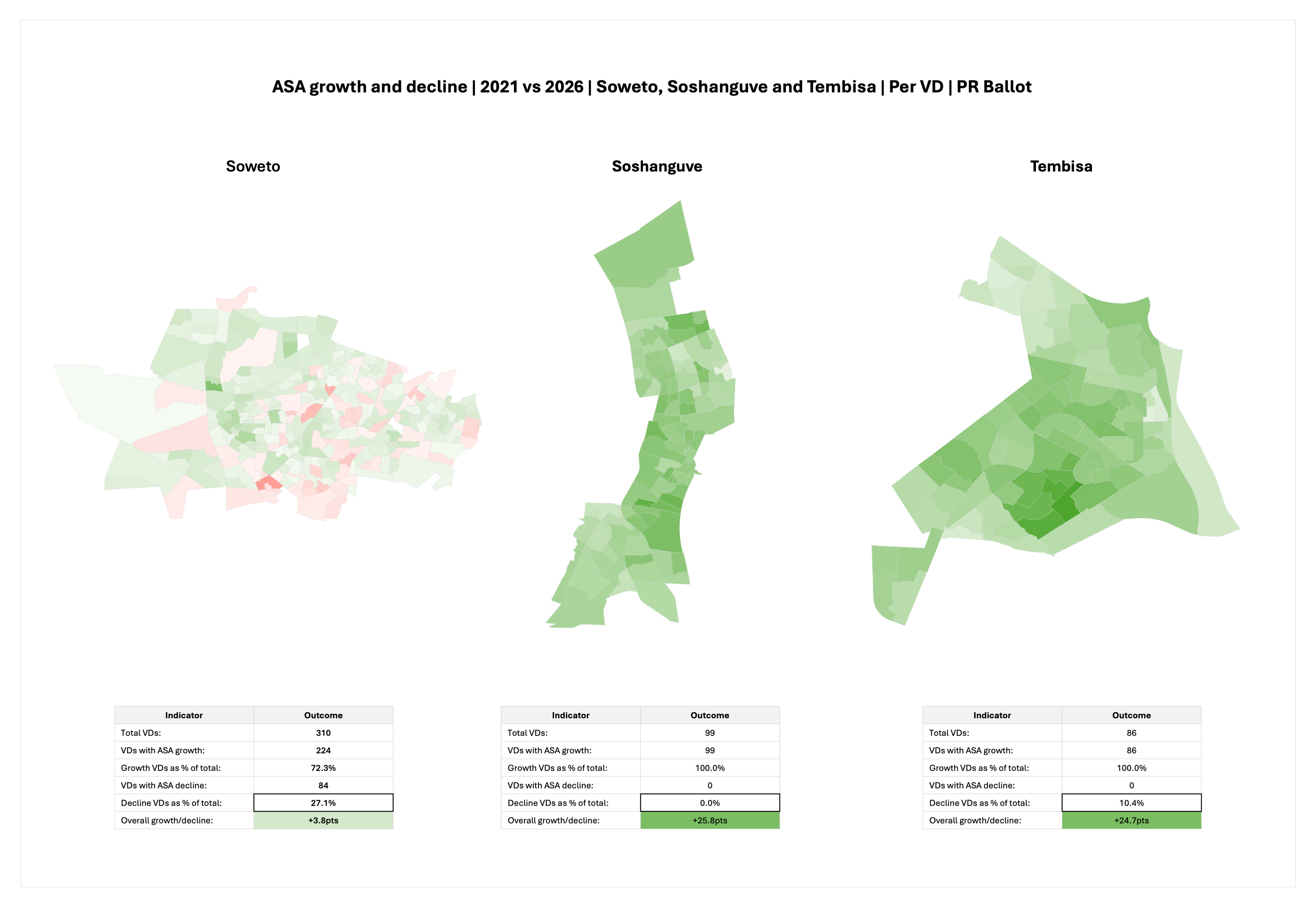
The story is a similar one to the metro-wide trends. Growth in Soshanguve (+25.8pts) and Tembisa (+24.7pts) was significant and, importantly, universal – 100% of VDs in both showed significant growth. In Soweto growth was minor (3.8pts) and not universal – ASA declined in 1/4 Soweto VDs (27.1%).
This pattern was evident across all townships in the three metros, to one degree or another. Small, limited growth in JHB, substantive growth in TSH and EKU.
Here is how ASA faired against the different parties, in each metro. The table below shows ASA’s performance in those VDs won by another party in 2021.
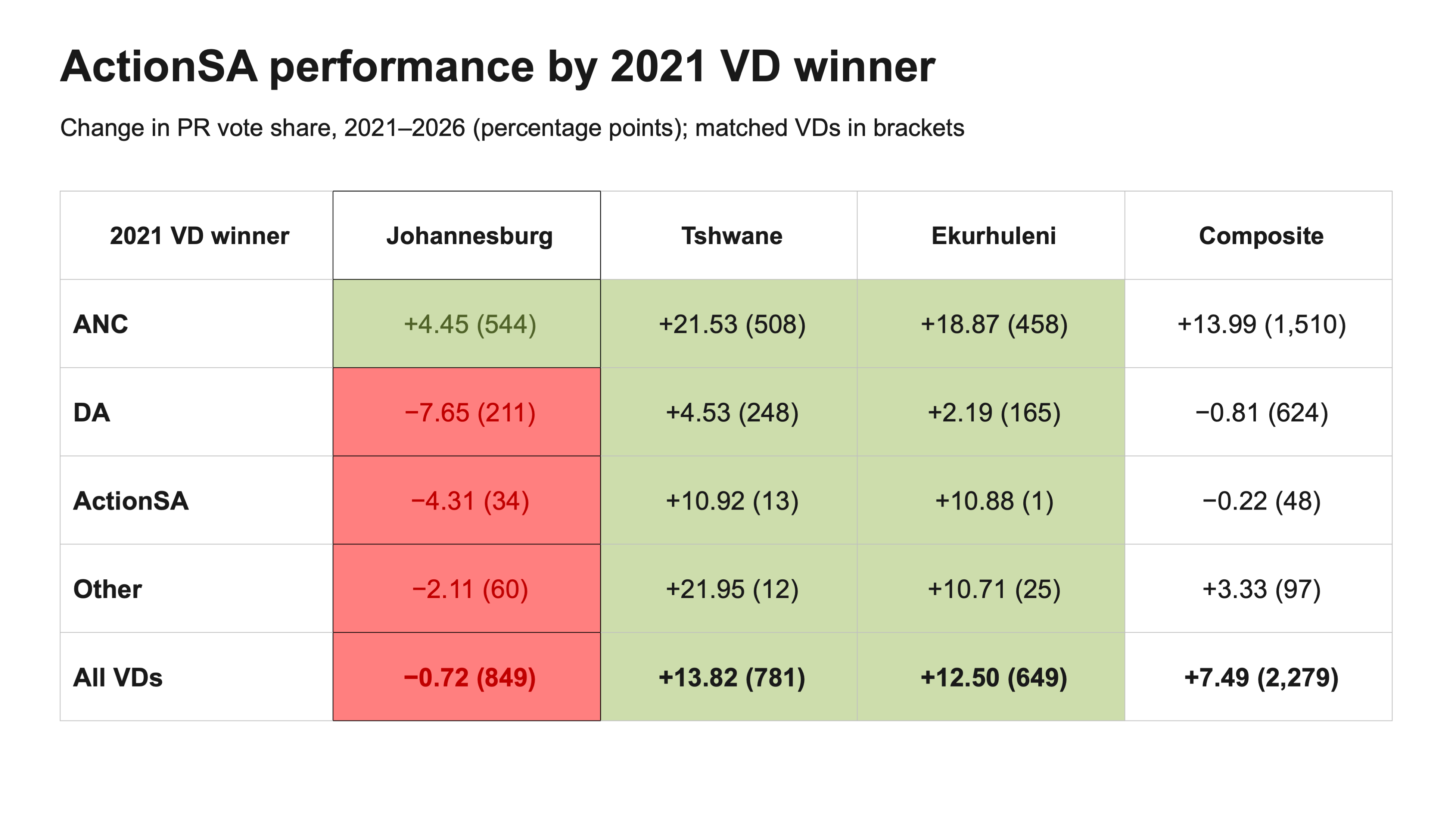
This table will perhaps be the biggest concern for ASA, when it comes to JHB and its campaign there. Apart from ANC-held VDs, in which ASA did well, growing by +4.5pts, it went down in every other category. It was substantially down in DA-held VDs (-7.6pts) but in DA-held VDs in TSH and EKU, it grew. It was down in VDs held by other parties, but again grew in TSH and EKU (-2.1pts vs +22pts and +10.7pts)
Perhaps most worryingly for ASA, it was down in ASA-held VDs, while in TSH and EKU it grew in ASA-held VDs (-4.3pts vs +10.9pts and +10.9pts).
One final set of insights on ASA VDs won:
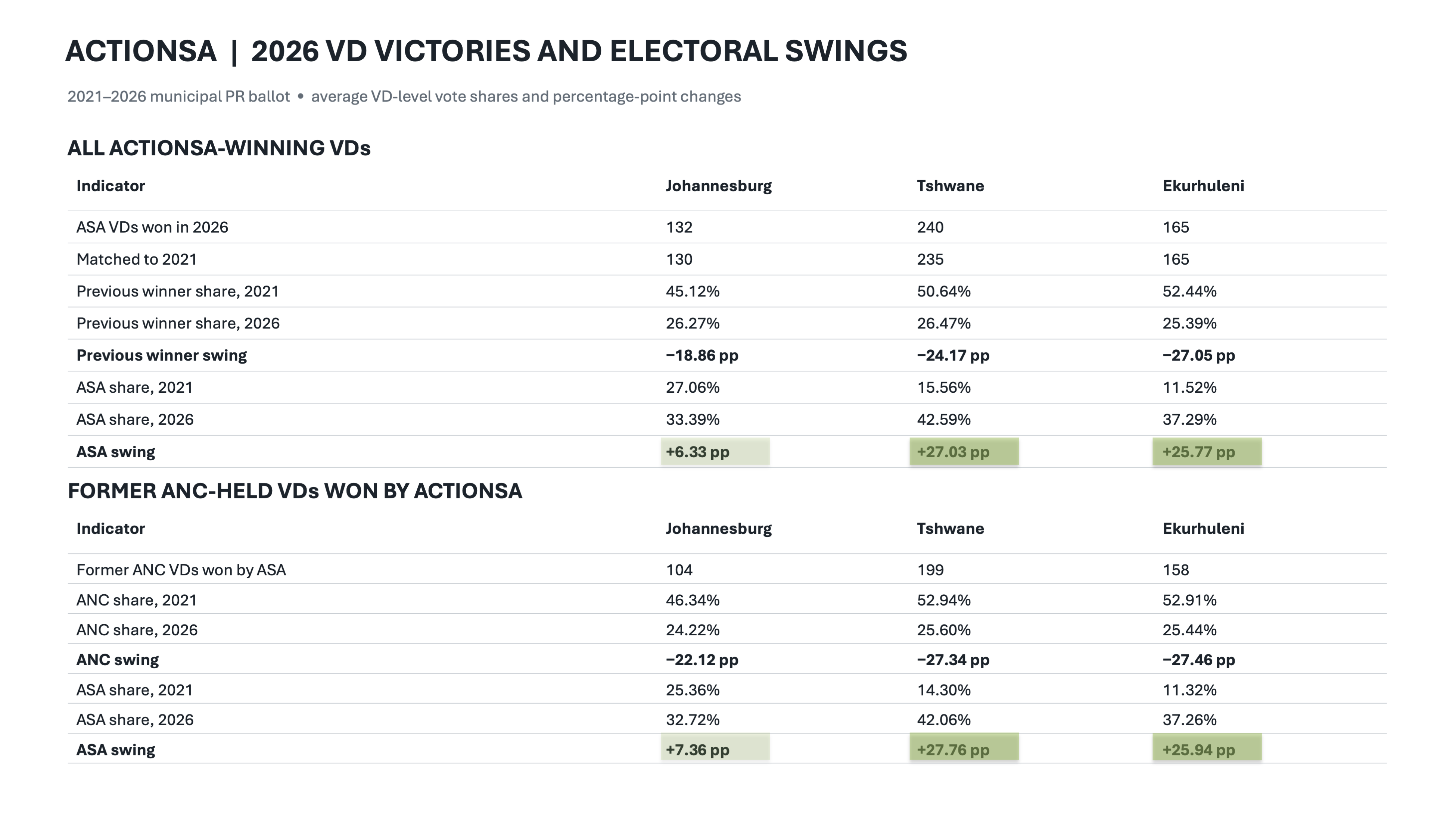
First, this in particular is a relative assessment, there is no decline in JHB here, it just performs worse than TSH and EKU. In JHB, ASA’s was not able to capitalise on damage done to its opponents as it was in TSH and EKU. In both other metros, it caused its opponents to drop by an average of 24.2pts and 27.1pts where it won a VD off them. In JHB it managed a respectable 18.9pts. However, ASA’s own performance was less impressive. Where it won VDs, it improved by 27pts and 25.8pts in TSH and EKU. In JHB, however, by just 6.3pts.
If you limited the universe of VDs it won to just those off the ANC, the same pattern holds in JHB: good damage ratio on the ANC, but undermined by a lack of growth on ASA’s part: 7.4pts vs 27.8pts and 25.9pts in TSH and EKU.
What were the consequences of all this?
The primary consequence is that, due to ASA’s collapse in JHB’s northern areas, limited growth outside townships in TSH and EKU, together with exponential growth in them, ASA has become far more racially homogenous as a party.
If we run all three of ASA’s national results through my BEM tool (Behavioural Estimation Model) – it estimates political party support by population group, using voting district election results, demographic composition and estimated turnout – ASA results are as follows:
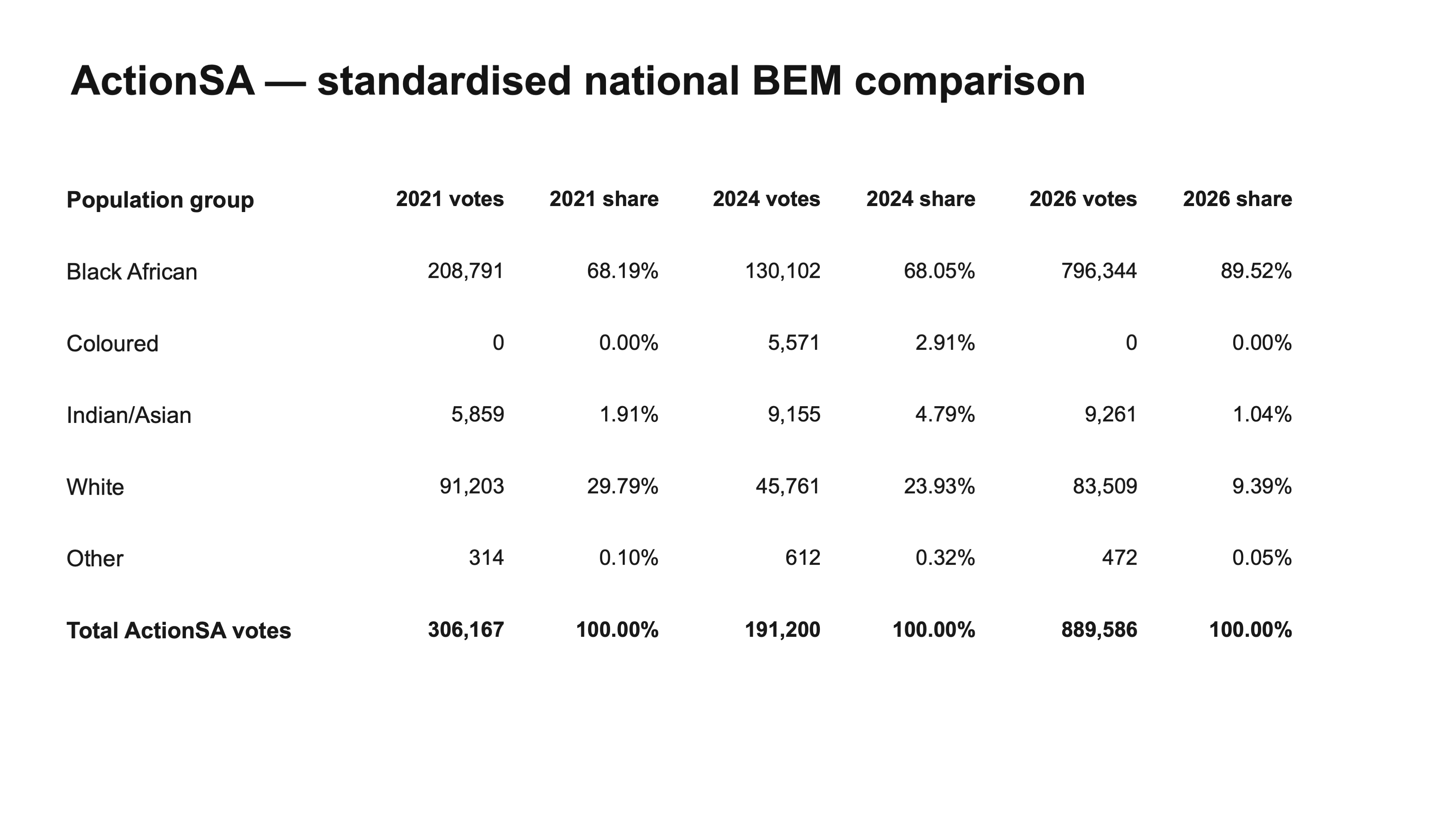
Just to be clear on the limits of the model, it is an estimate, like the census numbers. There is also some margin of error, around 2% on the white and coloured population, 1% on the black population and 4% on the Indian population.
But the basic trends in 2026 are plainly evident. Black voters now form 90% of ASA’s vote share (up 22pts from 2024), coloured voters are tending towards 0%, as are Indian voters, and white voters comprise just 9.3%, down 14.5pts from 2024, and down 20.4pts from 2021. Whereas ASA could, in 2021 and 2024, boast some racial diversity, it is much harder to make that case now, and next to impossible outside the small number of white voters the party retains.
What went wrong in Johannesburg?
It is difficult to answer this question definitely, without some qualitative research into Johannesburg voters, but we do know this: ASA’s candidates in Tshwane and Ekurhuleni ran substantively more positive campaigns than its candidate in Johannesburg did.
In Tshwane, the message was primarily focused on service delivery and demonstrating the difference ASA had brought to TSH, under the leadership of its mayor. The ASA TSH mayoral candidate was modest and calm, and focused on this particular message at the expense of all others. In EKU, ASA’s mayoral candidate put crime front and centre, and his particular reputation on this front. He too was modest and plainly spoken, and focused primarily on this message.
JHB was fundamentally different. ASA’s candidate there was highly abrasive, engaged in a great deal of personal political attacks and emotional rhetoric, often to the point of obsessiveness. Illegal immigration and scapegoating also featured prominently, and often divisively, along with public associations with March and March. ASA’s JHB candidate also put race front and centre of the ASA JHB campaign, evoking the threat of the return of apartheid and allegations of racism. Online, the JHB candidate was highly controversial and combative, moving from one pitch fight to another, denigrating and maligning those critical of the party. All this cut a stark contrast with the polite, reserved and non-confrontational nature of ASA’s other two candidates who remained primarily focused on things like service delivery and crime.
It is true, illegal immigration did feature in all three metro campaigns to one degree or another, but the way it was portrayed, in TSH and EKU was far less demagogic, more measured and sound.
This was no doubt a serious contributing factor to ASA’s final result. In TSH and EKU, the party produced spectacular results, its vote share exploded (especially in townships), its growth was universal and manifested to one degree or another in every political category. It both damaged the ANC and grew in ANC wards, and it built on existing ASA-held VDs, strengthening its position and lead. In turn, the impact of the mayoral candidates was profound, driving up the party’s PR vote over its ward candidates and helping to carry ASA’s success to even higher levels. As a result, both TSH and EKU were primarily responsible for ASA’s 2026 growth, the core underlying driver, without which, the party’s performance would have settled far lower.
In JHB ASA declined, in its strongholds, like Soweto, it did show some small grow (3.8%) but even this was limited, as ASA went backwards in 1/4 Soweto VDs. In the North of Johannesburg, the party’s vote imploded, losing almost 8pts in DA-held VDs. In the 34 ASA-won 2021 VDs the party went backwards, and while it did help (along with other parties) eat into the ANC vote, it could not fully capitalise on it, with limited growth. All of this resulted in JHB, a mainstay of ASA’s brand in 2021, dropping from contributing 54.7% of ASA vote share in 2021, by 30.5pts to just 24.1%, and it now sits behind TSH (23.5%) as the core pillar on which ASA’s performance rests,.
All this raises serious long term questions for ASA. The party has, to date, done everything in its power to avoid an elective conference, amending its constitution five times to delay it. At some point it will be forced to hold one, however, and with the 2029 national elections as its next big mile stone, as things stand, presumably with its interim president as its presidential candidate, those JHB results will raise some serious concerns about whether he is indeed the right person to carry ASA forward.
Given its tremendous success in TSH and EKU, particularly in TSH, and its decline in JHB, the one question, above all others, is whether the interim president is indeed the right person to carry ASA into the future. His style and campaign in JHB simply did not deliver, and cost ASA dearly in the North of JHB, thus damaging its ability to be able to present itself as a party for all constituencies. The contrast with the party’s outcome in TSH and EKU could not be starker, and it might well be the case that the best thing for ASA’s future, is to take the lessons from TSH and EKU to heart, and build its 2029 campaign around them, as opposed to what seems an ultimately destructive campaign in JHB.
This essay is the 20th in an on-going series on Election 2026/7, for all other editions of this series, please click here: Election 2026/7
Discover more from inside politics
Subscribe to get the latest posts sent to your email.


You must be logged in to post a comment.